
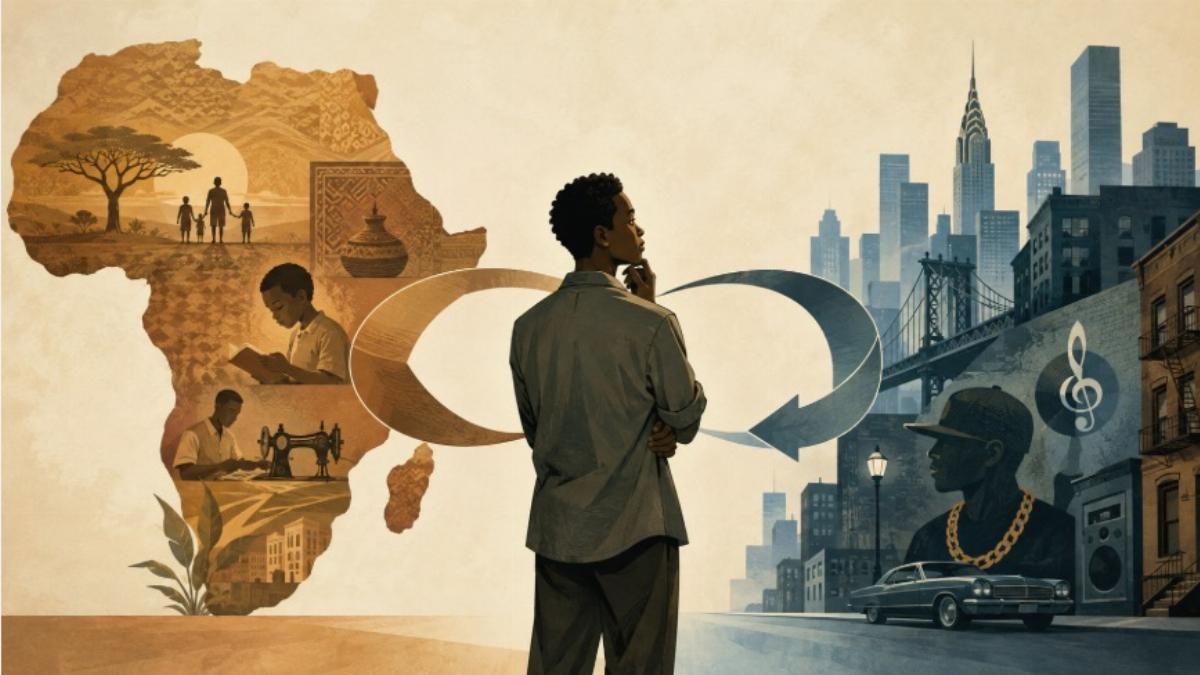
The disconnect between American blacks and Africa is profound, and it stunts their cultural development. A powerful strand of American black culture romanticizes Africa as an ancestral homeland, even though Africans themselves played an indispensable role in selling other Africans into slavery.
Read more The Mohammunist Manifesto—Punishment of Apostasy and Defection
At the same time, many African immigrants look with disdain on the ghetto culture that developed in parts of black America during the second half of the 20th century.
And then there is the strangest irony of all: While some Africans reject that culture, others eagerly imitate it.
There’s a lot to unpack here.
The Atlantic slave trade would not have existed without African complicity. The traders—first overwhelmingly Arab and African, and later European—who bought slaves on the African coast generally did not travel deep into the continent to capture them. African rulers, armies, raiders, and traders supplied the men, women, and children sold into slavery.
That does not absolve the Europeans and Americans who bought and exploited slaves. It does, however, complicate the modern narrative in which Africa appears solely as the innocent victim of Western predation.
Regarding the United States specifically, it was not the United States as a nation that introduced slavery here. Native Americans already practiced forms of slavery, while the British, French, Spanish, Dutch, and Portuguese brought African slavery to the New World.
Of the roughly 12.5 million Africans shipped across the Atlantic, only around 4% were brought to what became the United States, and 75-80% of those arrived before American independence. That does not give colonial or post-colonial America a moral pass, but it does suggest that the venom directed uniquely at America is historically misplaced.
After independence, the United States permitted slavery for another 72 years. It ultimately destroyed slavery through a Civil War in which modern estimates place the death toll at around 750,000 men, killed by battle wounds and disease.
But the irony involving Africa goes beyond slavery.
For much of the 20th century, black Americans made substantial economic and social gains. After WWII, black family income steadily climbed compared with white family income. Even before WWII, blacks with bachelor’s degrees were .
Marriage also became an important marker of freedom after the Civil War. Sadly, beginning in the 1950s, black men increasingly vanished from the family home. Given the connection between fatherlessness and crime, that family breakdown almost certainly contributed to the social disorder that followed.
Then came what became known as “ghetto” culture.
Poor communities have always had criminal and dysfunctional elements, and many black communities were poor. But beginning in the 1960s, parts of the black intelligentsia and political left increasingly treated behaviors associated with the urban underclass as somehow more “authentically” black.
Thomas Sowell has written extensively about this development, including in Black Rednecks and White Liberals. John McWhorter has likewise examined the disastrous cultural consequences of treating disdain for education and other self-defeating behaviors as signs of racial authenticity.
Read more Is Anyone Really Guilty Anymore?
Beginning in the 1980s, and especially with gangsta rap’s explosion in the 1990s, that subculture developed a recognizable visual vocabulary: boom boxes, heavy chains, grills, hand signals, droopy pants, backward hats, prison-style tattoos, and the celebration of criminal swagger. The boom boxes may be gone, but much of the rest remains.
And that gets us back to Africa.
Africa, particularly sub-Saharan Africa, remains the world’s poorest region. There are many reasons: fatalism, corruption, political instability, disease, geography, and the inhospitable nature of much of the land, to name a few.
What’s lucky in life is not, as Democrats insist, being a white man in America. Real luck is being born in America, rather than in one of the many African societies plagued by poverty, corruption, war, and disease.
Yet since the 1960s, a powerful strain of black activist culture in America has encouraged blacks to identify emotionally with Africa rather than with America, often imagining the continent as a repository of lost dignity and racial authenticity.
The striking thing is that many Africans do not return the compliment.
African immigrants have long looked critically at elements of American black culture. According to a recent study, written in almost impenetrable academese, many African immigrant families place enormous importance on education, family formation, work, and upward mobility. They often see America as a land of opportunity rather than oppression and deliberately distance themselves from what they see as destructive American black attitudes and behaviors.
That makes the current viral popularity of African videos mocking American ghetto culture especially interesting.
🔥🚨LATEST: Africans with ancestors who sold Black Americans into slavery have started uploading videos mocking Black Americans for their culture. pic.twitter.com/m1XXsZkvER
— Dom Lucre | Breaker of Narratives (@dom_lucre) August 27, 2026
Africans mock Black Americans. pic.twitter.com/jxXhvm2cAh
— Osaka James🇺🇸 (@osakajayms) August 29, 2026
But lest we get too excited, the influence runs both ways.
There are also young Africans who look to American ghetto culture as a model, copying its clothes, gestures, slang, music, and criminal posturing. That is profoundly sad and ironic because they are imitating the very subculture most closely associated with social failure.
Young Africans imitating..the styles, slang, and mannerisms of the American ghetto and its Drill rappers.
— Cornbread Mafioso 🖕🏾 (@Soulful1865) September 2, 2025
Even the negative and poverty side of Black America (17%) is worshipped by young Africans. They never copy the (83%) middle class and rich class of Black Americans. pic.twitter.com/6Zkn4Wb8p5
At the end of the day, American blacks would do better to look to America’s virtues rather than the imagined virtues of a fantasy Africa. And blacks on both continents would benefit from embracing the best values found in modern African immigrant communities rather than romanticizing the worst ones found in America.
Read more Venezuela: Did Trump just make a deal with the devil?
Image created using AI.