
(A list of previous essays in this series can be found at the end of this essay.)
Read more Is Anyone Really Guilty Anymore?
Classical Islamic law treats leaving the faith as a capital offense with no statute of limitations. The doctrine rests on a hadith in Sahih al-Bukhari, “whoever changes his religion, kill him,” and legal manuals such as Reliance of the Traveller, codify apostasy as a capital crime.
Abdul Rahman discovered the doctrine still had force in 2006. He was arrested in Kabul that February for converting from Islam to Christianity sixteen years earlier while working in Pakistan. Prosecutors charged him under Article 130 of Afghanistan’s constitution, permitting Hanafi jurisprudence, and a judge threatened death unless he reconverted. He refused. Though facing execution, a court returned the case, citing investigative flaws, and he was released to Italy.
Sudan shows the doctrine in action. Mahmoud Mohammed Taha, a seventy-six-year-old engineer who led the Republican Brotherhood, was arrested in January 1985 for pamphlets opposing President Gaafar Nimeiri’s imposition of Sharia law. Convicted of apostasy after a two-hour trial, followed by his refusal to recant, he was hanged at Kober Prison in Khartoum on January 18, 1985.
Twenty-nine years later, the same framework reached Meriam Ibrahim, a physician charged with apostasy for asserting she was Christian, not the Muslim the law denominated her to be because of her absent father, and then further charged with adultery for marrying a Christian man. Eight months pregnant, she was sentenced to death in May 2014 and gave birth twelve days later, shackled to the prison bed. An appeals court freed her weeks later under international pressure.
Mauritania shows the doctrine hardening rather than softening. Mohamed Cheikh Ould Mohamed Ould Mkhaitir, a blogger, was sentenced to death for apostasy in December 2014 over an essay authorities read as insulting Muhammad. On November 9, 2017, a Court of Appeals reduced his sentence to time served and ordered his release, crediting his repentance.
One week later, Mauritania’s Council of Ministers approved a new law, enacted April 27, 2018, eliminating repentance as a substitute for blasphemy’s death sentence. Mkhaitir’s release order went unenforced, and authorities held him incommunicado for another twenty months, denying his lawyers access. They freed him only on July 29, 2019, after he repented again on Facebook and television and the international community brought its weight to bear.
Iran’s Islamic Revolutionary Court in Yazd supplies another example. Dhabihu’llah Mahrami, a Baha’i born in Yazd in 1946, lost his Ministry of Agriculture post. Summoned before the court in July 1995, he was convicted of what the verdict called “national apostasy”—reverting to the Baha’i faith after a disputed 1981 conversion to Islam—and sentenced to death on January 2, 1996.
The court cited no statute. It cited Ayatollah Ruhollah Khomeini’s rulings, including Tahrir al-Wasilah, prescribing death for an unrepentant apostate. Iran’s Supreme Court, after initially quashing and remanding the case, confirmed a second death sentence in January 1997. A commutation followed in 1999, not a release. Mahrami died in Yazd prison on December 15, 2005, officially of a heart attack.
Marxist-Leninist communism reached an equivalent position toward the political apostate. Ignace Reiss, an NKVD officer who ran Soviet networks abroad, wrote to Stalin and the Central Committee on July 17, 1937, returning his Order of the Red Banner for Trotsky’s opposition. Seven weeks later, on September 4, near Lausanne, Switzerland, an NKVD team shot him on a country road.
Leon Trotsky, expelled from the Communist Party in 1927 and deported in 1929, had done the same, organizing from exile against Stalin’s direction of the revolution he had helped lead. The NKVD spent nearly two years cultivating agent Ramón Mercader before he drove an ice axe into Trotsky’s skull in Mexico City on August 20, 1940.
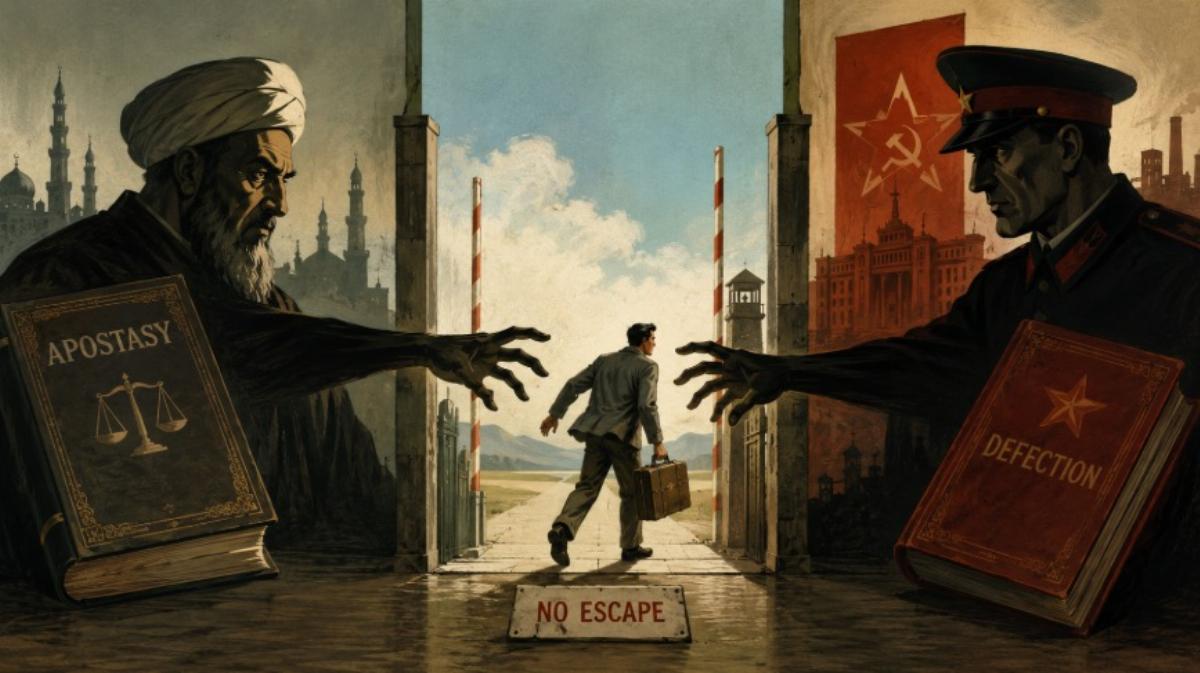
The parallel is not that Islamic law and Soviet practice share a rationale. One is a claim about divine law; the other is about the discipline required to defend a revolution. It is that both treat departure itself, not active resistance, as the offense that matters, and both hold the claim open indefinitely.
Abdul Rahman never organized against Islam. He simply stopped being a Muslim. Reiss and Trotsky never took up arms against the Soviet state. They simply stopped being Bolsheviks in good standing. In every case, the state’s claim on the person did not end when the person renounced it. It began there.
For the communist ideology to survive, communist punishment for defection did not require an extant Soviet Union. Georgi Markov, a Bulgarian novelist, defected in 1969 and was sentenced in absentia to six and a half years. He spent the next nine years in exile, broadcasting criticism of the Bulgarian Communist Party for the BBC and Radio Free Europe.
On September 7, 1978, on Waterloo Bridge in London, far from the Soviet Union, a passerby jabbed Markov with an umbrella that delivered a ricin-filled pellet into his thigh; he died four days later. KGB defector Oleg Kalugin later confirmed the KGB supplied the weapon at Bulgaria’s request.
China, governed by a party that has never renounced the doctrine, launched Operation Fox Hunt in 2014 and Operation Sky Net in 2015 to bring home Chinese “fugitives” and “corrupt” officials living abroad. Beijing claims over ten thousand returned.
In fact, not all are corruption suspects. ProPublica has documented dissidents and whistleblowers swept into the same machinery. Safeguard Defenders documented over a hundred undeclared Chinese police outposts in fifty-three countries, pressuring targets by threatening relatives.
North Korea is starker. Most who cross into China are economic migrants and trafficking victims, not dissidents, but a 2010 decree makes departure itself, whatever the reason, “treachery against the nation,” punishable by death. The UN Commission of Inquiry found in 2014 that those repatriated face systematic torture, arbitrary detention, and, for pregnant women, forced abortion and infanticide. Human Rights Watch reported that China forcibly returned at least 406 more since 2024 and that two women returned in October 2023 were executed the following August for helping other escapees reach South Korea.
Read more Venezuela: Did Trump just make a deal with the devil?
The argument that ordinary states also pursue fugitives abroad through extradition is grossly dissimilar to this case. Extradition operates through treaty and due process against specific crimes. What both traditions describe is different in kind—a claim surviving due process, pursued against people whose offense is departure itself, enforced by unmarked agents, not open proceedings.
Most Muslim-majority states have no codified apostasy statute. However, Pew Research counted twenty-two countries with apostasy laws as of 2019, only 11% of 198 countries surveyed worldwide, but nearly half of the roughly fifty Muslim-majority states. Counting statutes undoubtedly undercounts practice. Iran, Mahrami’s country, has no official apostasy laws, but still sentenced him to death under uncodified fiqh, and Pakistan’s converts face the same exposure through its blasphemy law.
Mauritania moved further into criminalizing apostasy in 2018, and no comparable renunciation exists on the communist side, where China and North Korea show the doctrine still operating, not retired.
Both traditions, in their strongest form, treat the boundary of the community as a place across which a person can be pursued, not a line that ends the state’s interest once crossed. Abdul Rahman and Mkhaitir survived on procedure and international pressure that will not attend every case. Reiss, Trotsky, Markov, Mahrami, and the women executed in North Korea in 2024 did not.
The distance between them is not a difference in doctrine. It is a difference in whether, on a given day, the state that wanted them back had already found them.
Image created using AI.
Previous essays in this series
- The Mohammunist Manifesto
- The Mohammunist Manifesto’s Wealth Redistribution Agenda
- The Mohammunist Manifesto’s Inequality Before the Law
- The Mohammunist Manifesto—The World as a Binary
- The Mohammunist Manifesto—Monopoly Rule By Elites
- The Mohammunist Manifesto—Public Or Private, Nothing Is Beyond Our Control
- The Mohammunist Manifesto—The Promise of ‘Transitional Phase’ Slaughter
- The Mohammunist Manifesto—Trojan-Horsing Society’s Institutions
- The Mohammunist Manifesto—Rejection of Pluralist or Limited Government
- The Mohammunist Manifesto—Transnational Loyalty Overrides National Borders
- The Mohammunist Manifesto—Control of Education and Formation of the Young
- The Mohammunist Manifesto—Surveillance, Informants, And Social Enforcement Networks
Endnotes
1. On the hadith “whoever changes his religion, kill him” (Sahih al-Bukhari) and its codification in classical fiqh, see Ahmad ibn Naqib al-Misri, Reliance of the Traveller (‘Umdat al-Salik), trans. Nuh Ha Mim Keller (Amana Publications, 1994), section o8.1.
2. Abdul Rahman’s 2006 prosecution for apostasy in Kabul, his refusal to recant despite a threatened death sentence, his release on procedural grounds, and his asylum in Italy: Radio Free Europe/Radio Liberty, “Afghanistan: Christian Convert Faces Execution,” March 21, 2006; Human Rights Watch statements from the period; contemporaneous reporting by NPR and ABC News, March 2006.
3. Mahmoud Mohammed Taha’s January 1985 trial, conviction, and execution for apostasy: Abdullahi Ahmed An-Na’im’s firsthand account, published in retrospectives on the twentieth anniversary of the execution; Gabriel Warburg, Islam, Sectarianism, and Politics in Sudan Since the Mahdiyya (University of Wisconsin Press, 2003). Meriam Ibrahim’s May 2014 apostasy conviction and death sentence, her shackled childbirth in prison, and her release weeks later following an appeals court reversal: Amnesty International, “Sudan: Woman Faces Death for Apostasy,” Urgent Action AFR 54/006/2014, May 13, 2014; contemporaneous coverage by the BBC, CBS News, and Al Jazeera, May–June 2014.
4. Mohamed Cheikh Ould Mohamed Ould Mkhaitir’s January 2014 arrest and December 2014 death sentence for a blog post authorities read as insulting Muhammad, the November 2017 reduction of his sentence to time served, his continued incommunicado detention despite that ruling, and his July 29, 2019 release following renewed public repentance: Committee to Protect Journalists case record; Human Rights Watch, “Mauritania: One Year On, Blogger Still Detained,” November 8, 2018; Reporters Without Borders, “Mauritanian Blogger Freed after Being Held Nearly Six Years,” July 30, 2019. On Mauritania’s April 27, 2018 law eliminating repentance as a defense to the blasphemy death penalty: Human Rights Watch, “Mauritania: Mandatory Death Penalty for Blasphemy,” May 4, 2018.
5. Dhabihu’llah Mahrami’s 1995 apostasy trial before Iran’s Islamic Revolutionary Court in Yazd, his January 1996 death sentence citing Ayatollah Khomeini’s Tahrir al-Wasilah, the Supreme Court’s confirmation of a second death sentence in January 1997, his eventual commutation, and his December 2005 death in custody: Amnesty International, “Iran: Dhabihullah Mahrami: Prisoner of Conscience,” MDE 13/034/1996; Abdorrahman Boroumand Center, “Zabihollah Mahrami: One Person’s Story,” iranrights.org; Baha’i International Community, “The Cases of Dhabihu’llah Mahrami and Musa Talibi,” bahai-library.com.
6. Ignace Reiss’s July 17, 1937 letter breaking with Stalin and the Central Committee, and his September 4, 1937 assassination by an NKVD team near Lausanne, Switzerland: Leon Trotsky, “Swiss Police Arrest Assassins of Murdered G.P.U. Man, Reiss,” October 1937, and Joseph Hansen, “How the GPU Murdered Ignace Reiss,” February 1941, both via marxists.org.
7. Trotsky’s 1927 expulsion, 1929 deportation, and the Mercader operation, including the August 20, 1940 assassination: Isaac Deutscher, The Prophet Outcast: Trotsky, 1929–1940 (Oxford University Press, 1963); on Mercader’s infiltration specifically, “Trotsky on Ice,” The New Criterion, April 2019, and “The Trotsky Assassination,” History.com, August 2015.
8. Georgi Markov’s 1969 defection, in absentia sentencing, and September 1978 assassination by ricin-tipped umbrella on Waterloo Bridge, London: “Georgi Markov,” U.S. Agency for Global Media; “Murder on Waterloo Bridge: Placing the Assassination of Georgi Markov in Past and Present Context, 1970–2018,” Cold War History (2022). On KGB general Oleg Kalugin’s confirmation that the KGB supplied the weapon at Bulgaria’s request: Kalugin’s post-defection interviews, as reported in multiple secondary accounts.
9. China’s Operation Fox Hunt (2014) and Operation Sky Net (2015): “Operation Fox Hunt: How China Exports Repression Using a Network of Spies Hidden in Plain Sight,” ProPublica; on overseas police stations, Safeguard Defenders, “110 Overseas: Chinese Transnational Policing Gone Wild” (2022) and “Patrol and Persuade” (2023), documenting more than a hundred stations across fifty-three countries.
10. On the systematic torture, arbitrary detention, and forced abortion faced by repatriated North Koreans, and the 2010 decree criminalizing defection as “treachery against the nation”: Report of the Commission of Inquiry on Human Rights in the Democratic People’s Republic of Korea, United Nations Human Rights Council, February 2014. On the 406 additional forced returns since 2024 and the August 2024 executions, Human Rights Watch, “China: No Letup in Forced Returns to North Korea,” October 15, 2025; HRW’s report does not state the reason for the executions. On the two women’s specific charge, helping other escapees reach South Korea, and their execution date of August 31, 2024, see Radio Free Asia, “North Korea Executes 2 Women Who Fled and Were Forcibly Repatriated from China,” September 2024.
11. Pew Research Center, “Four-in-Ten Countries and Territories Worldwide Had Blasphemy Laws in 2019,” January 25, 2022, counting twenty-two countries and territories with apostasy laws as of 2019, concentrated in the Middle East-North Africa region. On enforcement without a codified statute in Iran and Pakistan: Law Library of Congress, Global Legal Research Directorate, Laws Criminalizing Apostasy in Selected Jurisdictions (May 2014). Pew’s own denominator for “eleven percent” is the 198 countries and territories its wider survey covered, not the roughly fifty Muslim-majority states in the world (a range of 48–51 depending on source and whether territories are counted; see Pew’s 2011 and 2020 Muslim-population studies and the CIA World Factbook).