
America has become increasingly secular over the last sixty years. That is a phenomenon worth investigating. What happens to a nation when it abandons the Western principles upon which it was constructed?
Read more Sine Qua Non—Or The But For Cause Of Failure (Or Success)
John Adams warned us in what seems like a prophetic way that the Constitution was made for a moral and religious people and was wholly inadequate to govern any other. The Founders understood that our republic could not be properly sustained on positive law alone. It required people capable of governing themselves, guided by principles beyond the will of whoever happened to hold political power.
America cannot be understood through secularism alone. The institutions and traditions were shaped by Christianity and the belief that man answers to an authority higher than himself. Yet we have come to regard this inheritance as something from which we must free ourselves.
I am not advocating for a theocracy by any means. The state should not have any control over the church; it should not compel any religious practices on its people, and it should never force Christianity upon its citizens. But there is a profound difference between separating the institutional authority of church and state and separating a nation’s moral foundations from its religious inheritance.
The former protects religious liberty. The latter risks severing a civilization from its conceptual principles.
The reunification of church and state, as I use the term, means restoring the Christian moral tradition to its rightful place in our public life. It means recognizing that religious liberty includes the freedom to practice, teach, and live one’s faith without treating religious conviction as something that must be excluded from public institutions.
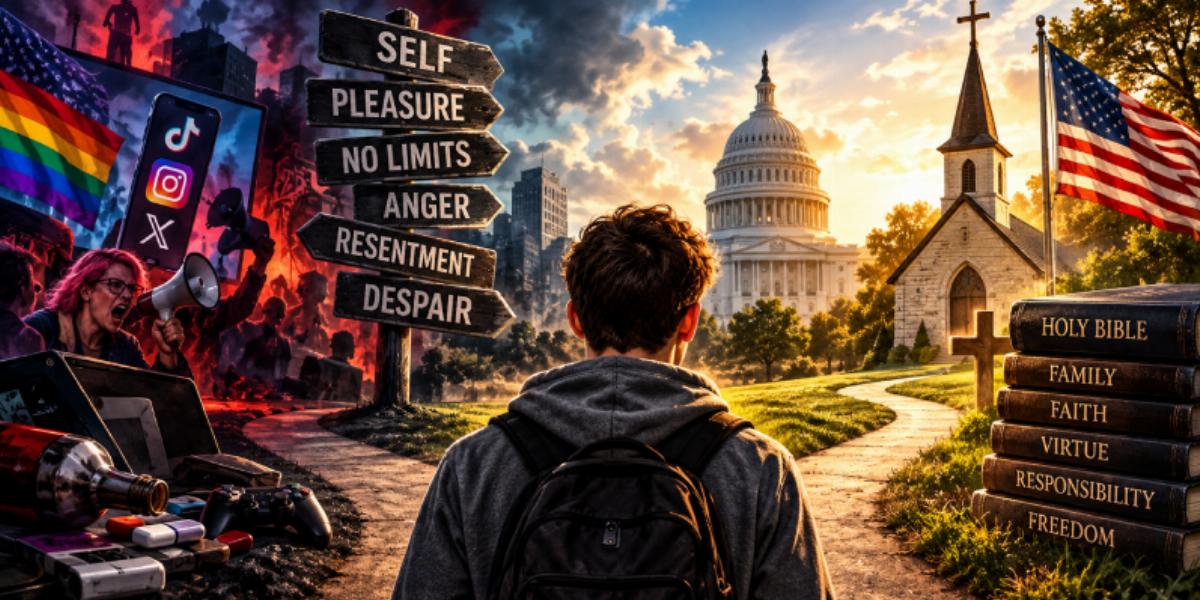
When a society abandons its moral inheritance, it does not leave a vacuum. Something will fill it. Consider the life of a boy.
From the moment of his creation, his existence is treated as a choice. He enters the world having narrowly escaped the judgment of someone who believed his life was theirs to permit or deny. As he grows, he is taught that he alone determines the boundaries of his existence, that his desires are his own authority, and that his purpose is his to invent.
He is stripped of providence, and his encounters begin to form him. He is promised undefined equality, unbridled liberty, and fulfillment without an objective means to an end for his life to be directed. In consequence, his appetite grows but is never satiated.
He wanders in search of something he cannot name, pursuing an end he cannot define. Severed from his true Being, he continues to seek purpose. He mistakes the freedom to choose for the knowledge of what is worth choosing.
The boy will nonetheless become a man, but his manhood has no grasp of manhood. He is taught to believe restraint is oppression. That his desire is an expression of his “true” self, he abandons sacrifice to his impulses for gratification. Without a moral boundary beyond his own will, he becomes increasingly captive to the very appetites he believes make him free.
His suffering grows, but he cannot comprehend its source. He looks outward whenever the world refuses him what he desires. His misery becomes resentment, his resentment becomes pride, and his pride prevents him from considering that the fault might lie with the desires he has permitted to rule him.
And now his suffering no longer belongs to him alone. He spreads his disordered understanding to those around him, reproducing in others the very conditions that have left him broken. If he can no longer bear his own existence, he may turn his destruction inward, leaving those closest to him to bear the consequences of a tragedy they may never fully understand.
Read more The Democrats’ Enslavement
The destruction appears sudden. But it began much earlier, in the gradual dissolution of the principles that might have restrained him.
Viewed through the lens of Christendom, the tragedy becomes unmistakable. When man abandons the moral principles by which generations before him sought to govern their lives, he does not become free of authority. He becomes subject to the authority of his own appetites and, eventually, to those powerful enough to exploit them. The First Amendment protects Americans from a theocratic government that establishes religion or commands which religion to follow. Yet in the twentieth century, the Supreme Court fundamentally reshaped the legal boundaries surrounding religious expression in public education. In Engel v. Vitale (1962), the Court ruled that public schools could not sponsor an official prayer. The following year, in Abington School District v. Schempp, the Court ruled against state-sponsored Bible reading.
These decisions did not prohibit private religious instruction nor outlaw Christianity. But they did signify a massive shift in the relationship between religion and public institutions, developments whose broader cultural consequences deserve serious examination.
Protecting a child from compelled prayer is not the same as protecting him from religion itself. Preventing the state from establishing a church does not require treating the moral instruction of churches and families as unwelcome. A parent should be free to teach his child the Christian faith. A church should be free to form consciences. A citizen should be free to bring religious convictions into public debate. It is nearly impossible to teach American history in good faith with no regard for the Bible or Christianity.
The state must remain a distinct and separate power from the church. But the protection of religious liberty became a just reason for severing the nation’s moral life from the inheritance of Christendom.
A free people has to be able to govern itself. Laws can provide punishments for certain actions, but they cannot make people good. For evidence of this, look at gun-free zones, which seem to be an invitation to those who seek to harm large numbers of people. Courts can decide cases, but they cannot teach anyone how to live. That work still falls to families, churches, and the communities that show people the difference between what they are allowed to do and what they ought to do.
The reunification I am asking for is a restoration of the moral first principles, not a merger of institutions. It requires Americans to stop treating their religious inheritance as an obstacle to overcome and to recognize the wisdom it may still offer.
This is a polarizing position, and defending it carries a political cost. But the difficulty of defending an idea does not determine whether it is worth defending.
It is time for patriots to stand up for the principles they believe in to strengthen their families, build their churches, teach their children, defend religious liberty, and insist that public life remain open to moral arguments grounded in the traditions that formed our civilization.
The boy was told he could live without limits. He was told he could define himself, chase whatever he wanted, and build his own purpose. But no man gets out of needing some moral order. He either recognizes one that stands above his own desires, or he ends up ruled by them.
A nation faces the same choice.
We can continue to discard our inheritance, or we can recover the principles that taught generations before us how to live, how to sacrifice, and how to govern themselves.
The battle is not simply between church and state. It is between competing understandings of man, freedom, and the good.
Read more Many Western Governments Won’t Survive
And it is a battle we must begin and cannot afford to abandon.