
Sine Qua Non means “without which, not.” In other words, “but for” is a prerequisite for factual cause. Factual cause is the bread and butter of metaphysics (the study of the nature of reality), which is considered a branch of philosophy (the study of large questions that cannot be scientifically measured) – also known as the study of wisdom. Are there changeless universals around which societies can structure themselves? Or are scientific predictables but a thin slice of the tangled nature of existence? Why is this important to an individual American voter?
Read more The Democrats’ Enslavement
It is important because an individual does not always know or come to know whether his or her action in voting (or failing to vote), and what or who is voted for, is the “but for” that changes civilizations. Small events, not votes, can also be the “but for” that changes the course of history. For instance:
Attila the Hun fought both the Western and Eastern Roman Empire with great success and was ready for the final kill until suddenly dying of an esophageal hemorrhage following a drunken stupor on his wedding night. The Hunnic Empire of Eastern and Central Europe subsequently ended in 468 AD — Western Civilization was preserved.
A freak fog emerged at the Revolutionary War Battle of Long Island in 1776, allowing George Washington and his troops to escape to Manhattan Island during the night, avoiding sure capture and probable hanging and an end to the American Revolution.
A late officer reshuffle meant David Blair was not on the Titanic when it hit an iceberg at 11:40 pm 400 miles south of Canada in April 1912. Blair had the key to the crow’s-nest locker in his pocket, forgot to give it to the replacement officer, and left the crew without binoculars to scout for icebergs. The ship sank after about two hours with great loss of life.
After a failed bomb attempt on the same day, Archduke Franz Ferdinand, heir to the Austro-Hungarian Empire, decided to go out later in the day, and a wrong turn by his driver led him directly to one of the earlier conspirators who shot him dead on the spot. WWI ensued.
Alexander Fleming left a petri dish of bacteria exposed in his laboratory, and when he found it, instead of destroying it due to exposure, he noticed that spores had grown around the bacteria that seemed to have killed some of it, and penicillin was discovered. The lives saved by this accidental discovery are incalculable.
This phenomenon, chance or novelty as a feature of the universe, seems to imply a tangled, if not chaotic, universe, rather than changeless universals, but it could just be that human beings have a say through thought, will, and action regarding what might otherwise be interpreted as unpredictable “but for” results. This is especially true where one vote, lack of a vote, or abstaining from a vote takes place.
Read more Many Western Governments Won’t Survive
James A. Bayard from Delaware abstained from casting the one vote for his state and caused Thomas Jefferson to be elected President in 1800.
Harry Burn from Tennessee, after a note from his Mother to be a good boy, voted “yes” to the 19th Amendment and was the deciding vote for women’s suffrage.
Andrew Johnson’s conviction in the Senate fell one vote short of removing him from office. Edmond Ross from Kansas voted “not guilty.”
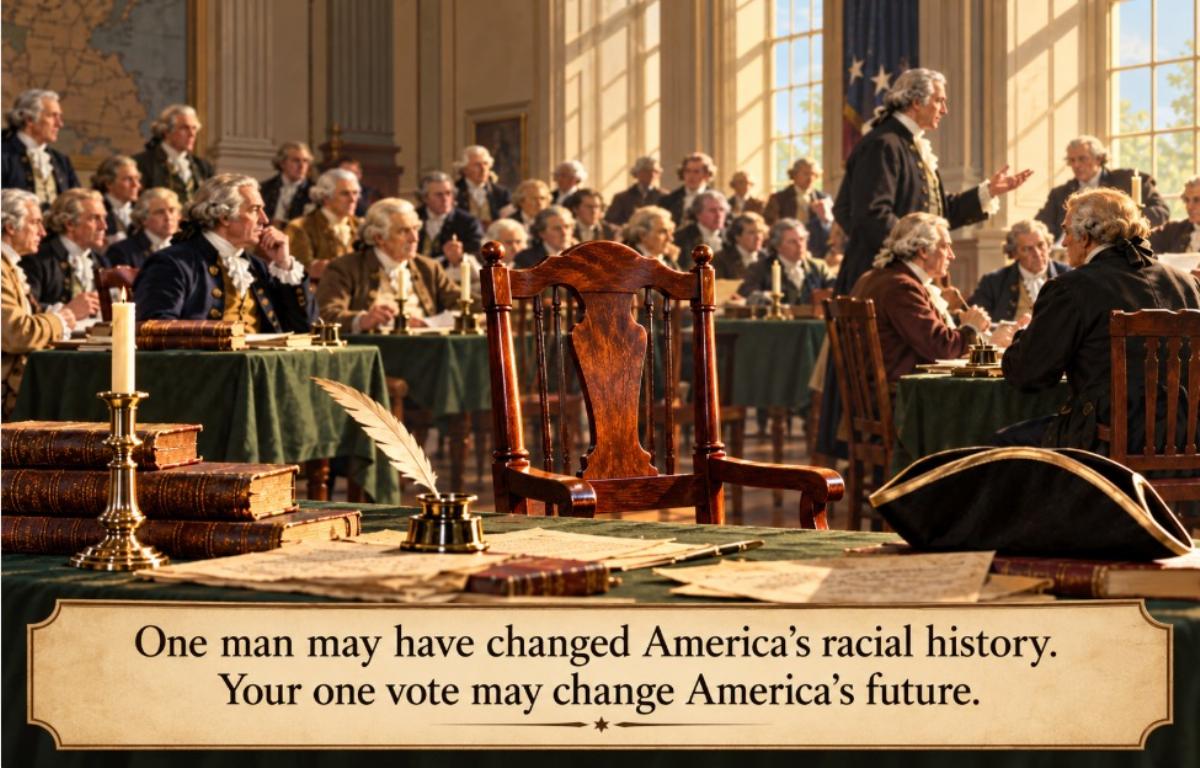
Arguably one of the most important of these “but for” scenarios in American history involves an absent member, due to an unknown illness, when America was governed by the Articles of Confederation. The Land Ordinance of 1784, introduced by Thomas Jefferson, banned slavery from all territories seeking to become states. It failed by one vote – that of Dr. John Beatty, representing New Jersey. South Carolina, Maryland, Virginia, and North Carolina voted “no” to the provision. Massachusetts, New Hampshire, Connecticut, Rhode Island, New York, and Pennsylvania voted “yes.” New Jersey would have voted “yes,” but for Dr. Beatty’s absence.
It is true that this legislation was later partially adopted by the Northwest Ordinance of 1787, but the anti-slavery provision applied only to those states in that region. What followed a lack of one vote was the various compromises for slave versus free states and the carnage and destruction of the Civil War of 1861-1865. Slavery was introduced into the American colonies by England in the mid-1600s, and but for one vote would have been eliminated in all new territories, then states, by the new United States of America in 1784.
The sine qua non of the seemingly endless racial divide in America today; the non-stop ugly accusations of hypocrisy and conflicting principle; not to mention the overlooked genius of the Founding structure; all coalesce around one illness of one delegate to the Confederation Congress and his missing vote. Slavery in the existing states would have withered and died, and those who labored under its tyranny would have moved to the wage-based economy emerging in the late 18th century in America and Europe. Indentured servitude was not mentioned in Jefferson’s legislation, but it, too, was based on an agrarian economy, not an industrial one.
Will yours be the deciding “yes” vote to our Constitutional Republic in November of 2026; will it be the absent vote that might make a difference; or will it be a “no” to the American experiment in development of the person through liberty of choice within the Rule of Law? This is what is entailed in the action steps Benjamin Franklin was talking about when he wondered if future generations could maintain the Republic. But for you?
Read more Gaza teacher says she was threatened for opposing hatred of Jews in classroom
Image created using AI.