
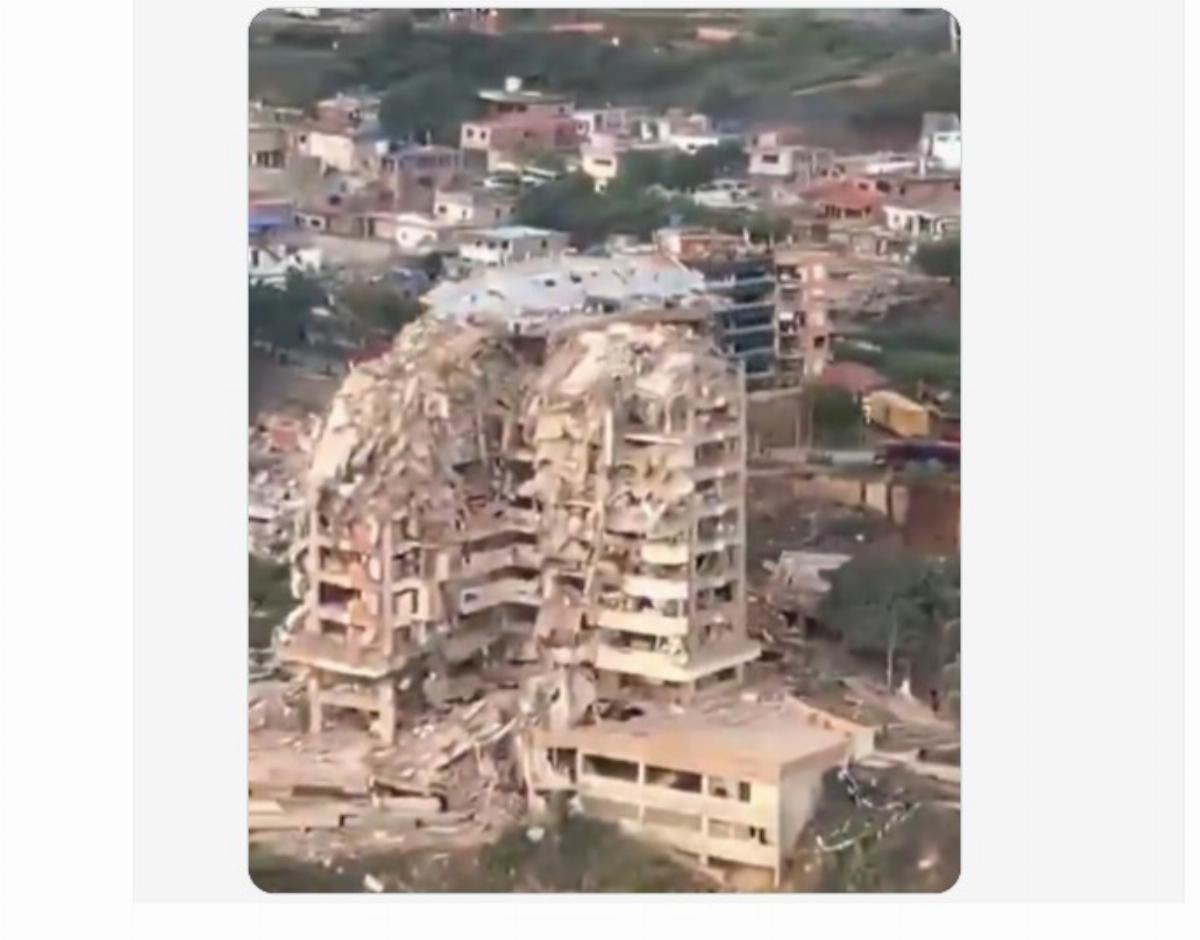
From the disaster of socialism to the real disaster of nature’s power is only a matter of minutes
Read more Venezuela: Post quake, time for President Trump to shuck Delcy Rodriguez
Such as we are seeing in the wake of Venezuela’s monstrous 7.2 and 7.5 ‘doublet’ earthquakes, the country’s worst in more than 100 years, which struck the northern coast of the country less than an hour apart yesterday.
This many areas of the country have been affected: The sprawling metropolis of Caracas, known as Liberatador, and the states of Miranda, La Guaira, Carabobo, Aragua, and Falcon, according to the Caracas Chronicles. Obviously, Yaracuy state, which is where the epicenter was must have been affected, it’s the home state of one of our finest sources on Venezuela, Daniel Duquenal, who is now living abroad. If Yaracuy was affected, it’s likely there are other states, such as Cojedes and Guarico affected, too. It’s absolutely terrible to think about. It’s the entire populated area on the coast, not the sparsely populated grasslands and dense jungle in Venezuela’s center and south, where the force of nature hit hardest.
It’s right that the international community, including, foremost, the U.S., has stepped up to help with search, rescue and survivor care. The people affected are very likely the ones who spent years protesting their terrible socialist governments, only to see their elections stolen in front of their eyes.
Look at the despair and the sorrow of the people unable to rescue their injured loved ones from beneath the tons and tons of rubble, some of them calling out, dying, in homes transforming by the hour into tombs:
🇻🇪🚨 SISMO | ”Mi vida entera, mi casa, mi sacrificio, mi trabajo, mi lugar seguro… mis perros y mi gato, mis vecinos; todo se acabó”, expresan los afectados en mensajes que circulan en las redes sociales, reflejando el vacío y la impotencia que se vive en el litoral.
El dolor… pic.twitter.com/A1aH7yOtFP
— Cristian Crespo F. 🇨🇺 (@cristiancrespoj) June 25, 2026
Señor danos fuerzas! 🙏
Desde la Guaira.#Venezuela 🚨‼️🆘 pic.twitter.com/9WPhdESJLe
— Cristian Crespo F. 🇨🇺 (@cristiancrespoj) June 25, 2026
🇻🇪 188 dead, 1,520 injured, and 50,000 people missing in Venezuela after the earthquakes
50,000 missing isn’t a search and rescue situation, that’s entire communities simply gone from the map.
Thoughts with everyone caught in this. It’s going to get a lot worse before anyone… https://t.co/bzSEnXGFYl pic.twitter.com/ZijPSpsdpC
— Mario Nawfal (@MarioNawfal) June 25, 2026
🇻🇪#URGENTE – Un geólogo señalo a Infobae que los dos Terremotos que sacudieron a Venezuela, liberaron una energía equivalente a unas 260 bombas nucleares. pic.twitter.com/B1zvlCdDQg
— DatoWorld (@DatosAme24) June 25, 2026
Un niño de 12 años fue rescatado de los escombros, lamentablemente no consigue a sus padres, se sospecha que hayan fallecido en los escombros. La situación en La Guiara, Venezuela, es muy grave, miles de personas están dentro de escombros y aún no llega la ayuda suficiente. 🇻🇪 pic.twitter.com/rzaXWMaWzt
— Eduardo Menoni (@eduardomenoni) June 25, 2026
Venezuela 🇻🇪: several housing projects in La Guaira collapsed at the foundation due to the earthquake.
The Chavista government had been warned for years that the cheap flats it was building were not safe in case of an earthquake. pic.twitter.com/JlYCdraWxa
— Thomas van Linge (@ThomasVLinge) June 25, 2026
There’s no search and rescue, there’s no ambulances, there’s no hospitals, there’s no fire trucks, and yes, fires are breaking out nightmarishly enough — Venezuela’s health care lies in ruins – nor is there an organized effort to dig out.
Socialism has well and truly taken over in that country, and as this leftish but still good essayist in the Caracas Chronicles notes, one of the effects is that the state has abandoned its basic functions of government:
The aftermath is even more devastating when one considers how profoundly unprepared Venezuela is to respond to a disaster of this magnitude. Natural disasters are catastrophic by definition, posing immense challenges even for wealthy countries with competent institutions. For the battered nation that is post-Maduro Venezuela, responding to a crisis of this scale may prove overwhelming.
Venezuela has faced what the United Nations defines as a complex humanitarian emergency, a prolonged and multidimensional collapse of the state’s ability to perform its core functions. This has been the status since at least 2016. Few sectors have suffered more than healthcare. Years of mismanagement, systemic corruption, and chronic underinvestment have devastated the country’s health system, compounding the deterioration of the electrical grid and other essential public services.
Since at least 2022, the Venezuelan state has increasingly adopted a hands-off approach to governance. This shift, shaped by a post-socialist form of laissez-faire economic policy, reduced state control over large parts of the economy and contributed to a modest but visible revival in business activity. In many ways, the tate appeared to retreat from major areas of public administration while preserving absolute control over others, particularly the security apparatus and the machinery of censorship and political repression.
Read more What Republicans still get wrong about reaching black voters
So there’s no infrastructure for search and rescue, let alone medical care in place. Socialists spend now, and spend on cronies, the idea of maintaining infrastructure for a rainy day is simply never done. That’s one reason why the country was so horribly unprepared for its Big One.
The other is that the country is loaded with shambling buildings, thrown up in the 1950s and 1960s quickly during the various oil booms, and never brought up to code.
First, socialism’s threats of state expropriation against apartment buildings, which has been going on for more than 20 years, puts a lot of damper on new construction. Ownership, see, isn’t always ownership, meaning, old buildings stay up, same as they do in rundown Havana, and new ones don’t get built. The old buildings were built before standard earthquake codes were developed and few were ever upgraded.
According to engineering firm Miyamoto International, which has a very good piece out:
From an engineering standpoint, the scale of structural damage is not surprising given what we know about Venezuela’s built environment. A significant share of the country’s building stock, particularly older urban residential construction, consists of unreinforced masonry — a material category that performs poorly in earthquakes and is prone to sudden, catastrophic collapse.
Structural engineers commenting on the disaster noted that many of the collapsed buildings were likely constructed before the early 1970s, under building codes that predate modern seismic design standards. Venezuela has since adopted updated codes aligned with international standards, including provisions from the American Concrete Institute. Buildings constructed under those newer codes are expected to perform markedly better — but in a city like Caracas, which grew rapidly through the mid-twentieth century, a large share of the housing and commercial stock predates those protections.
Venezuela reportedly does have globally recognized earthquake standards on new construction, but with Venezuela rated one of the most corrupt countries in the world, does anyone think they really followed them? Just look at that tweet above showing new low-income Chavista housing, precious little of which was ever built, and the new edifices that were built going down like bowling pins, full warnings in place about the absence of earthquake fitness.
Miyamoto explains that this is why disaster preparedness is critical:
It reinforces the critical role of pre-disaster mitigation: seismic risk assessment, retrofit programs, and updated construction enforcement before the event, not after.
No, they don’t seem to have any of that. You know Japan does. You know Chile does. I doubt Venezuela does.
Meanwhile, the Venezuelan socialist government chased the international insurance industry out of the country as greedy capitalists and now insurance is only available through a few local insurers the government allows to exist. The insurance international investors are forced to buy for buildings is something called ‘political risk insurance,’ against state takings, and it doesn’t come cheap.
Why build when the government is standing there, ready to take away, capitalist running dogs?
The failure of basic governance is a phenomenon we saw in Los Angeles on a smaller scale with the failed city and state responses to the Pacific Palisades and Eaton fires that burned those entire cities to the ground and left them in rubble, to be followed by red tape and high costs for victims and a coverup report by the perpetrators.
In Venezuela, the disaster has come at an untold scale, and right now, the state has just discovered it’s $240 billion in debt.
What it tells us is that socialism is devastating in its consequences during a natural disaster. And that should be a warning to all those Democrats in the states who see socialism as their answer to a Democrat party they despise. Vote for a socialist, hope there is never a natural disaster because the net impact is alway, everywhere, that socialists do not prepare for disasters, they spend the cash they can take immediately, and none of it to save the people.
Image: X video screenshot