
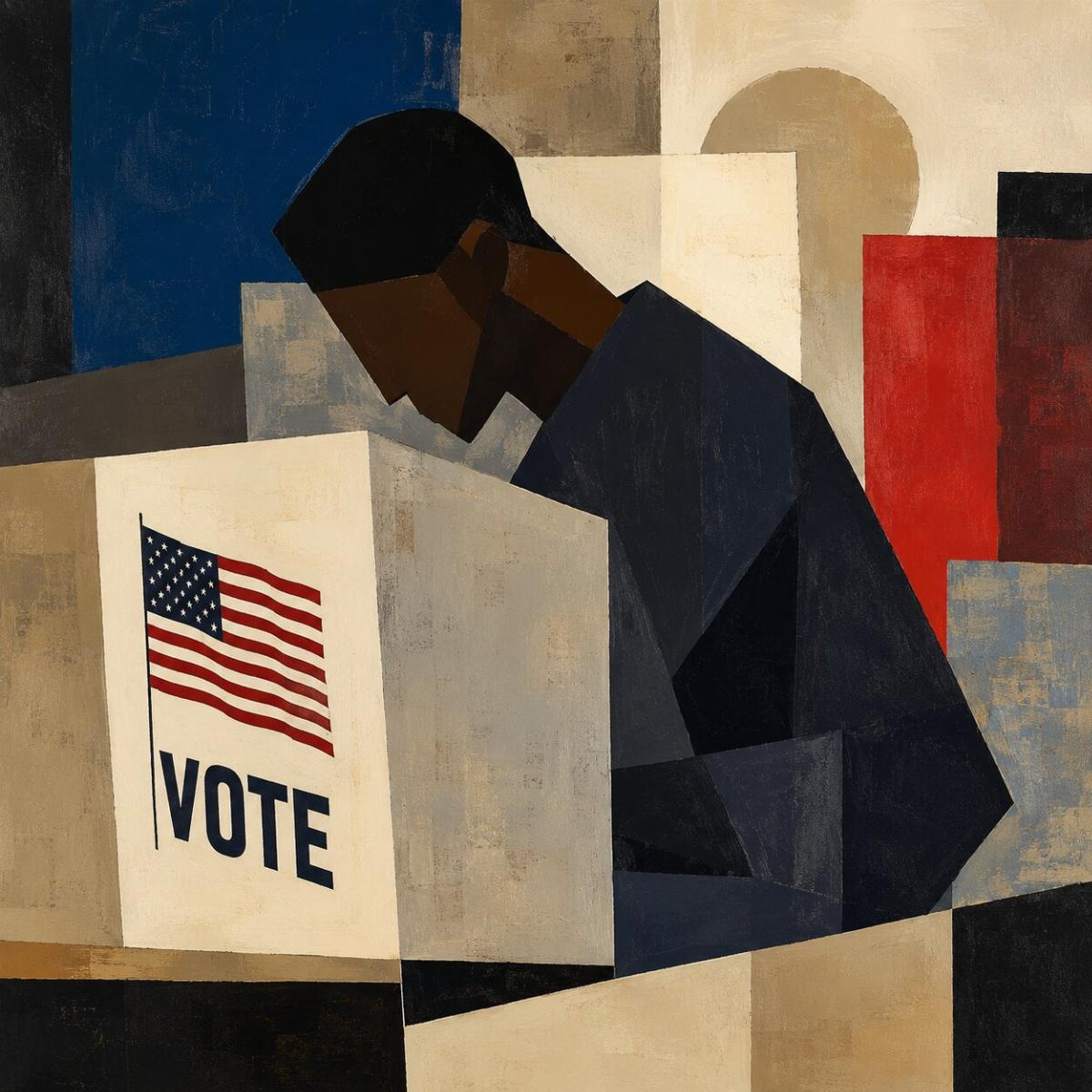
As a black Christian conservative, mental health advocate, father, and community worker, I have spent years engaging with people across ideological, economic, and cultural lines. In churches, community programs, informal conversations, and civic spaces, I have observed a recurring pattern in American politics that continues to limit meaningful engagement between the Republican Party and black voters.
If I were advising Republican leadership from a fireside discussion, I would begin with a direct but necessary observation:
Republicans do not primarily have a messaging problem with black voters.
They have a perception problem.
Too often, political strategy begins with assumptions rather than understanding. Black voters are analyzed as a demographic category rather than engaged as a diverse community of individuals with varied priorities, values, and lived experiences.
This leads to a fundamental error: the belief that black political behavior is driven primarily by race-based loyalty rather than by practical concerns, cultural values, and everyday life conditions.
It is not.
When I speak with working-class black Americans, I hear concerns that are deeply familiar across all communities: cost of living, education quality, neighborhood safety, family stability, job opportunities, and upward mobility. These are not abstract ideological concerns. They are immediate, lived realities.
And yet, Republican outreach efforts often default to policy explanations without relational context.
Policy matters.
But trust comes first.
One of the most persistent mistakes Republicans make is assuming that black voters are inaccessible or permanently aligned with the Democrat party. That assumption becomes self-fulfilling. If a group is treated as politically unreachable, engagement becomes minimal, sporadic, or purely transactional during election cycles.
Meanwhile, the Democrat party has benefited from historical alignment and institutional familiarity, even when that relationship is not uniform or unchallenged.
The result is not ideological uniformity among black voters, but uneven engagement from both parties.
The reality on the ground is more complex than either narrative suggests.
There is a significant portion of black America that holds values closely aligned with conservatism, even if those individuals do not always identify with the Republican label. These values include strong family structures, faith-based living, personal responsibility, educational discipline, entrepreneurship, and community accountability.
The challenge for Republicans is not that these values are absent.
It is that they are not consistently recognized or engaged.
Another recurring issue is tone.
Policy discussions that feel abstract, technical, or detached from lived experience rarely resonate in communities where trust is built through personal relationships and consistency over time. Many voters are not evaluating political parties based solely on ideological coherence. They are evaluating whether those parties understand them, respect them, and show up beyond election cycles.
Read more A bad morning for activist judges
In that sense, political engagement is not simply informational—it is relational.
This is where Republicans often fall short.
There is a tendency to engage through surrogates, media appearances, or high-level messaging campaigns rather than through sustained local presence in churches, community organizations, and neighborhood institutions.
Yet those are precisely the spaces where trust is built.
It is also important to recognize that black voters are not politically static. Generational shifts are already underway. Younger voters are increasingly open to questioning inherited assumptions, especially as they encounter economic pressures, educational concerns, and cultural changes that do not align neatly with traditional party narratives.
This does not guarantee partisan realignment.
But it does indicate fluidity.
And where there is fluidity, engagement matters.
Republicans often underestimate this fluidity because they interpret loyalty patterns as fixed rather than conditional. But political loyalty, like any form of trust, is maintained through ongoing reinforcement.
If that reinforcement is absent, it weakens over time.
If it is present and consistent, it strengthens.
The path forward for Republicans is not complicated, but it does require discipline.
It requires showing up in communities consistently.
It requires listening without immediate correction.
It requires engaging institutions that already carry trust, such as churches and local organizations.
It requires speaking plainly about issues that matter most to families.
And it requires abandoning the assumption that demographic identity determines political belief.
Black voters are not a monolith.
They never have been.
They are individuals navigating complex lives, making decisions based on values, experience, and opportunity.
The sooner Republican strategy reflects that reality, the more effective it will become.
Read more Reaping the communist harvest of generations of the uneducated
Not because persuasion becomes easier, but because understanding becomes real.
Image generated by ChatGPT.