
In 2017, Macalester College, a pricey Midwestern college, ran an article in its glossy “Macalester Today” magazine titled “The Dog Is In.” Indeed, that was the cover story. In the article, Macalester boasted about having multiple therapy dogs roaming the campus to help students deal with homework stress—students who, as best as I could tell, had about 12 hours a week of class time, plus homework. I was not impressed.
Read more Political Disunity Has A Cost
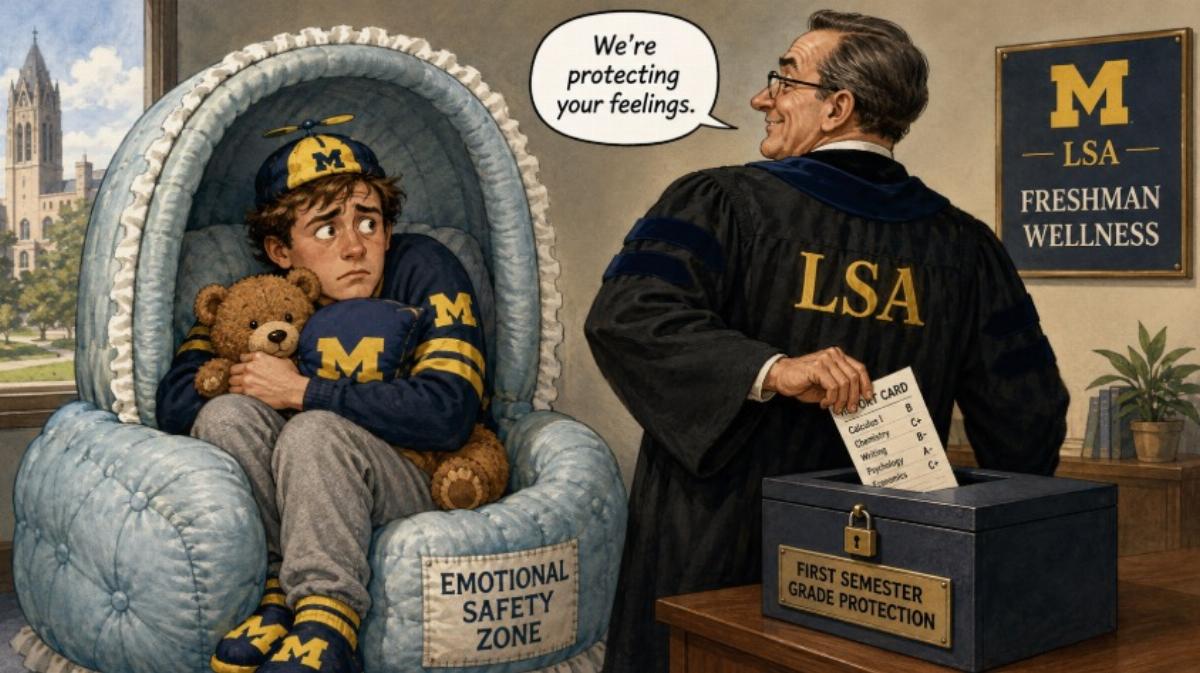
Little did I know, though, that worse was to come. Nine years after Macalester boasted about its students being so fragile that they needed therapy dogs, the University of Michigan has announced that it is hiding first-semester grades from freshmen, lest those same freshmen might be distressed if their grades didn’t meet their expectations:
The University of Michigan’s College of Literature, Science, and the Arts (LSA) will stop reporting traditional letter grades on first-semester transcripts for incoming freshmen beginning in Fall 2027, replacing them with “pass” or “no credit” designations as part of a pilot program aimed at reducing student stress and curbing a “mental health crisis”.
Students will still earn letter grades and receive instructor feedback in every course. However, those grades will remain internal, will not appear on official transcripts, and will not affect first-semester GPAs.
University officials say the policy is intended to help freshmen transition to college, support student well-being, and encourage students to take academically challenging courses without worrying that one difficult semester could permanently affect their records.
This is bat-fecal-matter crazy. If the students aren’t given specific information about their academic progress, they cannot fix their mistakes and change their trajectory.
Read more What ‘America First’ Really Means
I had a couple of times in college and law school where I was either lazy or confused, resulting in bad grades. Maybe I was made of stronger stuff than the new freshmen, or maybe, just maybe, I lived in a time when we were less infantilized, but those bad grades didn’t cause me to have a mental collapse. Instead, I fixed the problem, either by being less lazy or by haunting my professors until I understood what I was doing wrong. Failure (well, not an actual “F” but, still, bad grades) was as important a lesson as anything the professor was actually teaching.
It would be lovely if life were just about going from success to success and pleasure to pleasure. However, most of life is about dealing with harsh reality: The need to get good grades, a job, pay bills, deal with unpleasant people (including bosses or teachers), etc. Life is work.
Our ability to get the most out of life—to grow as a person and to be happy—comes not from gliding through the good times, but from learning when there are bad times: learning to change harmful behaviors, and learning to use reasonable optimism, not unreasoning, immature despair, as the engine powering you.
And one other thing: The grading system across academia has a profound flaw, and the way to fix it isn’t to hide information from students.
Grades should be weighted, with the grades at the beginning of the year, semester, or quarter having less value in the averaging than grades later in the quarter. What matters isn’t where you start; it’s where you end. If you struggle in the beginning but, through hard work, get better as you go, those early grades shouldn’t matter at all, or should matter minimally. In the same way, if you start slacking off after a fast start, that should be punished.
Read more The Mohammunist Manifesto—Public Or Private, Nothing Is Beyond Our Control
Image created using AI.