
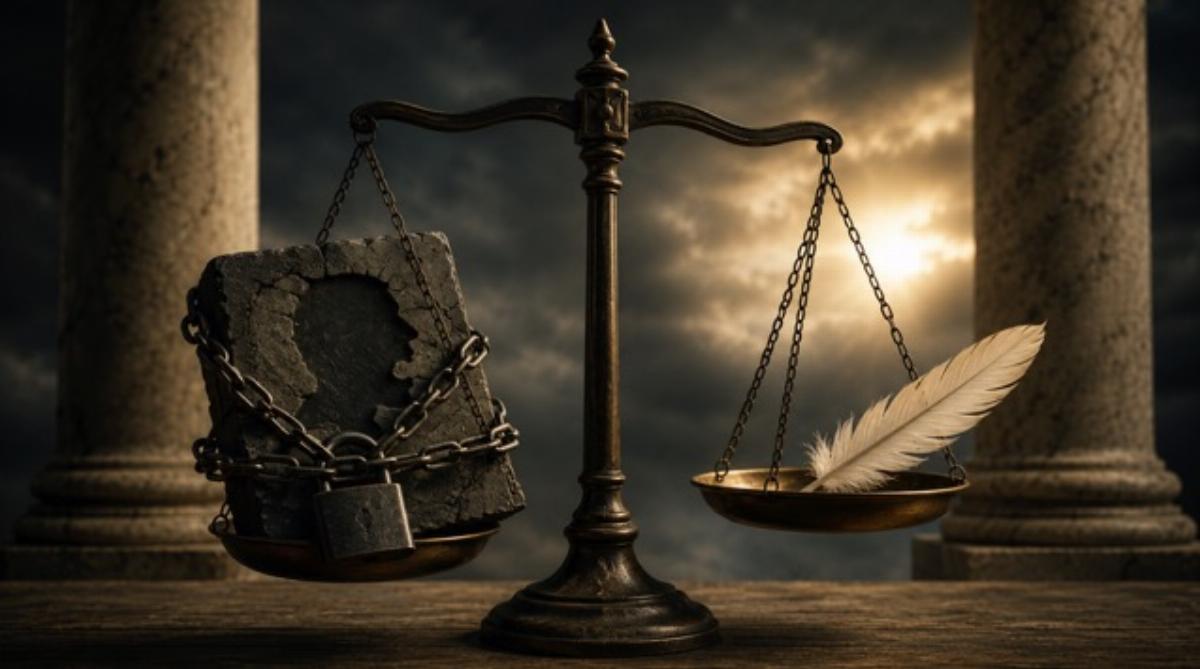
One of the great ironies of American politics is that every movement swears it’s against censorship—right up until it has enough power to do some censoring of its own. It’s almost adorable.
Read more To SAVE America — or not?
For years, conservatives rightly criticized Big Tech, universities, corporate America, and legacy media for suppressing dissenting viewpoints. We argued that free speech wasn’t merely a constitutional protection; it was a moral principle. We insisted that bad ideas should be defeated in the marketplace of ideas rather than buried beneath bureaucratic decrees or algorithmic exile.
I agreed then. I still do. Which is why I’m beginning to ask a question that makes some people on my own side a little uncomfortable.
What happens when conservatives become just as tempted to use institutional power to silence people they don’t like? As a Black conservative, I’ve learned that free speech is one of those principles everybody loves until somebody they can’t stand starts talking. Then suddenly the Constitution comes with an asterisk.
Let’s be honest. Every political tribe has its favorite form of censorship.
The Left often dresses it up in the language of safety, inclusion, misinformation, or protecting vulnerable communities. The Right is increasingly tempted to justify it in the language of patriotism, protecting children, combating ideological indoctrination, or preserving public morality. Different vocabulary. Same temptation.
Power has an uncanny ability to convince us that our restrictions are simply common sense while everyone else’s are authoritarian. History suggests otherwise.
Free speech has never been tested by agreeable people saying agreeable things. It has always been tested by offensive people saying offensive things. Defending speech you already like requires no courage whatsoever. Defending speech you find irritating, misguided, or even insulting is where constitutional principles stop being bumper stickers and become convictions.
That’s why I find myself increasingly skeptical whenever anyone begins a sentence with, “I’m all for free speech, but…” I’ve learned that whatever follows “but” usually involves someone deciding which opinions deserve oxygen and which should be quietly escorted out the back door.
The First Amendment doesn’t ask whether an idea is popular. It doesn’t ask whether it polls well. It certainly doesn’t ask whether it might ruin someone’s afternoon on social media.
It simply assumes that a free people are capable of hearing competing ideas without requiring the government—or increasingly, private institutions acting under political pressure—to function as national hall monitors.
Some readers will immediately object. “But George, some speech really is dangerous.” Of course it can be.
Threats, criminal conspiracies, defamation, and direct incitement have long occupied well-established legal categories. That’s not the debate. The debate is whether we have quietly expanded the definition of “harm” until it now includes disagreement itself.
Somewhere along the way, Americans stopped saying, “I think you’re wrong.” Instead, we started saying, “You shouldn’t be allowed to say that.” Those are radically different civilizations.
One believes truth emerges through debate. The other believes truth must be protected from debate.
As conservatives, we should be especially careful here. For decades, we were the ones demanding viewpoint diversity on college campuses. We objected when bureaucrats decided which speakers were acceptable. We criticized technology companies for selectively enforcing their rules. We warned that concentrated cultural power eventually becomes political power.
Read more The University of Michigan is now hiding grades from fragile freshman
Were we making a timeless argument? Or were we merely complaining because we happened to be losing? That’s the question history will eventually answer.
Winning elections should never cause us to abandon the principles that helped us win the argument in the first place.
One of the blessings—and frustrations—of being a Black conservative is that I don’t fit comfortably inside anyone’s political script. I’ve been called a sellout by people who think race should determine ideology. I’ve also occasionally been viewed with suspicion by people who assume conservatism requires intellectual conformity.
Both misunderstand what attracted me to conservatism. It wasn’t tribalism. It was liberty.
Liberty means accepting that people will often say things that offend us. Liberty means resisting the seductive belief that if we could only silence enough bad opinions, society would finally become peaceful. It never works that way.
Every censorship regime begins by promising to target only the truly dangerous voices. Eventually the definition of “dangerous” expands to include inconvenient voices, unpopular voices, and finally independent voices. That’s not a partisan observation. That’s human nature.
Politics changes. Power changes hands. The precedents you create today will almost certainly be used by your opponents tomorrow. Conservatives above all people should understand that.
Social media has only accelerated the problem. Every controversy now comes with an online firing squad. We don’t simply disagree anymore—we organize campaigns, demand apologies, contact employers, and measure victory by whether someone’s life has been sufficiently detonated before dinner.
Apparently we’ve replaced “I disagree” with “unsubscribe from his existence.” That’s not justice. That’s vengeance wearing business casual.
The Founders understood something we often forget. Freedom is messy. A republic is noisy. Open societies produce arguments, uncomfortable conversations, and occasionally spectacularly bad opinions.
The alternative isn’t harmony. It’s permission. Permission for whoever happens to hold power to decide which ideas deserve daylight. That bargain has never ended well.
Conservatives don’t strengthen their case by becoming more efficient censors than progressives. We strengthen it by demonstrating that our commitment to liberty survives even when liberty protects people we profoundly disagree with.
Otherwise, we’re not defending free speech. We’re simply negotiating whose turn it is to do the censoring. And that’s not conservatism. That’s just tribalism with better branding.
Read more Political Disunity Has A Cost
Image created by George P. Brooks using AI.