
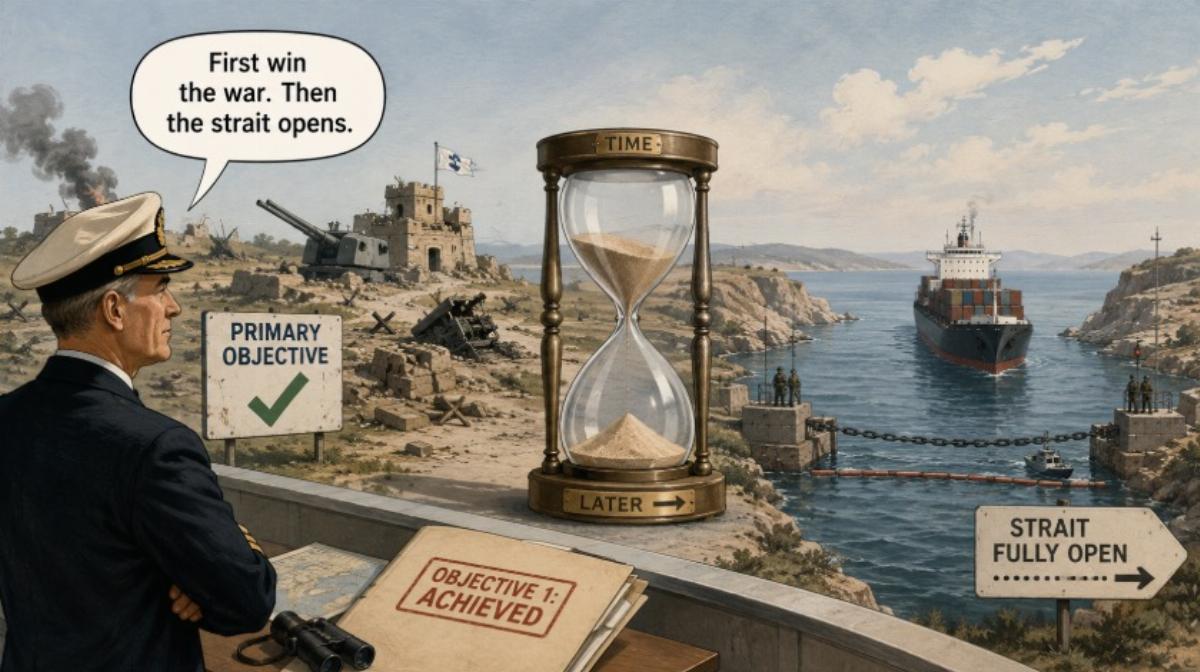
President Trump has consistently expressed a very pithy insight about dealing with Iran in a combat engagement: “Lousy fighters but great negotiators.” With such an insight, it is imperative to keep our focus on what America’s number one objective is in the current combat engagement, which is destroying Iran’s nuclear abilities. And, again, Trump recently did that:
The President reiterated that his administration’s position on the nuclear programme remains unchanged, maintaining that Iran must never obtain nuclear weapons.
With U.S. and regional forces arrayed against Iran, and with total air dominance, the possibility that Iran can soon develop a nuclear weapon indigenously has already been greatly, if not completely, reduced. As Victor Davis Hanson has correctly pointed out:
Iran will remain at a terrible disadvantage for years in dealing with the neighbors it has so gratuitously attacked. The regime currently has no effective combat aircraft or air defenses—and no allies.
In contrast, the Gulf states can field more than 700 combat aircraft, including F-15s, F-16s, F/A-18s, Rafales, Mirages, and Tornados. Israel has another 300, including late-model F-35s, F-16s, and F-15s. U.S. bases in the Middle East are home to some 300 more, including F-22s, F-35s, F-18s, F-16s, and F-15s—not counting carrier-based aircraft.
Furthermore, regarding the possibility of a loose nuclear weapon finding its way into the Iranian arsenal, any rogue nation or criminal syndicate selling such a device had best remember that an exploding nuclear weapon leaves forensic fingerprints pointing to its place of origin.
The physics are straightforward, including isotope analysis, chemical impurity analysis, and debris microanalysis that can help identify where a weapon was manufactured. Achieving assured attribution, however, may require laboratory analysis that can take time, potentially delaying retaliation.
But regardless of the specific processes, make no mistake: retaliation can and will happen against both Iran and whoever unleashed the hell of selling it a nuclear weapon, especially if Israel is hit.
Consequently, Trump is rapidly achieving his primary wartime goal. Sadly, based on a combination of ignorance and antipathy, many in the press, along with some national leaders and the entire Democrat party, will focus on Iran’s continued ability occasionally to hit ships transiting the Strait of Hormuz and portray that as evidence that the war is being lost. If they knew history, they wouldn’t make that argument.
Tactically and strategically, achieving completely free and safe passage for all nations is much harder because war has shifted to being drone-based. From any cave, on any day, a drone or drone swarm can be unleashed.
Read more The wind appears to be shifting in Oregon
Consequently, once V-I Day—Victory over Iran Day—is announced, and I bet that will happen sooner rather than later, one drone hitting one ship will still cause many to write that America lost the war. This will be despite America having removed a military threat an order of magnitude greater than a random drone attack: that is, a nuclear-armed Iran.
Ironically, the world has faced this problem of ocean commerce and a naval choke point before.
History tells us that, from 1429 to 1857, the Kingdom of Denmark charged a mandatory tax called the Sound Dues on all foreign ships entering or leaving the Baltic Sea through the narrow Danish straits. Those fees were a massive source of wealth for the Danish Crown, especially because they were backed by the cannons at Kronborg Castle.
The first real pressure on the Danes came at the Battle of Copenhagen in 1801, when Vice-Admiral Horatio Nelson’s brilliant tactics routed the Danes. Importantly, the battle was not about the strait. Instead, it was one of many important battles aimed at dislodging Napoleon during the 12-year-long Napoleonic Wars. The Battle itself was a remarkable historical engagement, often said to have been Nelson’s most audacious, and it was a telling blow against Napoleon.
When told to disengage by the ranking admiral, Nelson famously held his spyglass up to his blind eye and said he could not see the signal. This was not false bravado, because Nelson had no illusions about the Danes’ fighting abilities. Their seafaring heritage stretched back to Viking days, when they had overrun England itself and, for roughly 50 years, had been able to keep Danish kings on the English throne.
Nelson’s victory was absolute: 12 to 19 ships were sunk, destroyed, or captured, while British casualties totaled 274 killed and 737 wounded, with zero ships lost. He had achieved the primary anti-Napoleon objective. Nevertheless, it took 56 more years and international pressure before the 1857 Copenhagen Convention permanently ended the Danish tax on ships entering or leaving the Baltic Sea. In other words, practical victories may lag behind naval victories.
As the Iranian war ends with a legitimate V-I Day, drones hitting ships may persist. But the very good news is that, besides achieving the stated goal of successfully de-nuking Iran, the combat engagement has also spurred the construction of pipelines that can make Iran largely impotent in impeding the global movement of oil.
Ultimately, look to Denmark for an example of how long such a process may take. All is well that ultimately ends well.
Read more A Deplorable reads The New York Times
Image created using AI.