
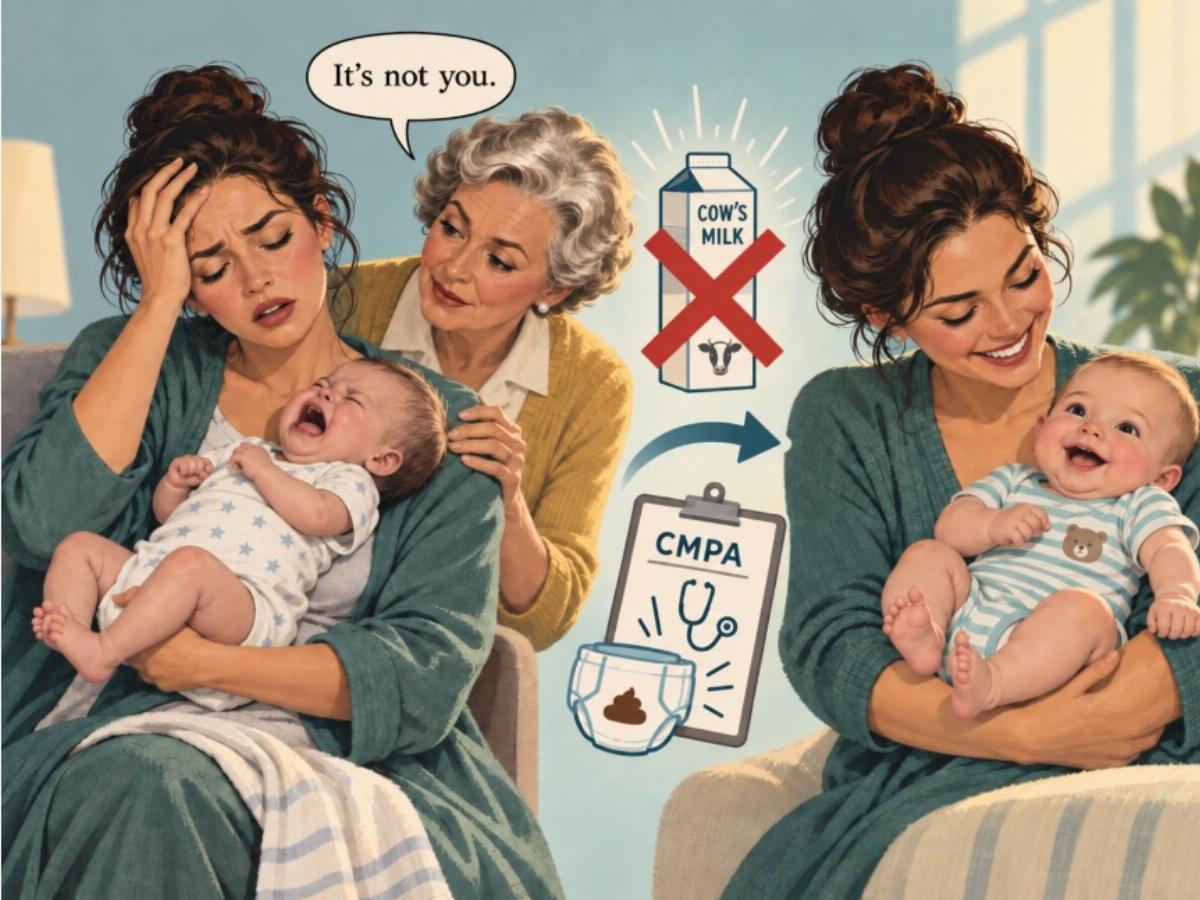
As regular readers know, I vanished fairly abruptly for a while. The reason was that a very unhappy grandchild half a world away necessitated a “grandmother to the rescue” trip. I went there partly to provide moral support and a chance to sleep to the mom and partly to see if I could “fix” the baby.
Read more Mamdani sues Trump for ending his ‘right’ to import a dependent foreign underclass
As it was, the way I fixed the baby was to tell the first-time mom, “It’s not you. Something is wrong with a baby that cries non-stop and resists nursing, and you need to take it to the doctor immediately.” That’s how I learned about something called a Cow’s Milk Protein Allergy (“CMPA”), something that, based upon my informal inquiries, is a common diagnosis today. I haven’t spoken to any older generation of mothers who’ve ever heard of it.
One of the worst things in the world for a new mother is a baby who won’t stop crying, no matter what. Mothers expect that from a newborn, but the problems begin as the weeks pass and the baby, instead of easing out of the chaos of the newborn weeks, actually gets worse.
For generations, an inconsolable baby was described as “colicky.” No matter what the exhausted parents do, this baby won’t stop crying: Feed it, don’t feed it, hold it, don’t hold it, bounce it, rock it…nothing works, and it sleeps only when it’s exhausted, so nighttime and naps provide no relief. The primary caregiver (usually the mom) is sleep-deprived and emotionally at her wit’s end.
This baby isn’t really failing, but it’s certainly not turning into a bouncing, smiling, plump little bundle of love. Life is miserable for everyone involved, and mothers often, and unsurprisingly, find themselves depressed and at their wit’s end.
In the past, parents were told, “This is a phase, and it will eventually go away.” Now, a savvy doctor says something different: “Show me the poopy diaper.” In some cases, the problem is obvious, with actual blood in the diaper. Yikes! However, in less severe cases, what the parents don’t see is mucus in the diaper, a stringy, clear substance that looks exactly like what’s in your nose when you have an allergy. That is a significant clue, especially when combined with the baby’s behavior, that it may be a non-IgE-mediated cow’s-milk allergy.
Huh? What’s that?
Well, we’re all familiar with IgE-mediated allergies. Those are the kind where people get hives, facial swelling, wheezing, vomiting, and, in a worst-case scenario, a fatal anaphylactic reaction. These allergies can often be investigated with blood tests or skin-prick tests, together with the patient’s history.
However, a non-IgE-mediated allergy is identified empirically: You remove the allergen and see if the problem clears up. (If necessary, you can confirm the connection by reintroducing the suspected allergen.)
Read more Clancy: Case or cause?
In the case of CMPA, it’s a truly terrible problem because it can painfully inflame and irritate the baby’s digestive tract. Think of a terrible stomachache, then make it chronic, and then imagine that you’re only three or four months old. Mother’s milk, the source of contentment, becomes an enemy.
Fortunately, if it is CMPA, the fix is surprisingly simple: The breastfeeding mother removes all dairy from her diet, right down to the casein/caseinate that’s often a food additive in many processed snacks. If you read labels, you’ll find that non-dairy creamers, deli meats, bakery items, cheese products, cream-based soups, candy, and even some canned tuna can contain casein to help bind and emulsify the product.
If the baby does indeed have CMPA, the results are magical. Within 36 hours, my grandchild was a completely normal baby: Willing to nurse, lie on a playmat, sit in a stroller, take naps, etc. It was like getting a brand-new baby.
Thinking about it, this isn’t surprising. In a pre-modern era, it was long known that if a mother could not nurse her baby, cow’s milk was not a substitute. The milk itself, of course, could be tainted, but by the 1960s, though, doctors slowly began to realize that babies could have a problem with something fundamental to cow’s milk as it passed through the mother’s milk. However, for reasons unclear to me, the older mothers I’ve spoken to (the ones who had kids in the 20th century) never heard of it, either from pediatricians or from other mothers.
Now, though, it is. Since I’m a chatty type, I’ve learned from speaking to several young mothers that many say that their own babies had or have it, or they know other mothers whose babies suffered from it. So, if you’re a parent, a grandparent, or a friend of a parent, and you have an inconsolable baby who’s either nursing or on a dairy-based formula, have the parents investigate CMPA; it may be the answer.
And as for why I’m writing about it here, part of it is because I find this fascinating and like to share useful information. The other part really is that unhappy people are leftists, while happy people, especially people with a stake in the future, are conservatives. So, we want happy parents who abandon their leftist college shibboleths and start thinking about a truly better world for their happy children.
Read more The Nordic model and the American diversity paradox
Image created using AI.