
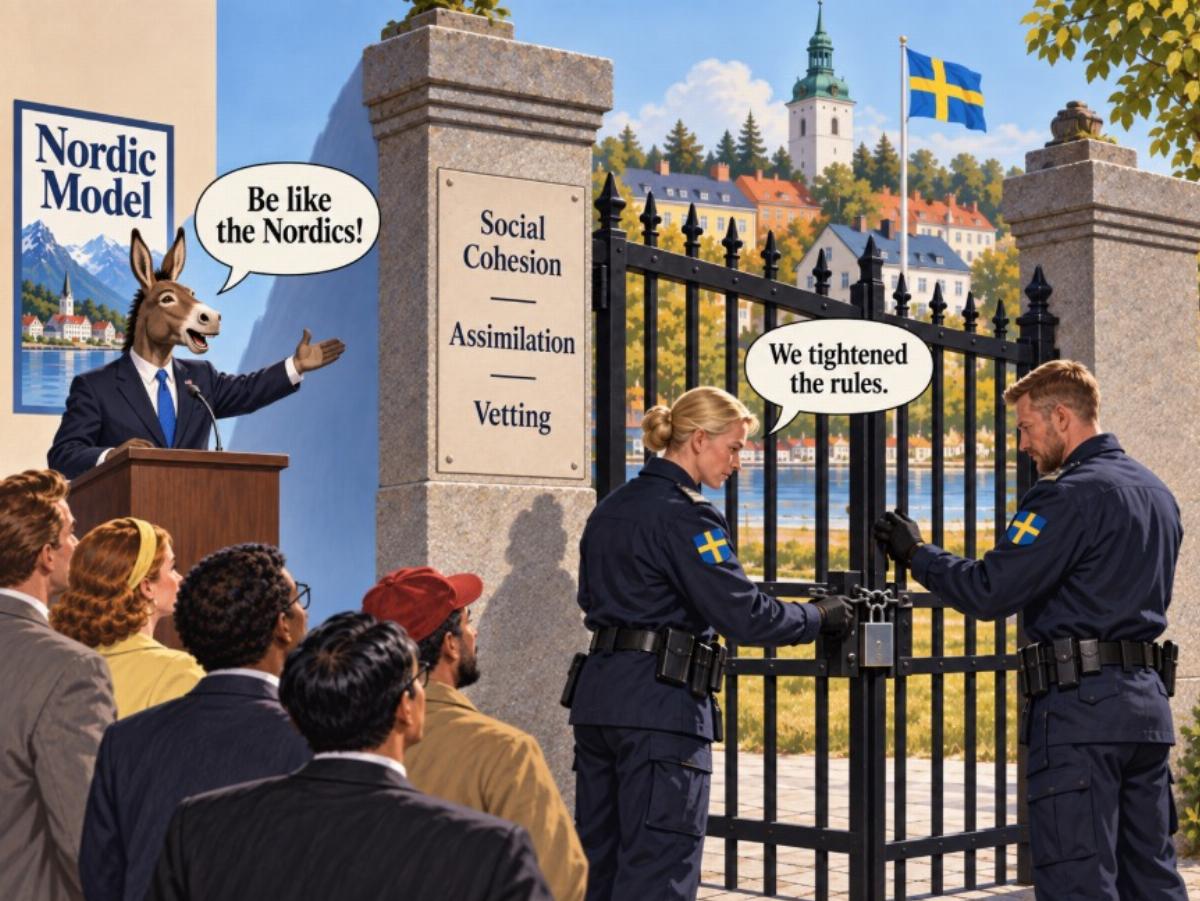
For years, progressive politicians, media figures, and cultural institutions in the United States have pointed to the Nordic countries—Denmark, Sweden, Norway, Finland, and Iceland—as shining examples of successful “socialist” societies. These nations are frequently cited as proof that expansive welfare systems, high taxation, and strong government intervention can produce happier, healthier, and more prosperous populations.
Read more Clancy holdout juror gets doxxed, and subsequently harassed
At the same time, many of these same voices insist that “diversity is our strength,” using the phrase as a moral justification for relaxed immigration enforcement and broad acceptance of illegal immigration in the United States. Yet when one examines the recent history of the Nordic countries themselves, a striking contradiction emerges.
In the past two decades, several Nordic nations—most notably Sweden—embraced the diversity narrative and opened their borders to large-scale, unvetted immigration. The assumption was that newcomers would assimilate into Nordic civic culture, adopt local norms, and strengthen society through multiculturalism. This belief was rooted in optimism, humanitarianism, and a desire to demonstrate moral leadership on the world stage. But the results were far more complicated than the political slogans suggested.
Nordic societies have historically been defined by high social cohesion, shared civic expectations, low corruption, and strong trust in institutions. These cultural foundations made their welfare systems sustainable.
When Sweden, Denmark, and Finland dramatically increased immigration from regions experiencing severe poverty, instability, and high crime rates, they discovered that assimilation was not automatic. Many newcomers arrived with vastly different expectations about governance, social responsibility, and the state’s role. The result was a sharp decline in social cohesion—precisely the ingredient that had made Nordic welfare systems work in the first place.
Sweden became the most visible example. Once celebrated as the world’s most generous welfare state, Sweden faced rising crime rates, strained social services, and growing cultural fragmentation. Neighborhoods that had been stable for generations experienced rapid change, and integration programs struggled to keep pace.
The promise that diversity would strengthen the nation did not match the reality on the ground. Instead, Swedish leaders began openly acknowledging that the country had moved too quickly, accepted too many unvetted migrants, and underestimated the challenges of assimilation.
Denmark responded even more decisively. After experimenting with multicultural policies, Danish leaders reversed course and implemented some of the strictest immigration laws in Europe. They emphasized cultural compatibility, civic responsibility, and preserving Danish social norms.
Finland and Norway followed similar paths, tightening asylum rules, increasing vetting requirements, and reinforcing expectations around integration and language proficiency. Iceland, though smaller, also maintained strict controls to preserve its social stability.
Read more It is the system that must be preserved, not a particular verdict
In other words, the Nordic countries that American progressives celebrate today have abandoned the very diversity narrative those progressives promote. They have concluded—based on practical experience—that diversity is not automatically a strength. Social cohesion, shared norms, and cultural alignment matter. Without them, welfare systems strain, crime increases, and trust in institutions declines.
This contrasts sharply with the American political environment, where “diversity is our strength” has become a catch-all slogan to justify policies that minimize enforcement, blur legal distinctions, and treat assimilation as automatic. The United States has 330 million people with enormous cultural variation, differing civic expectations, and a political climate defined by polarization and declining institutional trust.
The conditions that allow Nordic welfare structures to function do not exist in the United States. Yet the Nordic model is repeatedly invoked as if the two societies were interchangeable.
The contradiction is clear: since Nordic countries are seen as ideal, their focus on social cohesion, selective immigration, and cultural alignment should matter. Yet American progressives seldom mention these points because they conflict with the idea that diversity—especially from unregulated immigration—is inherently good. The Nordic model is used selectively and lacks the features that make it effective.
The United States has always been influenced by immigration, but in the past immigration was based on assimilation, shared civic values, and a common national identity. The legal immigration system was designed to examine individuals, ensure their suitability for American institutions, and encourage long-term integration.
Illegal immigration, however, avoids these protections. It brings in people whose backgrounds, education, and civic expectations are unknown. It strains schools, hospitals, and local governments, and hampers the social cohesion Nordic countries depend on.
The idea promoted in American politics—that it praises Nordic success while treating diversity as an unqualified strength—is attractive yet contradictory. Since the Nordic model is the one progressives like to promote, we must recognize its full reality.
It is important to consider social cohesion, cultural expectations, and immigration policy. Failing to acknowledge these facts does not benefit the United States; instead, it hides problems and prevents a frank conversation about policies that could realistically work in a country as big and diverse as ours.
Read more The Transgender Mirage Is Cracking
Image created using AI.