
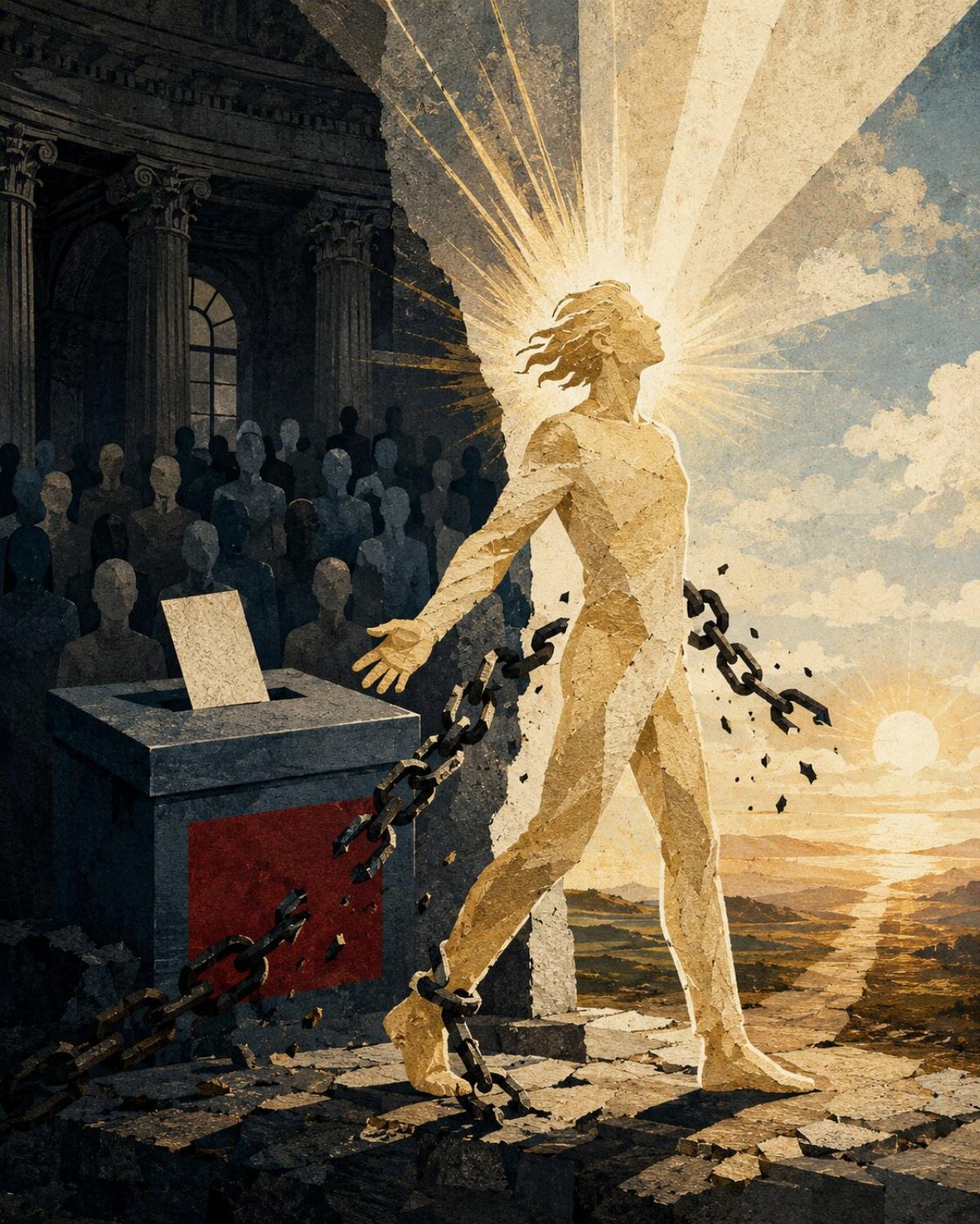
Democracy invites despotism. When understood as majority rule, democracy means that fifty-one of every hundred citizens can have their way with the other forty-nine.
Read more Can We Throw Off the Yoke of Government?
“But I want to keep my possessions, weapons, and children.” Too bad, the majority have decided to redistribute your property to those lazy bums over there, disarm you before you can do anything about it, and indoctrinate your children in public schools, so that they learn to resent you and love the State.
Democracy is dangerous without guardrails. Unless a society has a strong sense of moral virtue that fosters personal discipline, duty, and honor, base selfishness becomes the driving motivation behind all political action. Unless certain constitutional protections exist to safeguard each individual’s inviolable rights, democratic majorities devour those rights whenever expedient.
This should surprise no-one. Political philosophers such as Hobbes and Locke described humans’ pre-government “state of nature” as a chaotic, violent clash of self-interest. Adam Smith’s “invisible hand” regards self-interest as the engine of free markets. Consequently, it is easy to understand why forms of democracy that are unshackled from both moral and constitutional restraints prompt a society to descend back into a state of nature in which humanity’s worst impulses are again indulged.
When Western leaders speak adoringly of “our democracy,” citizens should prepare to guard their freedoms. My goodness, there is nothing inherently virtuous about democracy. North Korea’s Kim Jong Un runs the most repressive regime on the planet, but his country is known officially as the Democratic People’s Republic of Korea! China’s Xi Jinping is the general secretary of the oppressive Chinese Communist Party, but his nation remains officially the People’s Republic of China! Dictatorships around the globe claim to govern in the name of the people.
One might think that the blurry line between democracy and despotism would make Western leaders wary of singing democracy’s praises. Defenses of majoritarianism embrace the notion that the votes of a hundred people will lead to a more prudent outcome than we could reasonably expect from the decision-making of a single person. But that doesn’t make any sense. Would you rather live in a kingdom with a benevolent king or in a democracy filled with rapists, thieves, and murderers? If there is a 50/50 chance that any single dictator is good or bad, would there not be a 50/50 chance that a majority of citizens are good or bad, too? If one communist would take everything you have, wouldn’t fifty communists do the same thing? Democracy is a coin toss. It is the veneer of legitimacy that makes authoritarianism look shiny and sparkly. That hardly feels like something worth celebrating.
Democracy is just a process. It shouldn’t be idolized for its own sake. It can lead to just or unjust outcomes depending upon the moral virtue, shared culture, and general wisdom of the voters. Aside from these cultural attributes of a society, there is nothing more essential to a nation’s long-term peace and happiness than the recognition of and protections for inviolable, natural, God-given rights.
Freedom of speech, freedom of religion, freedom of association, the right to self-defense — these rights and other natural liberties do not come into existence because of majority rule. Our natural rights exist despite majority rule. As the Founding Fathers articulated in the Declaration of Independence, “We hold these truths to be self-evident, that all men are created equal, that they are endowed by their Creator with certain unalienable Rights, that among these are Life, Liberty, and the pursuit of Happiness.” We aren’t equal because of democracy; we are equal despite any democratic vote that might claim otherwise. Our lives, personal liberties, and connections to God exist because of His will, not the government’s.
The idea that rights and liberties exist separately from the promulgations of government forms the foundation of our constitutional system and, more generally, of human rights.
The U.S. Constitution spells out quite succinctly what powers each of the three branches of government — Legislative, Executive, and Judicial — shall have. From where do our three branches of government get these powers? The Preamble to the Constitution lays out the source of government power plainly: “We the People of the United States, in Order to form a more perfect Union, establish Justice, insure domestic Tranquility, provide for the common defence, promote the general Welfare, and secure the Blessings of Liberty to ourselves and our Posterity, do ordain and establish this Constitution for the United States of America.” In other words, the government’s legitimacy comes directly from the people.
Read more Republicans should love Jasmine Crockett
Every power that one of the three branches exercises is a power that arises from and is borrowed from the individual citizens of the United States. Any power not specifically delegated to the U.S. government remains with either the individual state governments or individual American citizens. This is profoundly important. The Constitution is not a document that empowers the federal government to do whatever it wants. It is a document that says, “You get to do only these discrete things. Everything else is off-limits!”
During the Constitutional Convention, there was significant debate among the Founding Fathers about the need for a Bill of Rights explicitly defending the inalienable liberties of American citizens. Since the text of the Constitution clearly limits the delegated powers of each branch of government, some Founders resisted the inclusion of a Bill of Rights because they feared that later generations might incorrectly interpret Americans’ inviolable freedoms to include only those rights specifically listed. Other delegates feared that, without a Bill of Rights, later generations might incorrectly reimagine the Constitution’s limited delegation of powers to include additional authorities that directly infringe upon Americans’ personal rights. Both fears proved prescient.
In order to clearly state their intentions to maximize the size of Americans’ personal liberty and to minimize the powers of the federal government, the Founding Fathers gave us the Ninth and Tenth Amendments as part of the Bill of Rights:
Ninth Amendment: “The enumeration in the Constitution, of certain rights, shall not be construed to deny or disparage others retained by the people.”
Tenth Amendment: “The powers not delegated to the United States by the Constitution, nor prohibited by it to the States, are reserved to the States respectively, or to the people.”
Taken together, these two amendments provide a redundancy within the U.S. Constitution that is meant to preserve human liberty. First, the text of the Constitution restricts the authority of the federal government to a small number of specifically delegated powers. Second, the Bill of Rights repeats the framers’ intent to reserve all other powers for the people or their individual state governments.
With this understanding in mind, a reasonable person should ask: How is it possible that the federal government is now so large and powerful that it encroaches upon nearly every aspect of our private lives? How is it possible that tens of millions of Americans either work directly for government agencies or receive taxpayer dollars in some form? How is it possible that there are too many administrative agencies, committees, and bureaucratic groups for any one person to name? How is it possible that three federal branches with a small number of delegated authorities have been replaced with a growing number of government programs with seemingly unlimited authorities?
The answer to each of these questions is the same: The generations between the Founding Fathers and our own progressively traded freedom for democracy. In the name of the people, lawmakers, presidents, and judges ignored the plain text of the Constitution — including the Ninth and Tenth Amendments of the Bill of Rights — to steal our inalienable rights and liberties.
In order to reject democracy’s despotism, the American people will have to demand their rights and liberties back.
Read more The promise Trump still has to keep
Image generated by ChatGPT.