
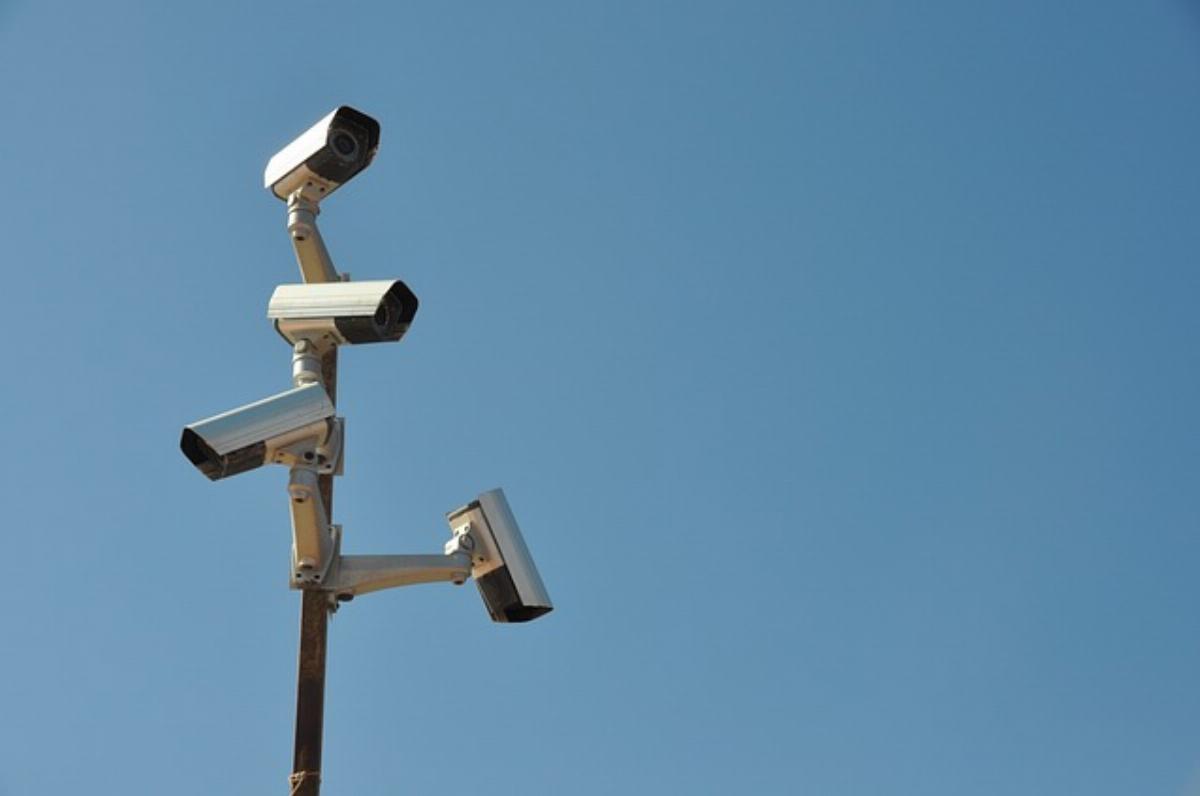
In Norfolk, Virginia, police can pull up a map showing the location of any car in the city with a few keystrokes. In Johnson County, Texas, sheriff’s deputies used the same technology to track an abortion patient through cameras across state lines. In dozens of towns, officers have been caught using it to stalk ex-girlfriends.
Read more From the Iranian crane to the red biohazard bag
The technology is an Automatic License Plate Reader (ALPR), most well-known for ones sold by company Flock Safety.
Its solar-powered cameras now blanket more than 5,000 American communities, logging license plates, vehicle types, bumper stickers, and the timing of every passing car. The company markets itself as a crime-fighting tool. What is actually being built, camera by camera, is a mass surveillance program that is reshaping the fabric of American society. And police are accessing it without a warrant.
When people know they are being watched, they change how they act. They avoid the protest because their license plate will be logged the moment they park. They grow cautious about whom they visit and whom they are seen with. They pull back from the kinds of associations that make dissent possible: meetings with journalists, membership in advocacy groups, connections to anyone the government might one day want to know more about. None of this shows up in crime statistics, but it changes who we are and how much freedom we have to live our lives.
Surveillance creates compliance and flattens the edges of dissent. Whistleblowers who might have come forward stay silent when they realize any meeting with a journalist can be traced back to them. Investigative reporters watch their sources dry up as sources realize anonymity no longer exists. Opposition movements lose the spontaneous, unmonitored energy that gives them power in the first place. The self-correcting mechanisms of a free society run on the assumption that citizens can act without the state watching, and when that assumption fails, the machinery of accountability seizes up.
A government that can watch everyone can, in time, control everyone. This is why democracies build limits on state surveillance. Those limits are being dismantled right now, quietly, without a public debate and without a vote.
For most of the country’s history, if the police wanted to know where you had been, whom you had met, or what you were doing on a given afternoon, they had to ask a judge for permission. The warrant requirement forced police, an institution with the power to ruin a life, to justify themselves before someone with the authority to say no.
A network of thousands of cameras that any officer can query, without a warrant, without probable cause, and without meaningful oversight, erases that principle. It gives law enforcement a tool of a kind that authoritarian governments spent the twentieth century trying to build, and hands it to local departments with almost no rules about how it can be used, whom it can be used against, or what happens when it is abused. The people most likely to be surveilled by this system are the same people who have always borne the brunt of overpolicing. The people least likely to be surveilled are the ones who bought the cameras.
Read more Maximum effort
And then there is scope creep. A city buys cameras to catch car thieves. A year later, the same vendor has added facial recognition to the cameras and is pitching gait analysis, to fingerprint a person’s unique way of walking, as the next upgrade. Departments in other states are pulling the city’s footage for cases the city has no involvement in. Private companies, from repossession outfits to insurance investigators, have found their way into the data through side agreements. And in more than a few towns, officers have used the system to run searches on journalists, on ex-partners, and on people they simply wanted to know more about. The system a city signs up for and the system it ends up with stop resembling each other quickly.
None of this has to continue. There is a bill in Congress that would begin to reverse it. The Surveillance Accountability Act, introduced in April this year, does something almost embarrassingly simple: It says the government needs a warrant to search your life, and if it doesn’t get one, you can sue. It closes the loopholes that let agencies buy their way around the Fourth Amendment and makes clear that stepping outside your door does not give the state license to scan your face, track your car, or log your movements. Whether it passes or not, its introduction is a signal that it’s time something was done about the intrusion into the private lives of hundreds of millions of innocent Americans.
Right now, the cameras are already up and the databases are already built, so the habits of a watched population are already forming.
The question worth asking, before we get any further down this road, is whether this is the future we want to write. A society where every movement is recorded becomes quieter, more cautious and more obedient. It becomes less capable of the disruptive, uncomfortable, essential work of holding power to account.
That is the trade being offered. We should refuse it.
Naomi Brockwell is founder and president of Ludlow Institute, leading one of the world’s largest privacy education platforms.
Read more A victory over the National Firearms Act
Image: Pixabay