
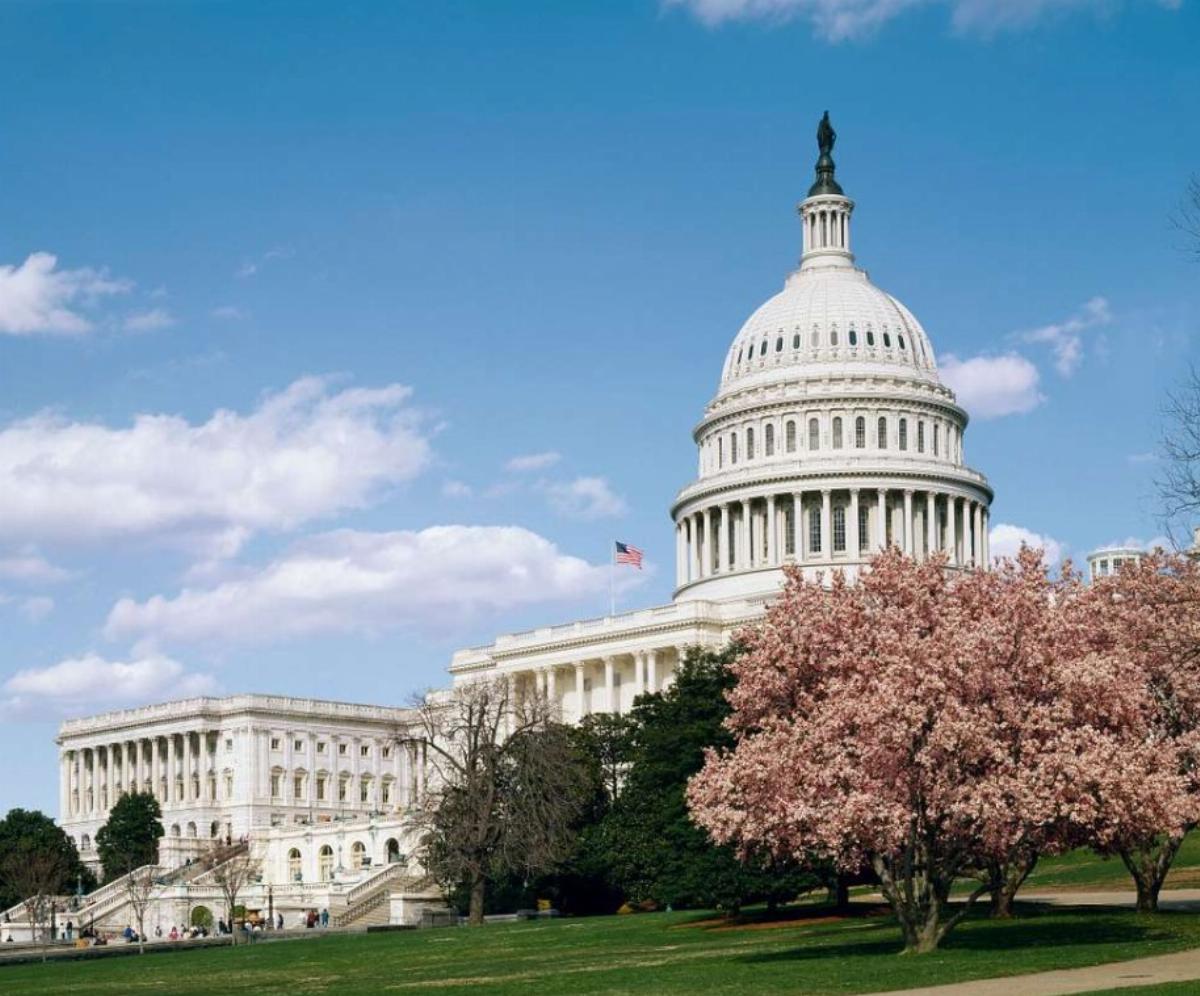
Responding to a plank in the Democratic Socialists of America’s platform, The Atlantic staff writer Jonathan Chait wrote this week that the abolition of the U.S. Senate “would rank among the great democratic advances in American history.”
Read more What Might Foreign Interference Look Like?
Apoplectic conservatives typically respond to this kind of statement with their would‑be mic‑drop reply: “The United States is a constitutional republic, not a democracy.” This statement is true but not dispositive. If the Senate were abolished tomorrow, the country would remain a constitutional republic, because it would continue to be governed by representatives of the people rather than by initiative, referendum, or plebiscite — the instruments of direct democracy.
There are other, more substantive defenses of the Senate, but leaving them aside for the moment, the DSA and sympathizing Democrats should be careful what they wish for. Abolishing the Senate would be a great and possibly permanent boon to conservatives.
Republicans may or may not retain control of the House of Representatives this year, but they are likely to retain it or regain it in 2028, when the presidential election will ramp up Republican turnout. In the meantime, continued self‑deportation and enforced deportation of illegal aliens will help keep future elections more honest. Tighter voter requirements, already adopted in many states and on the verge of being adopted nationally, will further reduce voter fraud, helping the cause of conservatism in a center‑right country. Most importantly, the 2030 census will lead to a reapportionment of seats in the House of Representatives that will ensure a short‑term and potentially permanent Republican majority.
Using Census Bureau data, the left-leaning Brennan Center for Justice projects that red states will pick up twelve new seats in the post‑Census reapportionment, whereas blue states will lose ten. Gaining states include Texas (+4), Florida (+3), Arizona, Georgia, Idaho, North Carolina, and Utah (+1 each). Losers include California (-4), New York (-2), Illinois, Minnesota, Oregon, and Rhode Island (-1 each). Pennsylvania and Wisconsin will also lose one each, which could benefit Republicans as well, depending on how the congressional districts are redrawn. Regardless of what happens in those swing states, Republicans now control 219 seats with one vacancy, and Democrats control 212 seats with three vacancies. After reapportionment, Republicans will likely control 230+ seats, with Democrats holding roughly 205.
With a solid majority — and without needing to compromise with a divided Senate — a Republican House would likely enact more conservative legislation, not less. At long last, balancing the budget and decreasing the size of the federal government would be within reach. Meanwhile, the Democrat party, already becoming radicalized, would likely grow more so, cementing conservative control of the federal government. Some House districts might see the election of socialists and even avowed communists. This can only help the conservative cause.
Read more There’s nothing toxic about these men’s masculinity
What Democrats may not realize is that a unicameral Legislature would make it surprisingly easy to impeach and remove an opposition president. Even if a liberal were somehow able to eke out a presidential victory, a conservative House could remove the president in a matter of weeks, if not days. Unable to pass legislation and under constant threat of impeachment, a liberal president would be a lame duck on Day One. It would be a Golden Age of conservatism.
Naturally, small states would not be happy to lose their outsized voice in appointments, treaty ratifications, and the passage of legislation that they now enjoy in the Senate. It should be remembered, however, that the seven smallest states will always have at least one representative in the House, regardless of their population. This will continue to give them more power per resident or voter than the larger states. And although the relative power of the states was of great importance to the Founders, it is hard to see the real dangers today. I have a difficult time imagining a federal law that would favor large states over small states being passed, let alone surviving constitutional challenges based on the Equal Protection Clause. What exactly are the large states going to do — pass infrastructure bills that benefit only them? It is worth keeping in mind that Republican delegations control five of the nine largest states, and Democrats control four. A large‑state coalition that would wield dictatorial power over the small states is a straw‑man fantasy.
As I wrote in these pages in 2024, the genius of the Founders is “expressed in the Declaration of Independence — namely, that all people are ‘created equal’ and that governments derive ‘their just powers from consent of the governed.’ A system that weights the consent of some people more than the consent of others … is in conflict with these basic principles.” The Senate gives disproportionate power — sometimes by a factor of three — to the voters in small states. This is anathema to the conservative principle of one person, one vote. The Senate’s defenders offer ingenious arguments in favor of its retention, but many — like the “republic vs. democracy” cliché — are based on logical and factual fallacies.
One thing that is not arguable is that the Senate deprives voters in large states of an equal say in their self‑government. As such, it does not embody conservatism’s bedrock principles. The Senate’s abolition would be a philosophical and political victory for conservatism.
Bradley Steffens is the author of two novels and seventy-five nonfiction books for young adults, including Donald Trump: Controversial 47th President and Leo XIV: The First American Pope.
Read more The Fauci diaries are out and they aren’t pretty
Image via Picryl.