
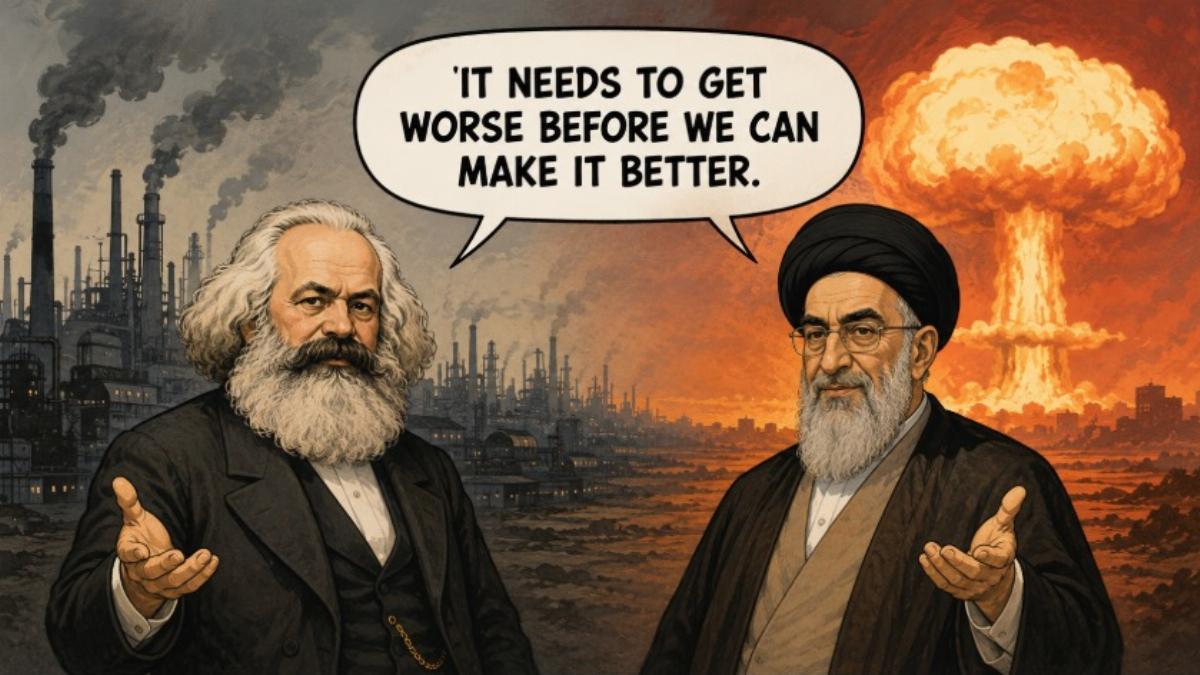
Marx’s theory of immiseration and Twelver Shia eschatology share a common structural feature: both teach that history moves forward only through a period of necessary, progressive worsening, after which a total redemptive inversion suddenly occurs. Everything else follows from that single shared manifesto.
Read more Humanism and Antisemitism
“Redemptive inversion” is the common core. It means the existing order is not improved by degrees; it is completely reversed. Workers’ misery and Islam-defined injustice are inverted into their opposites; that is, Islam-defined perfect justice and workers’ liberation.
In Marxism, the accumulated suffering of the working class under capitalism is inverted into the classless society. In Twelver doctrine, the earth filled with Islam-defined oppression is inverted into the earth filled with Islam-defined justice by the Mahdi. In both systems, the night must first become extremely dark—violently dark—before the dawn can break.
Marx explains the mechanism of that prior darkening in economic terms. In Capital, he analyzes the rising “organic composition of capital”—the growing ratio of constant capital (machines and technology) to variable capital (living labor). As this ratio increases, relatively fewer workers are required. An industrial reserve army of the unemployed expands. That reserve army then “disciplines the working class”: it holds down wages, weakens bargaining power, and keeps workers insecure and fragmented.
The result is relative immiseration. Marx’s own formulation is precise: “Accumulation of wealth at one pole is, therefore, at the same time accumulation of misery, the torment of labour (sic), slavery, ignorance, brutalization and moral degradation at the opposite pole.”
The classical Twelver sources describe a world engulfed in oppression, bloodshed, tyranny, and fitna (for extra credit, see here) immediately preceding the Mahdi’s appearance. They naturally express these conditions in the vocabulary of their own era rather than in terms of modern technology.
Today, however, no instrument is more capable of filling the earth with those conditions than nuclear weapons. A large-scale nuclear exchange would produce precisely the worldwide slaughter, famine, societal collapse, and pervasive disorder described in the traditions, but on a scale unimaginable to the authors of the classical texts.
The Islamic Republic of Iran’s adherence to Twelver Shi’ism, combined with repeated Mahdist rhetoric from senior leaders, makes it reasonable to analyze its pursuit of offensive nuclear capability not merely as an exercise in conventional statecraft but also in light of the eschatological framework that has long informed elements of the regime’s ideological worldview. Modern nuclear weapons are therefore best understood not as a revision of Twelver doctrine but as the most powerful contemporary means by which the doctrine’s prophesied conditions could be realized.
The parallel is therefore clean and limited: both systems require progressive worsening—economic immiseration on the Marxist side, total injustice and fitna on the Twelver side—as the indispensable precondition for sudden, total liberation. Marxism offers a materialist account of the worsening; Twelver doctrine offers a theological one. The shared skeleton is “things must get far worse before they can be made perfectly right” and violence is a condition precedent.
History has already judged the Marxist side of the claim. Wherever communism was implemented, it became the principal cause of immiseration—tens of millions dead from engineered famine and purges, permanent shortages, and large, sustained shortfalls in economic growth—while capitalism has proven the most effective anti-immiseration system ever recorded, reducing global extreme poverty from over 80 percent to under 10 percent.
The Twelver claim is inherently non-falsifiable. More importantly, the terms “justice” and “oppression” in Twelver eschatology are not equivalent to their modern liberal Western meanings, i.e., our understanding.
Classical Twelver doctrine understands justice primarily as the implementation of Allah’s revealed law and the rightful authority he established, while oppression consists fundamentally in rejecting, violating, or failing to implement that Allah-ordained order. Thus, a secular liberal democracy that protects broad civil liberties may still be viewed as unjust because it does not govern according to Sharia, while a state enforcing classical Islamic law may be regarded as just despite imposing restrictions that many Western observers consider oppressive. Any present-day chaos or oppression can therefore be interpreted as further “filling” of the earth under this religious framework, and the Mahdi’s continued absence is simply taken as evidence that the process is incomplete.
Once these differing definitions are recognized, the empirical question becomes whether societies governed in accordance with Islamic principles have, in practice, produced greater justice than liberal democracies when measured by widely accepted contemporary indicators such as political rights, civil liberties, human freedom, and constraints on government power. Broader empirical patterns reinforce skepticism toward the claim that Islamic governance has generally produced superior outcomes on those measures.
Muslim-majority countries on average record significantly lower scores on political rights, civil liberties, and human freedom than non-Muslim countries. Peer-reviewed studies find higher average authoritarianism in Muslim-majority states even after standard controls. The data do not support the claim that the non-Islamic world is uniquely unjust while the Islamic world is uniquely just.
The irony borders on inversion. Communism identified capitalism as history’s great engine of immiseration, yet communist states became history’s greatest producers of immiseration. Twelver eschatology depicts the non-Islamic world as the epicenter of injustice and oppression, yet the contemporary societies exhibiting the highest levels of political oppression and the lowest levels of human freedom are disproportionately Muslim-majority, while the freest societies are overwhelmingly non-Muslim.
Both ideologies therefore seek redemption by transforming societies that, by objective contemporary measures, outperform their own. The two want to foment revolution and death so the rest of the world can be lowered to the standards of their ideals. Prior worsening attended by violence is the price of ultimate redemption.
The current disfigurement of the Democrat party has eagerly embraced these perfidious, vicious, murderous groups. In reality, it is the Demohammunist Manifesto which did not appear in the title of this essay since the word seemed a bit long. That does not deny its truth.
Image created using AI.
References
– Applebaum, Anne. Gulag: A History. New York: Doubleday, 2003.
– Bergh, Andreas, Christian Bjørnskov, and Luděk Kouba. “The Growth Consequences of Socialism.” Journal of Comparative Economics 53, no. 2 (2025): 609–626.
– Courtois, Stéphane, Nicolas Werth, Jean-Louis Panné, Andrzej Paczkowski, Karel Bartošek, and Jean-Louis Margolin. The Black Book of Communism: Crimes, Terror, Repression. Translated by Jonathan Murphy and Mark Kramer. Cambridge, MA: Harvard University Press, 1999.
– Davies, R. W., and Stephen G. Wheatcroft. The Years of Hunger: Soviet Agriculture, 1931–1933. 2nd ed. Basingstoke: Palgrave Macmillan, 2010.
– Dikötter, Frank. Mao’s Great Famine: The History of China’s Most Devastating Catastrophe, 1958–1962. New York: Walker & Company, 2010.
– Economist Intelligence Unit. Democracy Index 2025. London: Economist Intelligence Unit, 2026.
– Fish, M. Steven. “Islam and Authoritarianism.” World Politics 55, no. 1: 4–37.
– Freedom House. Freedom in the World 2026: The Growing Shadow of Autocracy. Washington, DC: Freedom House, 2026.
– International Atomic Energy Agency. , GOV/2025/24, May 31, 2025.
– Khamenei, Ali. “Leader’s Speech on the Occasion of Imam Mahdi’s Birth Anniversary.” August 17, 2008.
Read more Why We Should Remember the Real Lindsey Graham
– Khamenei, Ali. “Leader’s Speech to Teachers and Graduates of Mahdaviat.” July 9, 2011.
– Kuru, Ahmet T. Islam, Authoritarianism, and Underdevelopment: A Global and Historical Comparison. Cambridge: Cambridge University Press, 2019.
– Lenin, Vladimir Ilyich. The State and Revolution. Originally written August–September 1917; first published 1918. Chap. 1, sec. 4 (“The ‘Withering Away’ of the State, and Violent Revolution”).
– Marx, Karl. Capital: A Critique of Political Economy. Vol. 1. Translated by Ben Fowkes. London: Penguin/New Left Review, 1976. Originally published 1867. Chap. 25.
– Marx, Karl. Wage Labour and Capital. 1847.
– Marx, Karl, and Friedrich Engels. Manifesto of the Communist Party. 1848.
– Al-Nu’mani, Muhammad ibn Ibrahim. Kitab al-Ghayba: The Book of Occultation. Translated by Abdullah al-Shahin. Qum: Ansariyan Publications. See chaps. 13–14 and 18.
– Sunan Abi Dawud. Book 38, “The Promised Deliverer (Kitab al-Mahdi),” hadiths 4282–4285.
– Vásquez, Ian, Matthew D. Mitchell, Ryan Murphy, and Guillermina Sutter Schneider. Human Freedom Index 2025. Washington, DC: Cato Institute; Vancouver: Fraser Institute, 2025..
– World Bank. Poverty, Prosperity, and Planet Report 2024: Pathways Out of the Polycrisis. Washington, DC: World Bank, 2024.
– Applebaum, Anne. Gulag: A History. New York: Doubleday, 2003.
– Bergh, Andreas, Christian Bjørnskov, and Luděk Kouba. “The Growth Consequences of Socialism.” Journal of Comparative Economics 53, no. 2 (2025): 609–626.
– Courtois, Stéphane, Nicolas Werth, Jean-Louis Panné, Andrzej Paczkowski, Karel Bartošek, and Jean-Louis Margolin. The Black Book of Communism: Crimes, Terror, Repression. Translated by Jonathan Murphy and Mark Kramer. Cambridge, MA: Harvard University Press, 1999.
– Davies, R. W., and Stephen G. Wheatcroft. The Years of Hunger: Soviet Agriculture, 1931–1933. 2nd ed. Basingstoke: Palgrave Macmillan, 2010.
– Dikötter, Frank. Mao’s Great Famine: The History of China’s Most Devastating Catastrophe, 1958–1962. New York: Walker & Company, 2010.
– Economist Intelligence Unit. Democracy Index 2025. London: Economist Intelligence Unit, 2026.
– Fish, M. Steven. “Islam and Authoritarianism.” World Politics 55, no. 1: 4–37.
– Freedom House. Freedom in the World 2026: The Growing Shadow of Autocracy. Washington, DC: Freedom House, 2026.
– International Atomic Energy Agency. , GOV/2025/24, May 31, 2025.
– Khamenei, Ali. “Leader’s Speech on the Occasion of Imam Mahdi’s Birth Anniversary.” August 17, 2008.
– Khamenei, Ali. “Leader’s Speech to Teachers and Graduates of Mahdaviat.” July 9, 2011.
– Kuru, Ahmet T. Islam, Authoritarianism, and Underdevelopment: A Global and Historical Comparison. Cambridge: Cambridge University Press, 2019.
– Lenin, Vladimir Ilyich. The State and Revolution. Originally written August–September 1917; first published 1918. Chap. 1, sec. 4 (“The ‘Withering Away’ of the State, and Violent Revolution”).
– Marx, Karl. Capital: A Critique of Political Economy. Vol. 1. Translated by Ben Fowkes. London: Penguin/New Left Review, 1976. Originally published 1867. Chap. 25.
– Marx, Karl. Wage Labour and Capital. 1847.
– Marx, Karl, and Friedrich Engels. Manifesto of the Communist Party. 1848.
– Al-Nu’mani, Muhammad ibn Ibrahim. Kitab al-Ghayba: The Book of Occultation. Translated by Abdullah al-Shahin. Qum: Ansariyan Publications. See chaps. 13–14 and 18.
– Sunan Abi Dawud. Book 38, “The Promised Deliverer (Kitab al-Mahdi),” hadiths 4282–4285.
– Vásquez, Ian, Matthew D. Mitchell, Ryan Murphy, and Guillermina Sutter Schneider. Human Freedom Index 2025. Washington, DC: Cato Institute; Vancouver: Fraser Institute, 2025..
– World Bank. Poverty, Prosperity, and Planet Report 2024: Pathways Out of the Polycrisis. Washington, DC: World Bank, 2024.