
The questions about the assimilation of Muslim communities in this country are becoming more, not less, controversial over time. Some people insist that Muslims are blending much better into our communities than in the past; other people feel certain that there will always be a division between our mainstream culture and the many cultures of Islam.
Read more Trump needs less trolling; more focus
Who is to be believed, and how critical are the conclusions we draw?
One way to look at assimilation is to point to two models of assimilation:
As an immigrant mother of American-born children who fled to the United States from repression in the Islamic world, I have observed how different models of assimilation shape Muslim citizens. Many have embraced the American dream and moved from the margins to the mainstream through hard work, cultural mixing, and patriotic gratitude. Yet today, a toxic alternative encourages some Muslim Americans to embrace identity politics and a victimhood mindset. Adopting that grievance tendency risks undermining, if not reversing, the many positive strides Muslims have made in adapting themselves to American life.
These models raise the question: which model dominates? And do the numbers matter if one group sees itself as victimized?
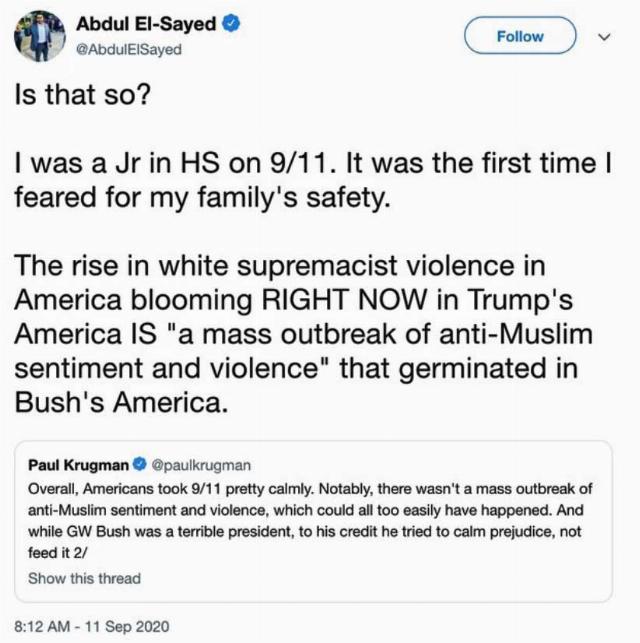
Graphic: X Post
A revealing poll (although limited in size to 750 people) describes the attitudes of Muslims regarding their lives in this country and their relationship to their home countries:
Ninety-five percent of those polled express pride in America, and 85 percent believe in the American dream. That’s a stark contrast with polls of the broader American population that show a precipitous decline in patriotism.
That enthusiasm, however, is tempered, among the 47 percent of Muslims who admit stronger ties to a foreign country. Despite living in North America, many still feel strongly linked to a home nation.
Other factors have been identified that help to measure the degree of acculturation. One is the children who are given American-sounding names. Another factor is the degree to which Muslims identify withthe Israeli-Palestinian conflict. A third example is the level of participation in a mosque community:
Thus, the Muslim community’s initial response to assimilation within the U.S. was to utilize mosques as a haven for social gatherings, especially for women to congregate. Depending on the particular mosque’s regulations, some even encouraged unified worship between men and women. Thus, this social aspect of Islam, as an umbrella for diverse peoples to connect, elaborated on mosques’ crucial role in the community as a sacred place of worship and as a locus for culture.
Read more The Government got into the bedroom with the War on Poverty. Can it get out?
Muslims have also been engaged with prison populations to proselytize their faith. One source explains that in so doing, their conversion efforts teach Muslim values such as responsibility, family values and accountability. Unfortunately, these same Muslims may also teach aspects of the faith that encourage worldwide domination by Islam.
There are other ways to determine the degree to which Muslims are identifying with the American culture, but they aren’t measured:
There assimilation succeeds or stalls depends on policy choices, labor markets, discrimination, and community responses — factors the sources identify but do not exhaustively quantify for every country or city.
And collecting accurate data about assimilation has its challenges, too:
PolitiFact and news reporting have repeatedly rejected blanket claims that ‘there’s no real assimilation,’ noting surveys where a majority of Muslim Americans express an American identity and many report non‑Muslim friendships. Multiple commentators also point out that high rates of religious disaffiliation among people raised Muslim in the U.S. — estimates cited by Cato and Newsweek — further understate assimilation when polls count only those who remain religiously observant.
Nevertheless, a number of factors point to the American ambivalence, even antagonism, toward the Muslim community. The inability to accurately determine whether Muslims are integrating into communities, when we have communities like the Somali community in Minnesota that has abused our systems; the crossover between Islam and Marxist and Socialist ideologies; the war in Iran and the unresolved situation in Gaza; and the rise of anti-Semitism in the United States. All of these contribute to a serious concern with Muslim immigration and assimilation in this country.
One Muslim immigrant makes the following recommendations:
The right choice is clear: Muslims should embrace America as a land of opportunity and shed grievance politics and resentment. Similarly, mainstream American civic leaders, including conservatives, should encourage patriotic Muslims who reject identity politics and genuinely celebrate the American dream. Such healthy assimilation offers an uplifting path for Muslim-American flourishing and American renewal.
Read more Handouts for stay-at-home mothers
We must question how realistic these suggestions are.
There seem to be no easy answers.