
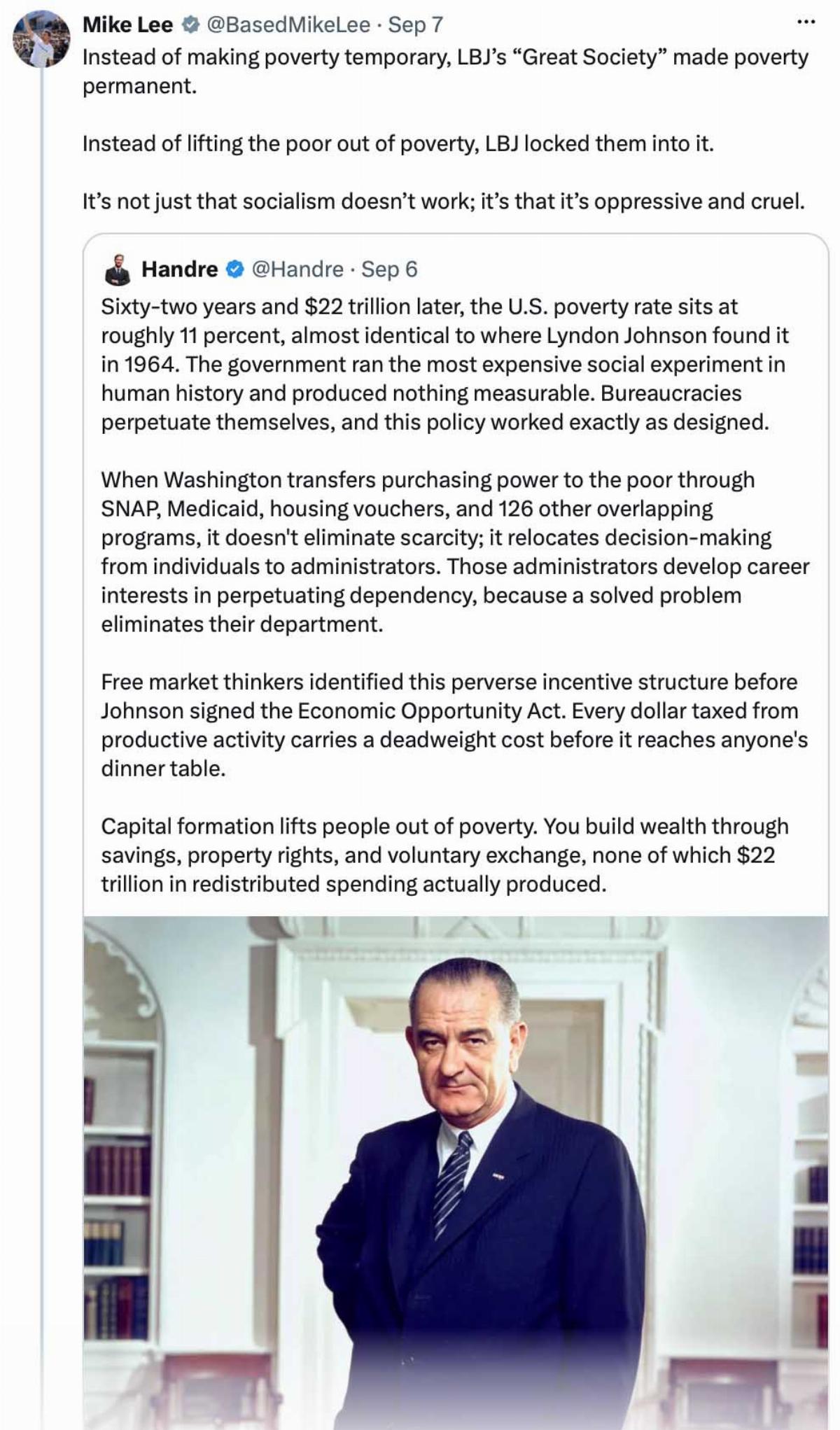
The War on Poverty did not announce itself as a bedroom policy. It announced itself as compassion. A problem was named. A class was recognized. A category was written. A check followed. Sixty years later, the check is still there, and so is the category. That is the sequence. Identify, classify, compensate, regulate, repeat. Once the state pays for a private obligation, it acquires a reason to define the obligation. Payment is not a visit; it is occupancy.
Read more Handouts for stay-at-home mothers
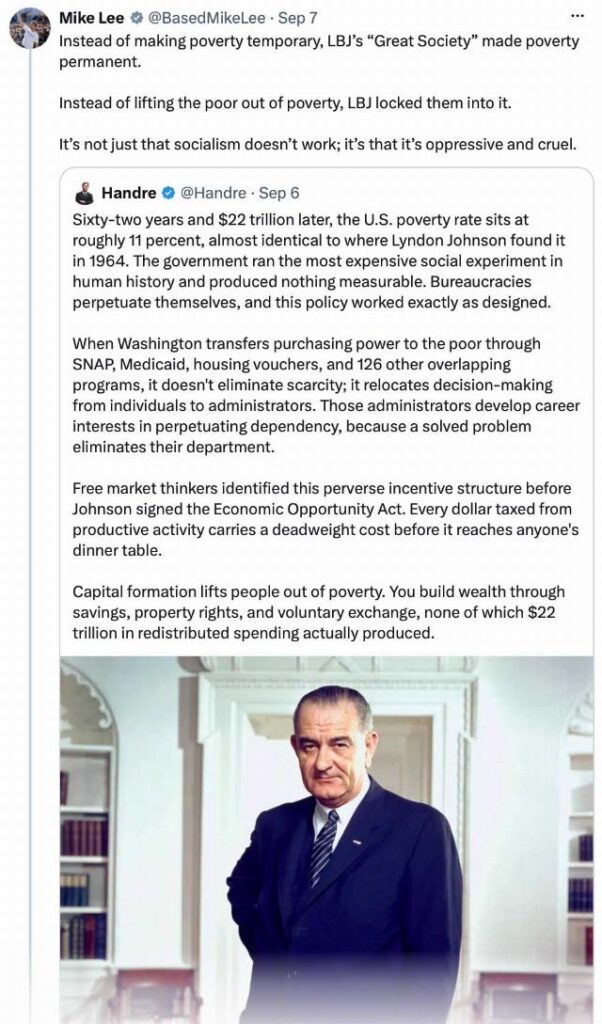
Graphic: X Post
The family was the room that got entered. Marriage rates, household formation, who raises the child, who leaves, who stays—these were never only market outcomes. They were also responses to rules about who qualified for help if the household looked a certain way. No conspiracy is required. Ordinary adaptation is enough. If the benefit attaches to a classification, people organize around the classification. The parent becomes a claimant. The household becomes a file.
Now a newer kindness proposes to restore the family by pricing what families already do: raise children, teach them, nurse them, supervise them, homeschool them, care for the old. Much of that work never appears in the GDP (Gross Domestic Product). The impulse sounds reasonable. If society values it, pay for it.
That is how the government stays in the room.
A mother does not invoice a frightened child. Government cannot pay by sentiment. It must decide who counts as a caregiver, what counts as homeschooling, how many hours, which household, what proof. The family stops being an institution that precedes the state and becomes an administrative class. Then oversight follows, because a purchaser has a right to inspect the purchase. Curriculum, testing, documentation, eligibility review. A program sold as parental independence becomes a lever over parenting.
Read more Where’s the reason in that?
The paradox is blunt. The complaint is that modern life forced too much of the household into monetary calculation. The proposed cure is another price list. We correct monetization with more monetization. We correct dependence with a better-designed dependence. The War on Poverty taught the method. The new family agenda threatens to apply it to the last institution that was supposed to stand prior to the method.
Getting out is not indifference. It is a different kind of help. Cut the tax burden on households. Let parents steer money already spent on their children. Remove obstacles to home education. Stop writing rules that punish marriage or two-parent stability. That enlarges the family’s room to act. Paying people to belong to the category “parent” keeps the state at the foot of the bed, clipboard in hand.
The first question is not how much the government should pay families to exist. It is whether a government that moved in with the War on Poverty still knows how to leave. If the family is to be valuable again, it will be valuable on its own ground—obligation, affection, memory across generations—not as the next protected victim class in a program that cannot end because ending it would look like an attack on the people inside it.
Read more Will the ‘Live Free or Die’ state submit to socialism?