
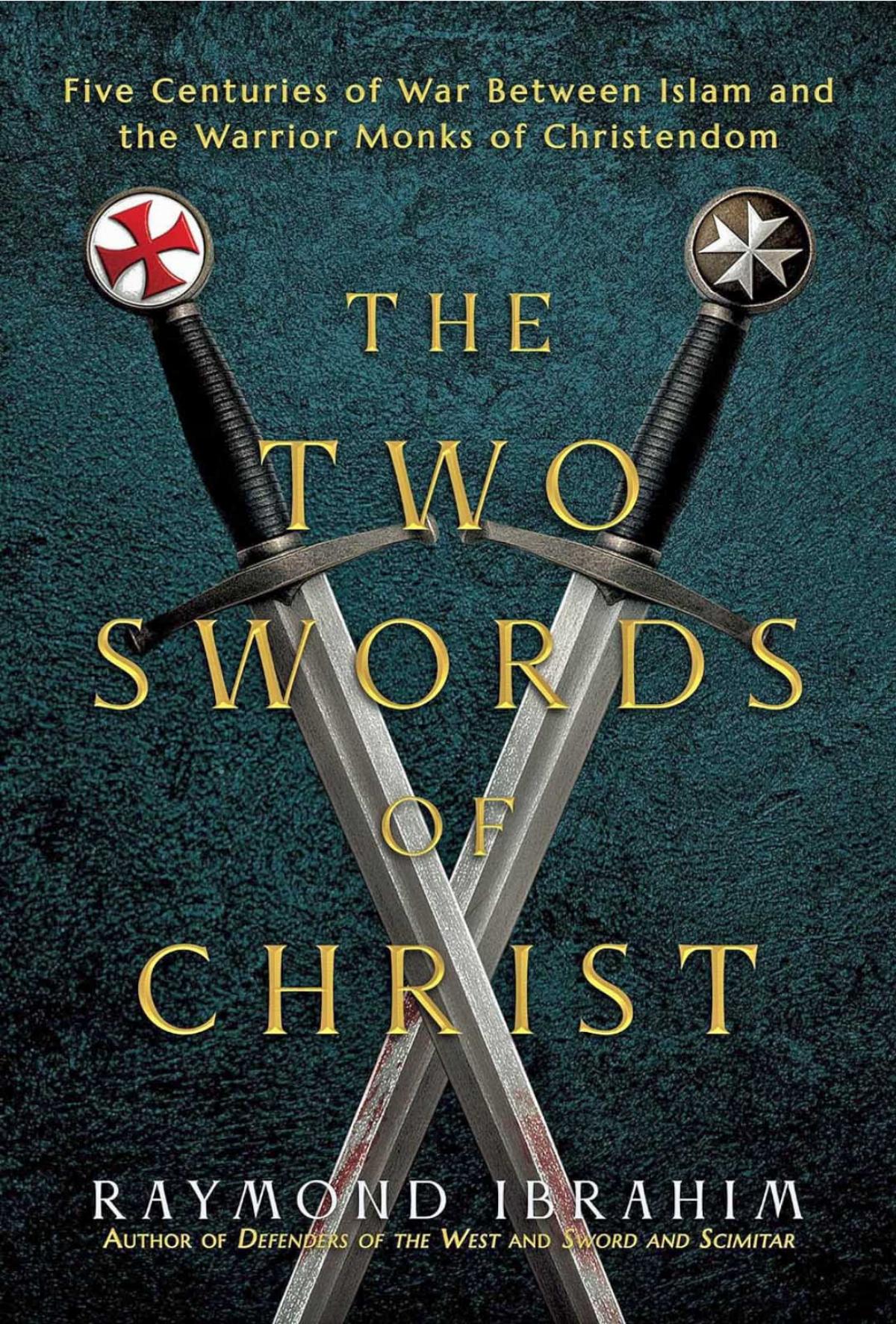
The Two Swords of Christ: Five Centuries of War Between Islam and the Warrior Monks of Christendom
Read more The real problem with mail-in ballots
Raymond Ibrahim.
Bombardier Books, 2025
449 pages, $25, hardcover
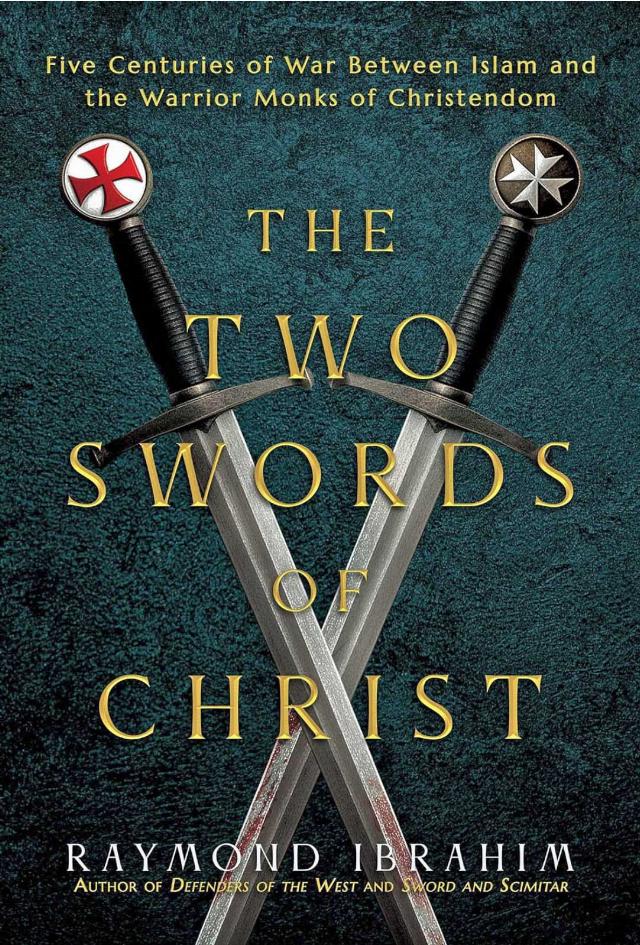
Graphic: Book Cover Scan
Like all worthwhile history, Raymond Ibrahim’s history of the Crusades clarifies the present.
To pick a current example, Ibrahim’s history would educate Pope Leo XIV about Iran’s obsessive quest to build an atomic bomb that could be launched to destroy the Vatican, among other places. And despite the Vatican being surrounded by a wall built in 852 by Pope Leo IV to keep out Muslim invaders back then, it won’t keep out intercontinental ballistic missiles now.
Beyond this object lesson for our current Leo, The Two Swords of Christ probes perennial questions such as: Are Christian soldiers and Warrior Monks oxymorons?
Ibrahim answers the question by quoting Jesus Christ’s imperative to His disciples: “he that hath no sword, let him sell his garment, and buy one.” They responded, “Lord, behold, here are two swords,” to which Christ answers, “It is enough.”
Beyond this imperative from Jesus, Christianity’s attitude toward war and conflict is rooted in Scripture as a whole and in its “just war” tradition, which seeks to keep warfare from getting out of hand.
Though Christianity was a fledgling, persecuted faith during its first three hundred years, it later became part of the establishment and had to seek justifications for and limits to war. Islam in the 7th century, under various caliphates, began conquering lands that Christians had gained by conversion. Subsequently, when Christian pilgrims wanted to visit these revered places, the Muslim settler-colonialists declared a jihad against them.
So, when in 1095 Pope Urban II called for a Crusade to safeguard the sacred sites in the Holy Land and to protect pilgrims journeying there, thousands of Europeans, at great personal and financial risk, volunteered for one of the most honorable undertakings in human history.
Among the most honorable and heroic of those who heeded the call are the protagonists in this narrative, the Knights Templar and the Knights Hospitaller, who early on had assisted Christian pilgrims to the Holy Land. But as Islam became increasingly greedy and hostile, the knights were forced to battle the Saracens, as they were then called, in order to protect Christians.
As Ibrahim writes: these war stories of “surreal feats of heroism have their source in the selfless courage of Biblical heroes, and likewise their story deserves to be told especially to those Christians who insist to their own detriment that faith and force are exact opposites.”
Ibrahim goes on to state his book’s theme:
“The example of these Knights – whose blend of Christian piety and martial discipline remains unmatched – proves otherwise, hearkening back to a time of moral clarity, conviction and courage.”
Much of this book then is a war diary with graphic descriptions like this of the great Muslim victory at the Battle of Hattin, written from the Muslim perspective about their great leader, Saladin, who:
“Set fire to the dry grass and the wind blew the smoke and flames directly in the faces of the military friars and their horses … sparks flew from the coats of mail and the glancing sabers, and the blood spurting from forth from the bosom of the throng deluged the earth like the rains from heaven.”
Afterward the battlefield was littered with:
“The limbs of the fallen cast naked on the field of battle, scattered in pieces… heads cracked open, throats split, spines broken, necks shattered bodies dismembered, stomachs disemboweled . . .“
And beyond the tragedy of those killed, ignominy was heaped on the survivors: women and children being stripped naked and whipped while being made to run behind horseback-riding escorts to the Islamic slave markets. Those who couldn’t keep up were cut down. Clergy were especially targeted for torture. The Armenian patriarch was stripped naked, dragged by his beard, and beaten with rods.
Read more Media oddly hell-bent on protecting criminals
Though the Knights were consistently outnumbered, they did beat back the Muslims in 1177, when Saladin, with a force of thousands, saw that Jerusalem was left undefended. So, he ventured into Crusader territory. But a counterattack by the Templars under leaders like Odo of St. Armand, who, along with the Franks with their crossbows, shattered enemy shields and armor as spearmen were cutting down the Muslim cavalry.
Then a thousand Mameluke Guardsmen were sent in, and the battle tilted toward the Saracen side, but with Odo leading, the knights prevailed as Saladin escaped to Cairo with three thousand fighters left of his original 26,000-man army.
It was a great victory for the Christians and so much so that Saladin had to engage in a propaganda campaign in Egypt to trumpet his victory. Nonetheless, though his army was ravaged, as the home team, he did have an endless pool of men to draw from.
Further supporting his theme that Christians are obliged to defend their faith, Ibrahim recounts the story of Francis of Assisi, later a saint, who in 1219, during a lull in the fighting, engaged in a memorable “interfaith dialogue” with the sultan, al-Kamil.
After first crossing into Saracen territory, Francis was beaten, then dragged before al-Kamil. And contrary to his advisors’ insistence that Francis be beheaded in accordance with Islamic law, the sultan engaged him, asking, If Jesus said to turn the other cheek, why were Christians invading Saracen lands?
Francis, quoting Christ, responded: “If your right eye causes you to stumble, gouge it out and throw it away. For it is better to lose one part of your body than for your whole body to be thrown into hell.” Francis thus argued that the Crusades were a necessary act of retribution for the Saracen conquest of Christian territory and its blasphemies against Christ.
Furthermore, Francis warned the sultan that if he remained a Muslim, God would damn him. As Ibrahim writes, “one early source has the sultan say, ‘I could never do that. My people would stone me.’” Nonetheless, he allowed Francis to return to the Crusader side, which itself was seen as a miracle.
As Christoph Maier, an expert on St. Francis, writes: Francis was not opposed to violence in the war between Christians and Muslims, and he indicated that those who died in the war were holy martyrs. As Ibrahim concludes, St. Francis has more in common with the Christian military orders than he has with his namesake, the late Pope Francis.
Raymond Ibrahim has recorded another noble chapter in the history of Christendom, now referred to as “the West”, in a narrative that shows the contemplative part of Christianity is compatible with the times when conflict is necessary. The Two Swords is also a response to the canard that the Crusades were but another precursor to the supposed evil of Western imperialism.
Additionally, rumors persist that the Knights Templars engaged in various nefarious activities. To rebut such a claim, Ibrahim cites the celebrated medieval historian, Jonathan Riley-Smith, who notes that the order’s former members never substantiated such tawdry claims. Besides, the order was invariably transparent in its affairs.
Mr. Ibrahim is fluent in Arabic, a talent that underpinned his successful first book, The Al Qaeda Reader. In that book, he showed that Osama bin Laden, when writing for an Arab audience, admitted the real reason for 9/11 was to conduct a jihad against the infidels and not payback for America’s supposed role in the Middle East or because the West is contributing to climate change.
That anyone would take such rationales seriously is merely another sign of the guilt the West bears based on the distorted history that Ibrahim’s books are devoted to correcting, most notably in Crucified Again, an update on Islam’s continuing persecution of Christians, and Sword and Scimitar, a chronicling of Islam’s fourteen centuries of relentless attacks on Christians.
As Muslim immigration continues into the West under the bogus rationales of “diversity and inclusion,” Ibrahim’s voice becomes an indispensable guide to what this invasion is presently showing and the bleak future that will surely follow in its wake.
Read more The AI threat to our Republic