
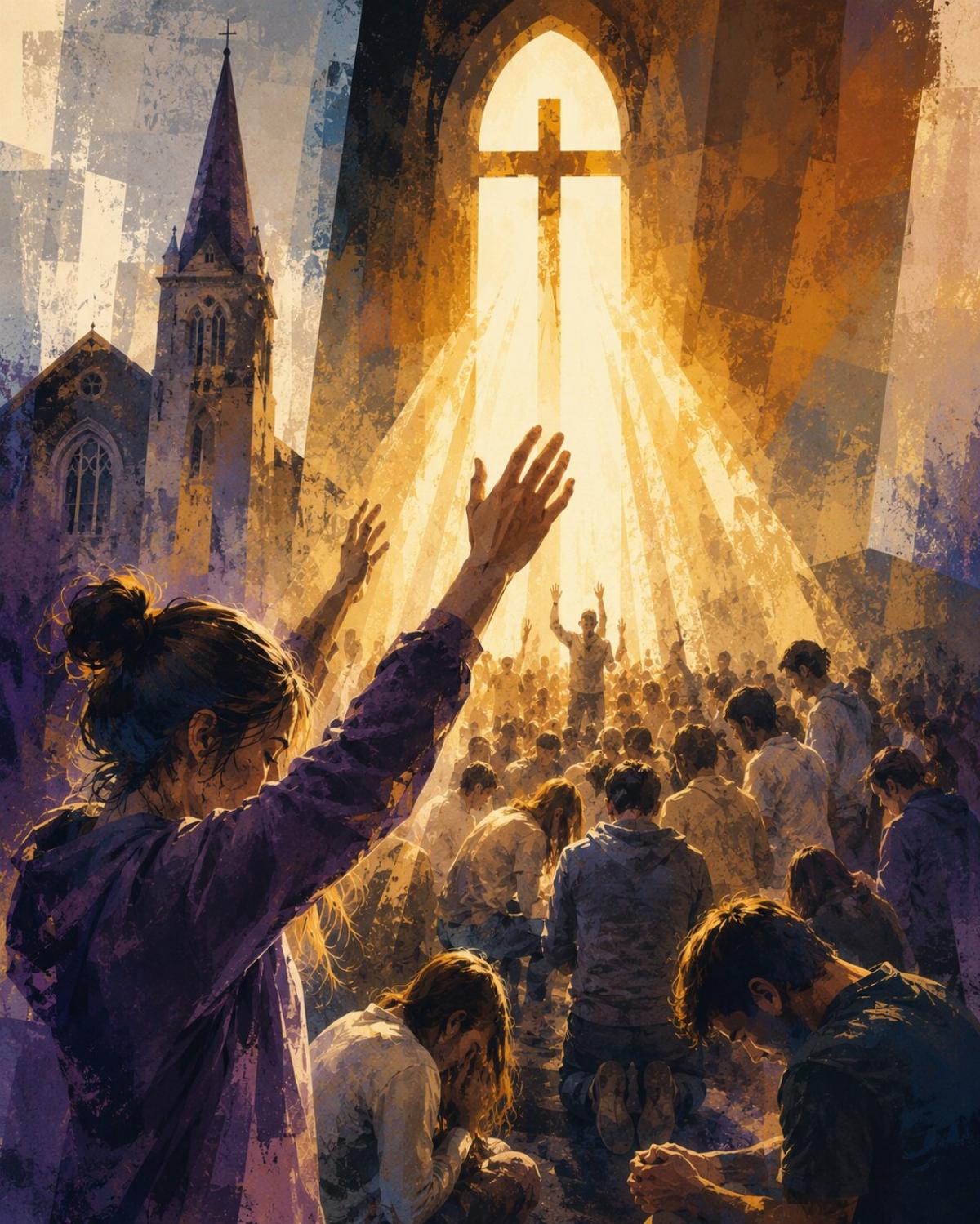
Having grown up in a Catholic family, evangelical revivals have always struck me as emotionally overwrought and lacking in substance. When people sway their bodies and/or fall to the floor in so-called “Spirit” motivated swoons, my initial response is to think of a Benedictine monastery where the spiritual manifestations are mostly interior, thanks to the powerful incantations of Gregorian chant.
Read more Mamdani Mocked The Jews’ Solemn Tisha B’Av Observation
When the evangelical Jesus Movement hit Protestantism in 1970, it was a given that it would soon seep into Catholic territory. The effect of this overlap did much to inspire what was then referred to as the Catholic Charismatic Renewal, best represented by the National Cursillo Movement, which has been capitalizing on ecumenism and “extraverted” outpourings of the Spirit since the mid-1960s. In the 1970s, examples of this new “rapture” form of worship could be spotted in many Catholic churches: parishioners lifting up their hands in the manner of Southern Baptists as they recited the Our Father, or racing around the church in revival-like swirls at the “Kiss of Peace” during Mass.
But, as Rod Dreher noted in The American Conservative, “Kumbaya” worship is “definitely not my worship style, but the Holy Spirit surely doesn’t need my permission to show up and change hearts.”
Still, Catholics (at Mass) acting like evangelical Protestants seemed like some sort of heresy to me. This behavior was certainly anti-liturgical. As Catholics, we were taught to revere the Holy Spirit—or the Holy Ghost in pre-Vatican II terminology—and not scatter that mystical mystery around like parade confetti. By that I mean the mechanized and sometimes careless way in which millions of Christians invoke the Holy Spirit, in some cases dropping the word “Holy” so that the “Spirit” part seems to be on a par with New Age crystal seers who never define what “Spirit” they are invoking.
Fast forward to Asbury University, a small Christian college of 1,600 students in Wilmore, Kentucky, where on February 8, 2023, the required chapel service for students did not end. As one Asbury student noted, “Revival isn’t hype. It’s just ordinary people who are hungry. This is going to spread.” Prophecy fulfilled!
By Presidents’ Day weekend, ten- to twenty-thousand people had flocked to Wilmore to witness the 24/7 worship services. People flew in from all parts of the world to participate or see what was going on. Finally, the crowd surge became too much for this little Kentucky town. University officials had to call it quits and announced that the last on campus “outpouring” would be February 24, after which, according to the Asbury live stream website, “No further public Outpouring services will be held on Asbury’s campus.”
The services were then moved to an off-campus site where they still attract a fair share of attention. The revival has spread to other campuses throughout the nation.
It’s ironic, perhaps, that the last great Asbury campus revival occurred on February 3, 1970, when, according to Ministry Watch, “2,000 witness teams were sent out from Asbury to churches and colleges across the country.” The Jesus Movement aside, 1970 was a watershed year in American cultural life. It was a time when people walked away en masse from organized religion and biblical concepts of God, thanks mainly to the effects of the Sexual Revolution.
Today, we see a decimated cultural landscape where “Nones” (no religion) outnumber churchgoers, and where the biblical concept of God has been reduced to ash in moral relativist crematoriums (“Let’s pray to the universe”).
The leftist media reported on the Asbury events in a relatively neutral manner. On the satirical end of the spectrum, The Babylon Bee summed up the events in Kentucky with the following headline: “Asbury University Revival Started Night Before Huge Group Project Was Due.”
Dreher focused on the revival’s “visceral experience of the Presence of God,” and noted, as have others, that this transcendent event occurred naturally without a celebrity pastor, marketing PR hype or any form of media manipulation.
“Some are calling this a revival,” he wrote, “and I know that in recent years that term has become associated with political activism and Christian nationalism. But let me be clear: no one at Asbury has that agenda.”
The normally left-leaning Atlantic chimed in with its own analysis:
But its appeal is actually its physicality and simplicity. In a time of factionalism, celebrity culture, and performance, what’s happening at Asbury is radically humble. And it gives me great hope for the future of American Christianity….Fox News’s Tucker Carlson was asked not to come to cover the revival, because it has nothing to do with politics or business. No one wants to pervert or disrupt what God is seemingly doing in this community.
Read more The Lockdown Dissidents Vindicated
Curious words, indeed.
A revival, when it is happening, might have nothing to do with politics, but can the same be said once the revival is over and the effects of it work to change hearts and minds because of “what God is seemingly doing?”
A powerful transcendent experience usually leaves its marks on an individual. If “light” has been shed into what once was dark, then one will naturally begin to see life (the culture around them) with new and different eyes. How could they not?
Saint Paul was not the same person after his personal transformation on the road to Damascus.
How could a pro-choice student who had a “Jesus experience” at Asbury not change his views to pro-life? How could a student bathed in “the light of the Lord” at Asbury support the trans agenda, be brainwashed into the artificial world of non-binary pronouns, or continue to subscribe to the Marxist taint inherent in most left progressive ideas?
The political consequences of the Asbury Revival will still be felt for years to come.
Dreher paraphrases Anglican theologian J. Brandon Meeks:
Revival will have done its job if it sends its participants back into the everyday world of Christian life and practice with a new awareness that what we do there has everlasting meaning — and it changes how we live. The revival is not the point; it is only valuable insofar as it leads to repentance.
“It changes how we live” is key here. No matter what you may think about the legitimacy or illegitimacy of the Great Revival at Asbury, the long-term effects of it are bound to fall outside the woke bosom of the Democrat party.
This doesn’t mean that those “repentant” students are now going to plan a crusade to storm the Capitol building, as MSNBC would have you believe. But it’s almost certain that most won’t opt to stay in a political party that actively works against their “Holy Spirit” experiences.
The Survey Center on American Life recently noted that in the last 20 years “the surge in nonreligious Democrats stands out.”
Additionally:
- Democrat religious membership has fallen further than among Republicans, more than doubling the partisan gap in religious membership.
- Fewer than half of Democrats report being a member of a church.
- In 1998, two-thirds of Democrats agreed that religion was important to them but two decades later only 43 percent of Democrats held that view.
In contrast, here’s this, from Gallup:
Gallup’s latest data, from 2024-2025, show 42% of young men saying religion is very important to them, up sharply from 28% in 2022-2023.
[snip]
The finding that Republicans have driven heightened religious attendance among young men — and that a similar increase has occurred among young Republican women — suggests political dynamics may be playing a role in religious changes among the nation’s young adults.
Read more The Left Is Using Kids As A Trojan Horse For Total Online Surveillance
“Revival or ruin,” as one Asbury student exclaimed.
Image generated by ChatGPT.