
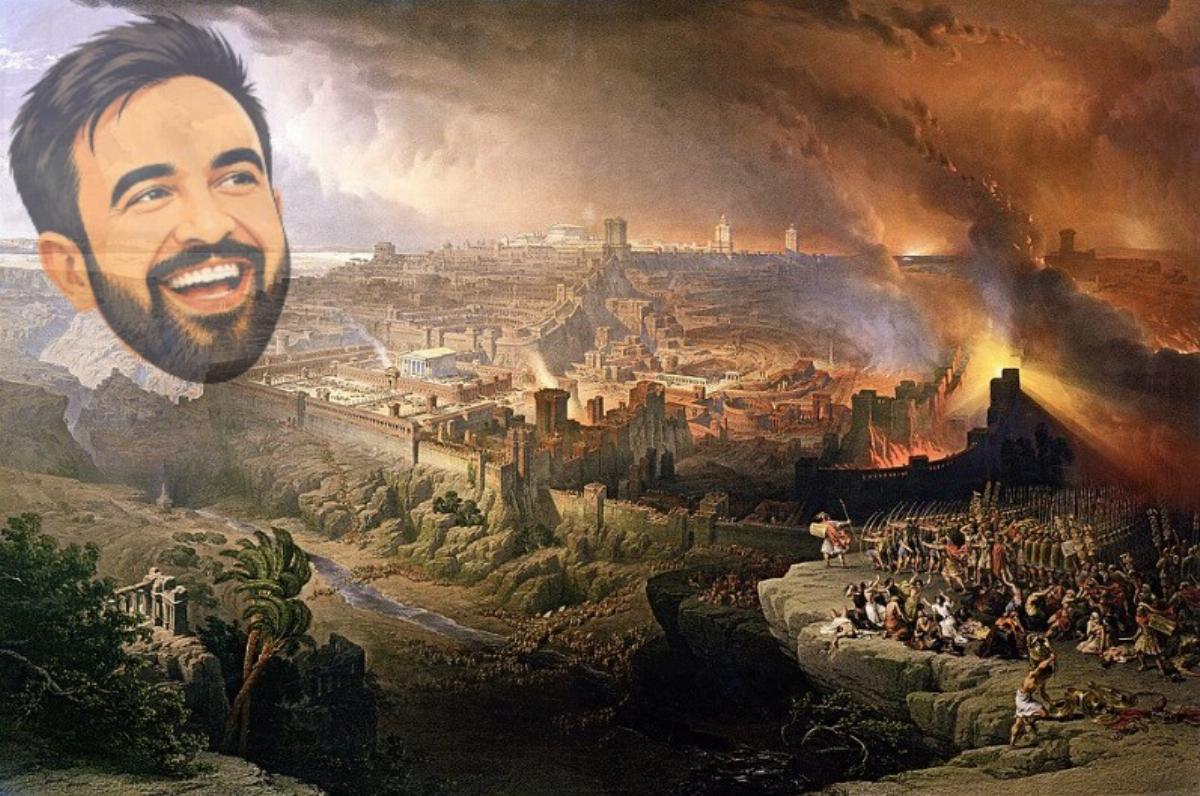
On July 22, 2026, Mayor Zohran Mamdani posted the following tweet:
Wishing a peaceful Tisha B’Av to Jewish New Yorkers across the five boroughs.
From sundown tonight until tomorrow, mourners will pause and reflect on the history and resiliency of the Jewish people.
May all observing have a safe and meaningful fast.Read more The Lockdown Dissidents Vindicated
— Mayor Zohran Kwame Mamdani (@NYCMayor) July 22, 2026
Hours earlier, the same account belonging to this no-account released a video branding Benjamin Netanyahu a “war criminal” and “the architect of a horrific genocide,” urging federal authorities to execute an ICC arrest warrant while conceding New York City lacked independent power to do so.
Benjamin Netanyahu is a war criminal. pic.twitter.com/YRezmW6YVx
— Mayor Zohran Kwame Mamdani (@NYCMayor) July 22, 2026
The sequence is revealing. Condemnation first; ceremonial greeting second.
Tisha B’Av is not a generic day of Jewish resilience. It mourns the Babylonian destruction of the First Temple in 586 BCE and the Roman destruction of the Second Temple in 70 CE, the loss of Jewish sovereignty in the Land of Israel, and the ensuing exiles. The fast exists because a Jewish nation governed Jerusalem, built its central sanctuary there under Jewish political authority, and lost both through conquest.
Solomon’s First Temple was built in the 10th century BCE within the United Monarchy of Israel. The Second Temple was rebuilt when Jews returned to the land after the Babylonian exile and was later expanded it under Herodian rule.
Both constructions presuppose organized Jewish political control, independent governance, and national existence in the land millennia before Muhammad. This is not modern Zionist invention; it is the historical premise of the holiday itself. By publicly recognizing Tisha B’Av, Mamdani necessarily acknowledged Jewish sovereignty in Jerusalem—the very principle his record repeatedly undermines.
Mamdani is a practicing Shia Muslim who took the mayoral oath on Qurans. His political pattern is consistent: he has treated Israel’s existence as a Jewish state as illegitimate, refused to condemn “Globalize the Intifada,” became the first New York mayor in six decades to skip the Israel Day Parade, and revoked the city’s adoption of the IHRA working definition of antisemitism on day one.
His greeting carefully omits Jerusalem, the Temples, exile, and sovereignty, reducing the day to vague “history and resiliency.” That flattening allows the speaker to claim moral credit while rejecting the logical implications of what is being remembered.
The broader context is not something Mamdani’s critics invented. Islamic scripture contains repeated polemics against Jews (Quran 2:61, 5:64, 5:82, 9:30).
Classical tafsirs often generalized these characterizations. The hadith literature includes the Gharqad-tree tradition (Sahih Muslim 2922) describing a final battle in which Muslims kill Jews. In modern practice, “Khaybar, Khaybar, ya Yahud—the army of Muhammad will return” has become a standard chant at anti-Jewish/Israel rallies.
Khaybar was the 628 CE oasis north of Medina where Muhammad’s forces besieged, defeated, and subjugated the Jewish tribes. Many were killed, others expelled or reduced to tribute-paying status. The chant celebrates that military victory over Jews and functions as a threat of recurrence.
When a Muslim mayor issues a bland Tisha B’Av greeting the day after calling the elected leader of the Jewish state a war criminal and architect of genocide, the message lands less as comfort than as a slap across the face—a performative reminder (warning?) of historical destruction of Jewish communities and sovereignty, delivered under the cover of civic courtesy.
Mamdani’s wife, Rama Duwaji, a Syrian-American illustrator, has liked and engaged with posts framing the October 7, 2023, Hamas massacres as resistance to “apartheid,” questioning reports of sexual violence as a “mass rape hoax,” and earlier celebrating figures linked to the Popular Front for the Liberation of Palestine while posting “Fuck Tel Aviv.” When the spouse of the mayor of the city with the world’s largest Jewish population outside Israel engages content that softens or celebrates the largest single-day slaughter of Jews since the Holocaust, it reinforces the atmosphere in which the holiday greeting is received—and sent.
Throughout history, Jews have frequently been accepted as victims while resisted as sovereigns. Sympathy may attach to Jewish suffering, but opposition does arise when Jews exercise political agency or defend national existence.
Tisha B’Av repudiates that double standard. The liturgy repeatedly invokes Zion, Jerusalem, restoration, and return. For more than two and a half millennia, Jewish religious tradition has preserved the hope of restoration to Zion.
Following the destruction of the Second Temple in 70 C.E., that hope became a permanent and central feature of Jewish liturgy. Modern Zionism did not invent that aspiration; it translated an ancient religious and national hope into political reality. To commemorate the loss while condemning the restoration is therefore historically inconsistent.
Read more The Left Is Using Kids As A Trojan Horse For Total Online Surveillance
Mamdani’s greeting illustrates the inconsistency. It acknowledges a history that begins with Jewish nationhood in Jerusalem yet pairs that acknowledgment with a political posture that treats the partial end of exile as the greater offense—and, through timing and context, evokes the older Muslim victory at Khaybar as the model for dealing with Jewish power.
One cannot meaningfully commemorate the destruction of Jewish sovereignty while denying the legitimacy of its restoration. The two propositions are inseparable. If the loss deserves remembrance, the existence of what was lost cannot honestly be denied.
New York’s Jewish community does not require lectures on resiliency from a mayor whose allies and personal circle treat Jewish national restoration as original sin. Genuine solidarity is measured by consistent defense of Jewish security, acknowledgment of Jewish peoplehood, and recognition that the right of national self-determination belongs to the Jewish people no less than to any other nation. On that standard, carefully crafted holiday messages are no substitute for a coherent public record. Its “sincerity” is taqiyya (Islam’s sacralized lying). The contradiction—and the slap—at the heart of Mamdani’s greeting remains.
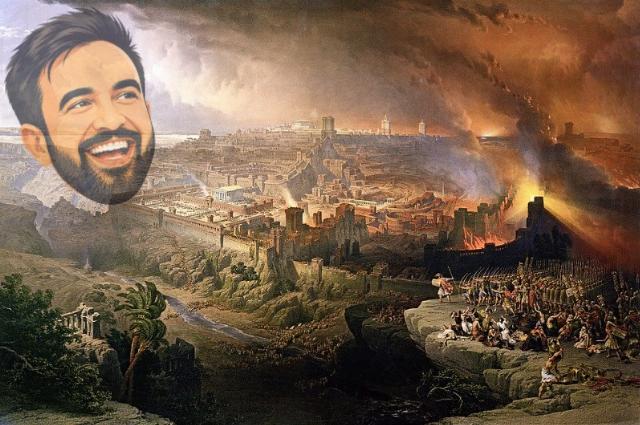
The Roman Destruction of Jerusalem by David Roberts (edited). Public domain.
References
1. Mayor Zohran Kwame Mamdani, X post, July 22, 2026 (Tisha B’Av greeting text).
2. Associated Press, December 31, 2025 (Mamdani’s mayoral oath on Qurans); NY1/Spectrum News, February 2, 2026 (identification of Mamdani as New York City’s first Shia Muslim mayor).
3. Associated Press / Reuters / Washington Post coverage, July 22, 2026 (Netanyahu “war criminal” and “architect of a horrific genocide” statements; ICC warrant remarks and acknowledgment that New York City lacks authority to execute the warrant).
4. City of New York Executive Order No. 1, January 1, 2026; Times of Israel, January 2, 2026 (revocation of New York City’s adoption of the IHRA Working Definition of Antisemitism).
5. Associated Press / Jerusalem Post, May–June 2026 (absence from the Israel Day Parade and departure from longstanding mayoral practice).
6. The Free Press, March 7, 2026; Associated Press, April 16, 2026 (Rama Duwaji’s social-media activity regarding October 7, 2023, and earlier posts).
7. The Holy Bible: 1 Kings 5–8; 2 Kings 25; Ezra 1–6; Psalm 137; Lamentations (construction, destruction, exile, and restoration of the First and Second Temples under Jewish rule).
8. Shaye J. D. Cohen, From the Maccabees to the Mishnah, 3rd ed. (Louisville: Westminster John Knox Press, 2014); Lester L. Grabbe, Ancient Israel: What Do We Know and How Do We Know It?, rev. ed. (London: T&T Clark, 2017); Lee I. Levine, Jerusalem: Portrait of the City in the Second Temple Period (538 B.C.E.–70 C.E.) (Philadelphia: Jewish Publication Society, 2002); Ismar Elbogen, Jewish Liturgy: A Comprehensive History, trans. Raymond P. Scheindlin (Philadelphia: Jewish Publication Society, 1993).
9. The Qur’an, trans. M. A. S. Abdel Haleem (Oxford: Oxford University Press, 2004), 2:61, 5:64, 5:82, 9:30; Sahih Muslim 2922 (Gharqad-tree tradition).
10.Anti-Defamation League, backgrounder on the “Khaybar, Khaybar, ya Yahud” chant (historical significance of the Battle of Khaybar and the chant’s modern use as an anti-Jewish threat).
11.David Nirenberg, Anti-Judaism: The Western Tradition (New York: W. W. Norton & Company, 2013).
Read more Maine Democrats may have nominated someone as unelectable as Platner