

As America prepares to celebrate its 250th birthday, a new poll reveals something that would have been almost unthinkable just a generation ago.
According to an Elon University , roughly two-thirds of Americans say they would rather live in the United States than any other country.
That’s reassuring.
What isn’t reassuring is that among Democrats, 55 percent would prefer to live somewhere else. Only 10 percent of Republicans feel the same way.
Think about that for a moment.
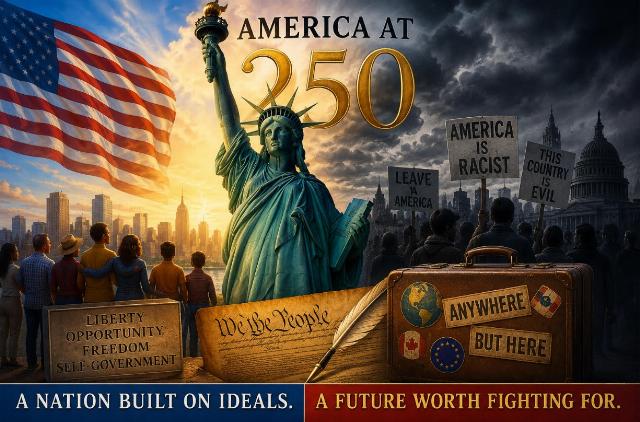
Image created by ChatGPT
A majority of Democrats would rather live in another country than the one that has produced more freedom, prosperity, innovation, and opportunity than any nation in human history.
The poll raises an uncomfortable question: Is American exceptionalism dying?
For most of our history, patriotism was not a partisan issue. Americans disagreed about taxes, wars, immigration, religion, and countless other issues. Yet most shared a common belief that America was a special place.
Not perfect. Not flawless.
Special.
Millions crossed oceans to get here. Others risked prison or death escaping communist regimes to reach American shores. Few people spent their lives plotting elaborate escapes from the United States. They escaped to America.
Today, however, many Americans have been taught a very different story.
Instead of viewing America as history’s greatest success story, they are taught to see it primarily as a catalog of sins: slavery, racism, colonialism, inequality, privilege, oppression, and climate destruction.
America’s greatest moral failing — slavery — was ultimately confronted through a bloody civil war that cost more than 600,000 lives. Few nations have shed so much blood correcting their own mistakes.
Every nation has flaws. America certainly does. But only in modern America have entire educational and cultural institutions dedicated themselves to convincing citizens that their country is uniquely bad.
The result should surprise no one.
People who are taught to hate their country’s history eventually begin to hate the country itself.
The Elon poll found Americans proud of their nation but increasingly pessimistic about its future. In a similar vein, Rasmussen Reports found that only about one-third of likely voters believe the country is heading in the right direction.
The reasons vary by political affiliation.
Many Democrats are convinced America remains systemically unjust. They see racism around every corner, economic inequality as proof of oppression, and climate change as an existential threat. Increasingly, many look favorably on socialism, an ideology that has repeatedly failed everywhere it has been tried.
Republicans have a different set of concerns.
Many believe government institutions have become corrupt, weaponized, and largely unaccountable. They watched years of Russia collusion hoaxes, selective prosecutions, censorship efforts, and lawfare directed against political opponents. They see a federal bureaucracy that often appears more interested in preserving its own power than serving the public.
Many Trump supporters worry that the system is so deeply entrenched that even electoral victories may not be enough to reform it.
Different diagnoses. Same symptom.
A growing loss of confidence.
But there is an important distinction between believing America is headed down the wrong track and believing America itself is the problem.
The former is patriotism.
The latter is something else entirely.
Patriots criticize their country because they want to improve it. They recognize flaws while remaining grateful for the blessings they enjoy. In relationships, that’s called constructive criticism.
Those who view America primarily as an oppressive force often move beyond criticism into contempt.
Read more The nearly nonexistent scourge of Glock switches
There is a profound difference between saying America did bad things and saying America is fundamentally bad. The former is history. The latter is ideology.
For decades, Americans have watched celebrities threaten to leave the country whenever voters elect a Republican president.
When George W. Bush won, they were leaving.
When Donald Trump won, they were leaving.
Many never packed a suitcase, like Barbra Streisand and Cher.
Others left briefly before quietly returning, as Ellen DeGeneres did.
The irony is difficult to miss. These are often individuals who accumulated extraordinary wealth and fame under the American system. Free speech allowed them to express themselves. Free markets allowed them to become rich. American audiences made them stars.
Yet many seem eager to condemn the very country that enabled their success.
The broader problem extends far beyond Hollywood.
A nation cannot survive if it loses confidence in itself.
Nature abhors a vacuum.
When pride in one’s nation disappears, something else inevitably fills the void. History offers plenty of examples.
People still need meaning. They still need identity. They still need something larger than themselves.
If they no longer find that in family, faith, community, and country, they often find it in ideology.
That helps explain the rise of identity politics, victimhood culture, and increasingly radical political movements. These movements often function less like political philosophies and more like substitute religions, complete with doctrines, heresies, and rituals of public confession.
A society that stops teaching gratitude eventually teaches grievance.
A society that stops celebrating achievement eventually focuses on resentment.
A society that loses confidence in its culture becomes vulnerable to every fashionable idea that comes along.
There is an old saying: “When there comes here, here becomes there.”
America was never defined by race, ethnicity, or ancestry. Instead, it welcomed newcomers. It was defined by a shared set of ideals. The genius of the American experiment was assimilation.
People arrived from every corner of the globe and became Americans.
Not hyphenated interest groups competing for power.
Americans.
They embraced a common civic culture rooted in liberty, constitutional government, personal responsibility, and equal opportunity.
That shared identity helped transform a diverse population into a unified nation.
The encouraging news is that most Americans still choose America.
Despite relentless negativity from academia, Hollywood, much of the media, and many political leaders, two-thirds of Americans would still rather live here than anywhere else.
America’s 250th birthday should be more than a celebration of the past. It should be a reminder of what made this nation exceptional in the first place.
Countries do not remain great by accident. They remain great because each generation chooses to preserve the principles that created their success.
A nation that loses faith in itself risks losing far more than an election. It risks losing the very civilization that made it exceptional in the first place.
Brian C. Joondeph, M.D., is a Colorado-based ophthalmologist who writes frequently about medicine, science, and public policy.
Follow Brian:
Twitter @retinaldoctor
Substack Dr. Brian’s Substack
Truth Social @BrianJoondeph
LinkedIn @Brian Joondeph
Email [email protected]