
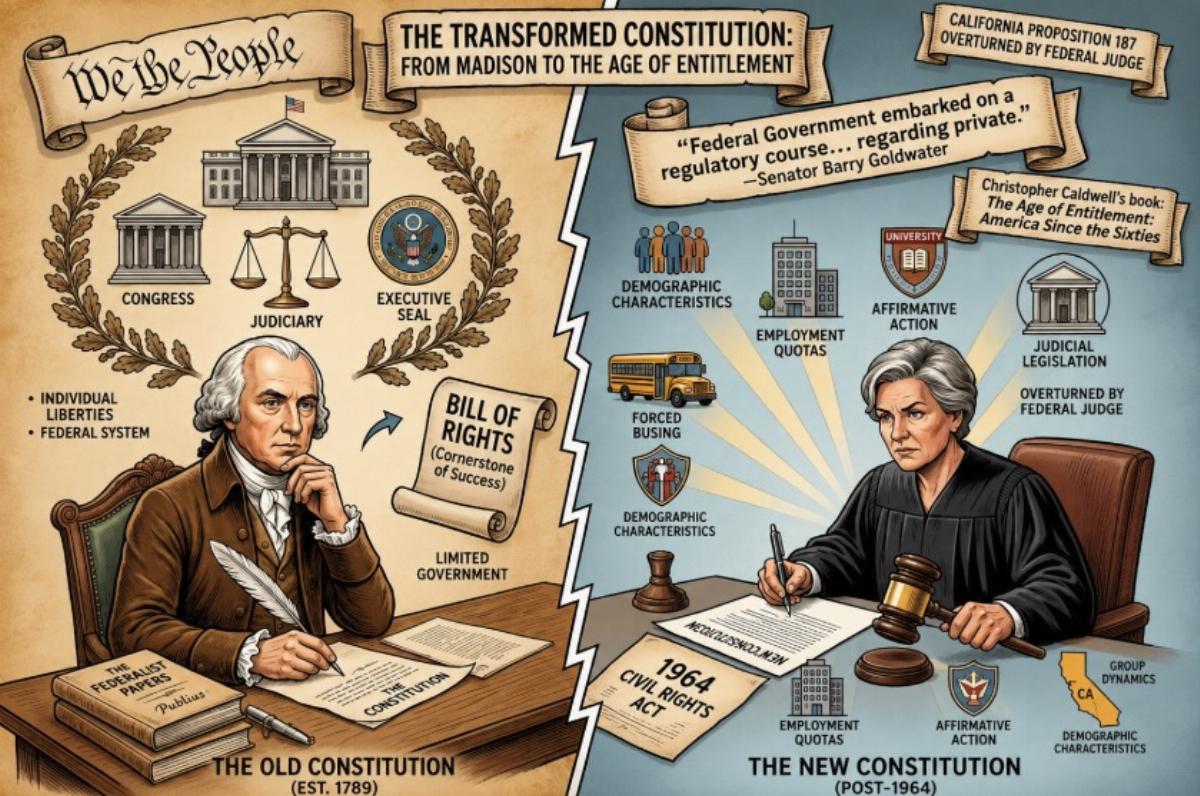
James Madison, the Father of the Constitution, was the driving force behind transforming what started out as a water navigation dispute between Maryland and Virginia into the Constitutional Convention, which then produced our Constitution. Madison was not only one of the primary influences during the Convention itself but also, writing as Publius (along with Alexander Hamilton and John Jay) in the Federalist Papers, he advocated for its ratification.
Read more There Is No Good Case Against Punishing Government Program Fraud
His Constitution, with its staggered terms, federal system, three branches of government and more, was written specifically to tamp down and limit the power of both mobs and government. He was, by any stretch, a brilliant man, a student of history and a man of extraordinary vision.
All that being said, there was one place where Madison was, rather astonishingly, blind: A Bill of Rights. He thought one was unnecessary because 1) nothing in the Constitution gave government the power to oppress citizens and 2) explicitly stating some rights had the potential to be seen as a limitation on those citizens’ rights that weren’t explicitly stated. For a man so aware of the nature of man, his initial position was curious.
Eventually Madison came around, and history has proven that the Bill of Rights, which has been the cornerstone of American success for most of her history, was indeed necessary.
But it was not sufficient.
It was part of the Old Constitution.
Today we’re living under a New Constitution where what’s written is archaic. Christopher Caldwell, in his extraordinary book The Age of Entitlement: America Since the Sixties, lays out what he calls the New Constitution, one which is utterly detached from the Old Constitution.
Caldwell argues that while the Old Constitution was based on individual liberties and freedoms from government intervention, the New Constitution is just the opposite, one characterized by group dynamics, demographic characteristics, and a demand that the government must remediate all perceived inequities.
The New Constitution went into effect on July 2, 1964, when LBJ signed the 1964 Civil Rights Act (“CRA”).
Senator Barry Goldwater voted against the bill, stating
The two portions of this bill to which I have constantly and consistently voiced objections, and which are of such overriding significance that they are determinative of my vote on the entire measure, are those which would embark the Federal Government on a regulatory course of action with regard to private enterprise in the area of so-called ‘public accommodations’ and in the area of employment—to be more specific, Titles II and VII of the bill.
So loud was the worry that those two Titles would give the government too much power that one of the bill’s primary drivers, Senator Hubert Humphry, felt compelled to state:
Contrary to the allegations of some opponents of this title, there is nothing in it that will give any power to the Commission or to any court to require hiring, firing, or promotion of employees in order to meet a racial ‘quota’ or to achieve a certain racial balance. That bugaboo has been brought up a dozen times; but it is nonexistent. In fact, the very opposite is true. Title VII prohibits discrimination. In effect, it says that race, religion and national origin are not to be used as the basis for hiring and firing.
As we all know, that was 100% wrong. In fact, as Caldwell points out, the Civil Rights Act of 1964 opened the door for fundamentally changing virtually every aspect of American life.
From public accommodations to employment to housing to banking to college acceptance to healthcare, immigration enforcement, and more. Every single aspect of American life was now under de facto government control.
Read more Straight As, Empty Minds
But it was not just government regulations that brought us this brave new world. Rather, out of fear of being sued under various aspects of the CRA, companies, schools, police forces, unions, and practically every organization in America adopted similar practices in an often futile effort to demonstrate their anti-discriminatory bona fides.
And of course, even though the law came about specifically as an effort to eliminate Jim Crow laws targeting blacks in the South, in reality it opened up a Pandora’s box of “remedies” that “protected” almost every group in America except white heterosexual male Christians. Whether it was women in combat or bakers making cakes for gay marriages or dudes playing in girls’ sports, the courts—empowered by the CRA of 1964—became the venue of choice for changing the face of American life.
Over the 60 years following the passage of the CRA, the New Constitution would take hold, giving us the most consequential change in American governance since the ratification of the Constitution: An army of federal judges (and justices) who began to see themselves, not just as jurists, but as legislators. Suddenly, things that could never get passed by Congress became the law of the land, things such as affirmative action, forced school busing, abortion, the Defense of Marriage Act, and gay Marriage.
And we cannot forget one of the most cancerous ideas ever to make it onto the American political stage, namely “Disparate Impact,” the insane idea that if a group is underrepresented in any targeted organization, that is effective to create a presumption of discrimination.
At the same time, things that legally passed by referendum were thrown out, such as California’s Proposition 187 in 1994. Having passed by 59% to 41%, it denied state-funded non-emergency social services, public healthcare, and public education to illegal immigrants. A federal judge struck it down, saying that it intersected with federal immigration authority.
The ultimate demonstration of the reality of the Democrat-driven New Constitution came when Trump was first elected in 2016. Federal injunctions were virtually nonexistent in American history and grew only slightly after 1964. Even during the Reagan years in the White House, they were rare, largely because, faced with an overwhelmingly Democrat-controlled House, Reagan ultimately left most Democrat priorities in place.
All that comity changed in 2017 when Donald Trump was inaugurated. Pushing back against the woke leftist bureaucracy and seeking to control the border, Trump ran into a buzzsaw of judicial activism. Why? Because for the first time in the history of the New Constitution, the one that no American voted for, someone was challenging it and its activists in black robes didn’t like it.
Fundamentally, this New Constitution is a way to achieve objectives without ever having to convince a majority of your fellow citizens to vote for them. The foundation of law is no longer based on the words of a 240-year-old document, but rather on the coordinated machinations of community organizers, slimy lawyers, an endless array of professional victims and power-hungry jurists who legislate from the bench. It’s a tyranny of a tiny, mostly Ivy League-educated leftist cabal, the intellectual progeny of the radicals who took over universities in the 1960s.
For many Americans, the ideas that undergird the Old Constitution, such as individual freedom, free speech, limited government and private property, no longer hold sway. They prefer the New Constitution, where the government’s purpose is to redress any perceived inequity, redistribute away any inequality and ensure no minority’s (writ large) feelings are hurt by mean words.
America prospered because Madison gave us the Old Constitution, specifically written to rein in the worst excesses of human nature. The New Constitution eviscerated that and empowered those worst excesses. That is a recipe for disaster. No nation has ever succeeded under such rules. It always ends in bloodshed and tyranny.
Read more Trump is Right: Americans Should Embrace AI Data Centers
Image created by Vince Coyner, using AI.
Follow Vince on X at @ImperfectUSA.