
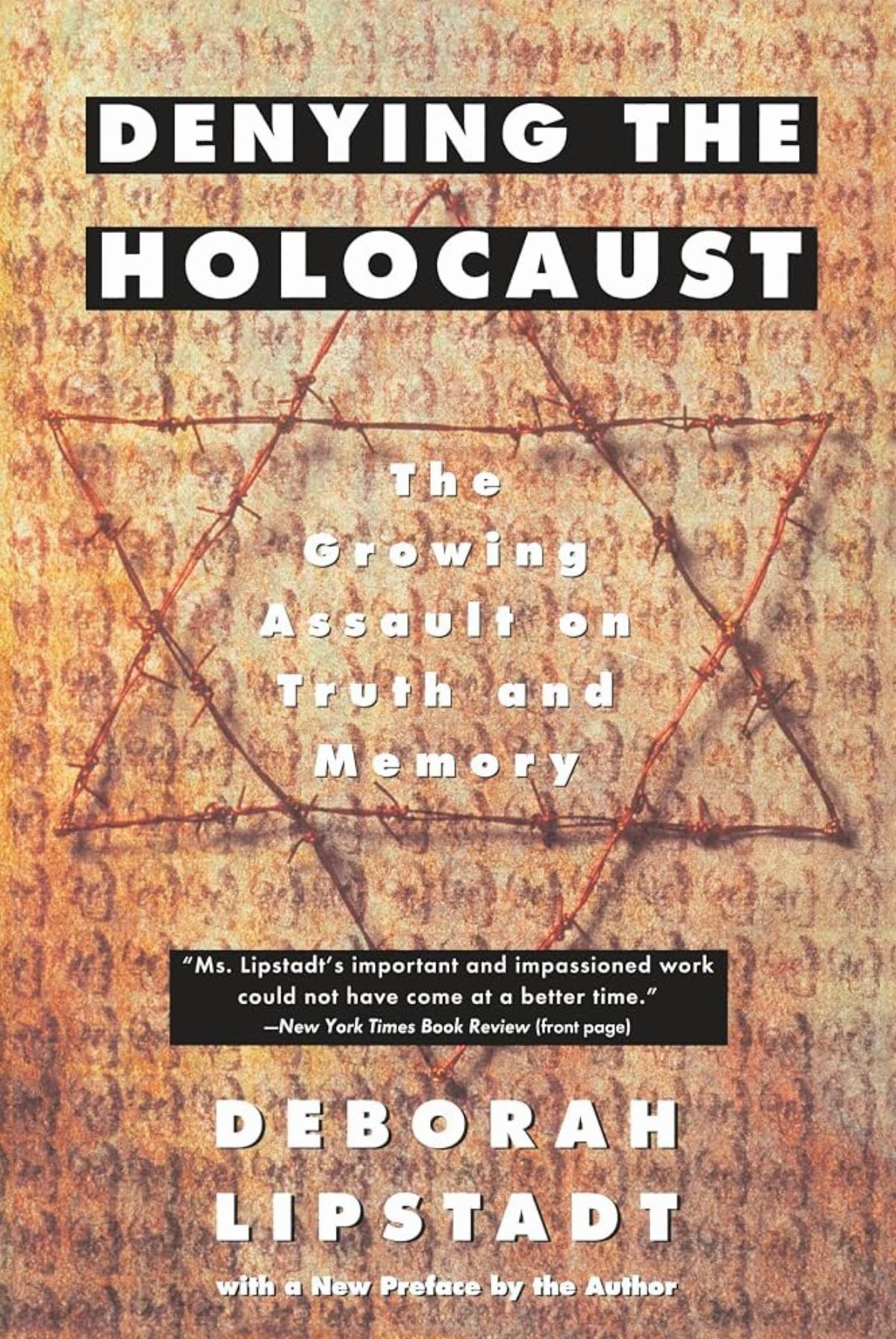
Over 30 years ago, historian and social critic Deborah Lipstadt wrote a powerful book, Denying the Holocaust, warning the public about the dangers of this pernicious ideology. This year, I was drawn to this book because debates are raging again, this time amplifying across social media, about the truth of World War II, what happened in the death camps, and how we sift out the truth from the lies.
Read more The Laffer Curve More Relevant Today Than Ever
I wasn’t expecting to agree with her on everything. She’s an unabashed liberal, progressive, even. Her ideological bent was crystal clear when President Joe Biden nominated her as U.S. Special Envoy to Monitor and Combat Anti-Semitism in 2022, for which she received unanimous confirmation. During her confirmation hearing, Republican members confronted her over a number of incendiary, inflammatory, even libelous statements that she had published about them as well as then former president Donald Trump. One of her targets, Wisconsin U.S. Senator Ron Johnson, confronted her about her nasty remarks directed at him over the January 6th incident. She didn’t look very good trying to defend the indefensible, and she eventually apologized. She ultimately got the job because Democrats controlled the Senate at the time, and no one wanted to appear opposing the fight against antisemitism, no matter the appointment.
Despite her current left-wing bent, Lipstadt is a fierce defender of freedom of speech. During an Oxford Union speech in 2016, she declared that Holocaust deniers should have the freedom of speech, including the right to lie about history. However, historians must have the right to call them out for their dishonesty, too.
Even though Lipstadt wrote the book three decades ago, her research into the Denialist industry and the tactics used by the Deniers come off as very current. Indeed, underneath the surface of seeming scholarship and respectability, one finds a morass of bitterness and bigotry against a group of people. Their relentless determination to blame Jews for all the ills of the world comes out page after page among Holocaust deniers, even if they have Ph.Ds. and claim that their works are exhaustive research.
Before talking about specific deniers—institutions and individuals—Lipstadt announces in her first chapter that she refuses to debate Holocaust deniers. They are repugnant not merely for holding noxious views, but for their deliberate refusal to recognize the copious archives, research, and data affirming the horrific systemic slaughter of six million Jews under Hitler’s Third Reich. In her view, a debate with a denier is to legitimize their views as serious scholarship or opinion.
Throughout her book, I reflected on that notion, and I found that it does have some merit. You don’t debate people who have no serious regard for truth, evidence, integrity, or process. Why give them a platform? Then again, the survivors, the historians, the archivists all have a responsibility to debunk the lies and keep telling the truth.
Throughout the book, her political bent was crystal clear, which is the only defect. She spent a great deal of time attacking right-wing interests and organizations for promoting Holocaust denial. She criticized patriot groups, liberty groups, and even the John Birch Society in the same sentence as discredited Holocaust denial organizations. I know many John Birchers, and they are not hostile to Israel, nor do they traffic in Holocaust denial.
I wonder how Lipstadt is responding to the growing antisemitism on the left? From the Democrat party’s growing demonization of Israel, to the repeated attack against Jews as “privileged members of the intersectionality hierarchy,” including the recent decision by civil rights attorney Alan Dershowitz to leave the Democrat party over its overt antisemitism, the Left has transformed into the repository of Holocaust minimalism and outright denialism.
Read more What is a Think Tank?
Of course, there’s one other problem fundamental to her work. She treats Nazis and national socialists as right wing. Reviewing the Nazis’ politics, it’s clear that they were a left-wing ideology, complete with the nationalization of industries, universal health care schemes, gun control, massive government spending, and an abusive expansion of the state to undermine individual liberties. In this regard, sadly, Deborah Lipstadt engages in a little revisionism of her own. Yet her bias does not negate the dangers of Holocaust denial and the necessary responses to combat it.
Putting aside the criticisms, Deborah Lipstadt’s book was very informative. I learned about the incredible work of Mel Mermelstein, a Holocaust survivor who lived through Auschwitz, immigrated to the United States, settled in Long Beach, California, and then took on the challenge from the notorious Holocaust denier pseudo-historical journal, the Institute for Historical Review. The specific account is fascinating: the IHR offered $50,000 to any Holocaust survivor who could prove that Jews died in gas chambers. Mermelstein took the challenge, even though many Jewish groups had discouraged him. Not only did he win the contest, but he took IHR to court and forced them to pay a larger award for pain and suffering! Leonard Nimoy starred in a TV movie retelling the story.
Lipstadt goes to great lengths to document not just the truth of the Holocaust, but the extensive research behind it, and she even goes into length how Holocaust deniers exploit and distort the evidence to push their destructive, false narrative. She calls out specific pamphleteers, and how all too often they merely reference each other to create this cloud of credibility around their work.
She pays considerable attention and elucidates true historical revisionism. When it comes to interpreting the facts of history, revision is not only essential, it’s endemic. Historians are always piecing together the evidence before them, seeking patterns and searching out causes and effects. What revisionism cannot do, Lipstadt affirms, is change the facts, ignore the truth, or lie about the evidence itself. Holocaust deniers routinely engage in those vile practices.
Also to her credit, she spends an entire chapter castigating college newspapers around the country who printed advertisements from Holocaust deniers. Many of the newspapers, their editing boards, and the administrators at the respective campuses engaged in an extensive, rigorous debate about whether freedom of speech should require the newspapers to print the ads. This section of her book was particularly intriguing, because she did a thorough job of exploring the different points of view, even though she was critical of many of them.
She maintained that no newspaper should have posted the advertisements. Since in her view, such publication would lend credence and legitimacy to Holocaust denial views. Furthermore, some of the advertisers gave the impression that the deniers were offering only a difference of opinion. No—they were categorically lying, like claiming that 2 + 2 = 5 or that George Washington never existed. That is not a matter of opinion or interpretation, Lipstadt affirms. Furthermore, private newspapers have the right and responsibility not to print lies, nor are they bound by the First Amendment to print everything submitted to them.
After reading Denying the Holocaust, I appreciated Lipstadt calling out the cowardice and collusion of the universities and printing houses. Her takes against the Holocaust denial industry are relevant today. We should appreciate her stand for truth, even if her politics is misguided or just plain wrong.
Read more What Really Causes Inflation?
Image: Book cover.