
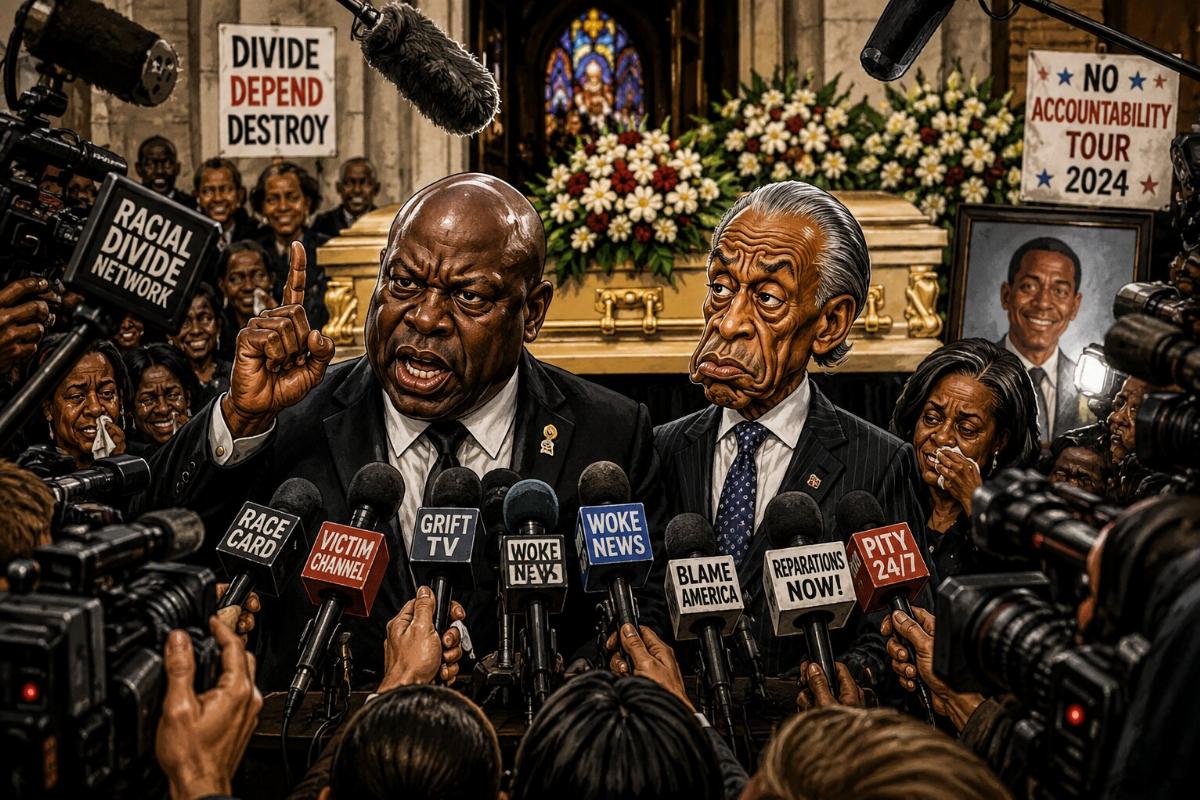
There was a time when civil-rights leadership meant building institutions, organizing communities, confronting unjust laws, registering voters, educating children, and preparing people to stand on their own feet.
Read more Denying the Holocaust: Deborah Lipstadt, Revisited
Today, too much of what passes for civil-rights leadership begins with a dead black body and a press conference.
Before the investigation is complete, before witnesses have been fully interviewed, before the autopsy is finished, and sometimes before the family has even buried its loved one, the familiar cast begins arriving. Cameras appear. Microphones are arranged. Historic references are summoned. Suspicion becomes accusation, accusation becomes a slogan, and the slogan becomes a national fundraising and media event.
Ben Crump and Al Sharpton have perfected this model.
That does not mean every case they touch is fraudulent. It does not mean police misconduct never occurs, racism is imaginary, or grieving families do not deserve aggressive representation. George Floyd’s death happened in front of the world, and though it was his own overdose that took him, the optics weren’t great. Breonna Taylor’s death raised legitimate questions about policing and accountability. The poisoned water in Flint was a genuine institutional disgrace.
But the existence of real injustice does not excuse turning every unexplained tragedy into racial theater before the facts are known.
The recent death of Nolan Wells illustrates the problem. Wells was an 18-year-old black college athlete found dead after a Fourth of July trip to Horn Island, Mississippi, with friends. His family deserves answers. The circumstances deserve a complete, transparent investigation. The people who were with him should be questioned thoroughly, the digital evidence examined, and every inconsistency resolved.
But an independent autopsy did not establish a cause or manner of death. It found no fractures or deep-tissue injuries and listed the findings as undetermined pending further investigation. That should have produced caution.
Instead, the case was quickly elevated into a national civil-rights spectacle. Sharpton delivered the funeral eulogy. Crump held press conferences. Celebrities attached rewards and public statements. Mississippi’s racial history was placed beside an investigation that had not yet established what happened.
Demanding transparency is legitimate. Suggesting a racial storyline before evidence establishes one is something else.
This is how the pipeline works. A tragedy occurs. The facts are incomplete. The emotional temperature is raised before the evidentiary record is built. The public is encouraged to choose sides. Anyone urging patience is treated as indifferent to black suffering. By the time the facts arrive, millions of people are already emotionally invested in a conclusion.
We have seen versions of this before.
In 1987, Tawana Brawley claimed she had been abducted and raped by white men. Sharpton became one of her loudest defenders, turning the allegation into a national racial cause. A grand jury later concluded that the story was fabricated. The accusation collapsed, but Sharpton’s career did not. He moved on, while the people falsely accused had to live with the wreckage.
During the Michael Brown case in Ferguson, “Hands up, don’t shoot” became a national creed. Crump represented Brown’s family, and Sharpton helped transform the shooting into a defining civil-rights moment. Yet the Justice Department later found that the physical evidence and credible witness testimony did not support the claim that Brown had surrendered with his hands raised when he was shot. The slogan survived the evidence because the slogan was more useful than the truth, and that should trouble anyone who claims to care about black progress.
Read more The Laffer Curve More Relevant Today Than Ever
When every questionable encounter is presented as proof of a racial system, black people are trained to interpret uncertainty as persecution. We are taught to see ourselves as permanent targets, forever waiting for a famous lawyer or preacher to arrive and translate our pain into national outrage.
That is not empowerment but dependency with television coverage.
Crump’s role is especially powerful because he operates at the intersection of law, media, and public emotion. He is often introduced as “Black America’s attorney general,” a title that should make independent black thinkers uncomfortable. Black America did not elect an attorney general. We did not authorize one man to decide which deaths represent us, which families become symbols, or which narratives speak for millions of people.
A lawyer’s obligation is to his client. That is proper. But a racial spokesman claims something larger: the authority to frame a private tragedy as a collective indictment of America.
Sharpton plays the ministerial version of the same role. He arrives with the language of Scripture, history, mourning, and movement politics. The funeral becomes a rally, the eulogy becomes an indictment. Grief is placed inside a ready-made national narrative. The pattern creates terrible incentives.
News networks receive dramatic content. Activists receive visibility. Politicians receive talking points. Lawyers gain leverage. Organizations receive donations and relevance. Celebrities receive a cause to endorse. Social media receives another racial war.
The modern grievance industry has become dangerous. It does not need racism to disappear—in fact, quite the opposite. Its relevance depends upon racism remaining the primary explanation for black hardship. Every improvement threatens the business model. Every case that turns out to be more complicated than advertised must be forgotten quickly so the next funeral can restore the narrative.
Black conservatives should say plainly what too many people are afraid to say: not every white person near a black tragedy is a murderer, not every police shooting is an execution, not every unanswered question proves a conspiracy, and not every racial spokesman speaks for us.
We can support grieving families without converting grief into political inventory, and we can investigate misconduct without assuming guilt based on race.
Real black progress will not come from becoming better customers of the outrage industry. It will come from stronger families, safer neighborhoods, better schools, ownership, discipline, mental health, serious local leadership, and institutions that exist before the cameras arrive.
Black America does not need another guardian descending upon us after death. We need the freedom and courage to follow the evidence wherever it leads—even when the truth is less profitable than the story.
Read more What is a Think Tank?
Image generated by ChatGPT.