My previous essay examined the parallels between Communism/Socialism and Twelver Shia violence. But to be clear, violence is the currency of all Islam, full stop. Despite claims to the contrary, almost no one converts to Islam (or becomes Commie/Socialist) absent coercion of one form or another. The Twelvers were highlighted because of the current situation with Iran and the homicidal Blues Brothers rulers itching to get their grubby fingers on the nuclear button.1 2
Read more How the 1964 Civil Rights Act Eviscerated the American Constitution
Another feature of the Mohammunist Manifesto is wealth redistribution, i.e., the predatory taking of property from some and giving it to others.
In the seventh century, an Islamic system of taxation emerged that openly ranked human beings by faith, extracting wealth from the “dhimmi inferior” to sustain the “Muslim superior.” That system was jizya.
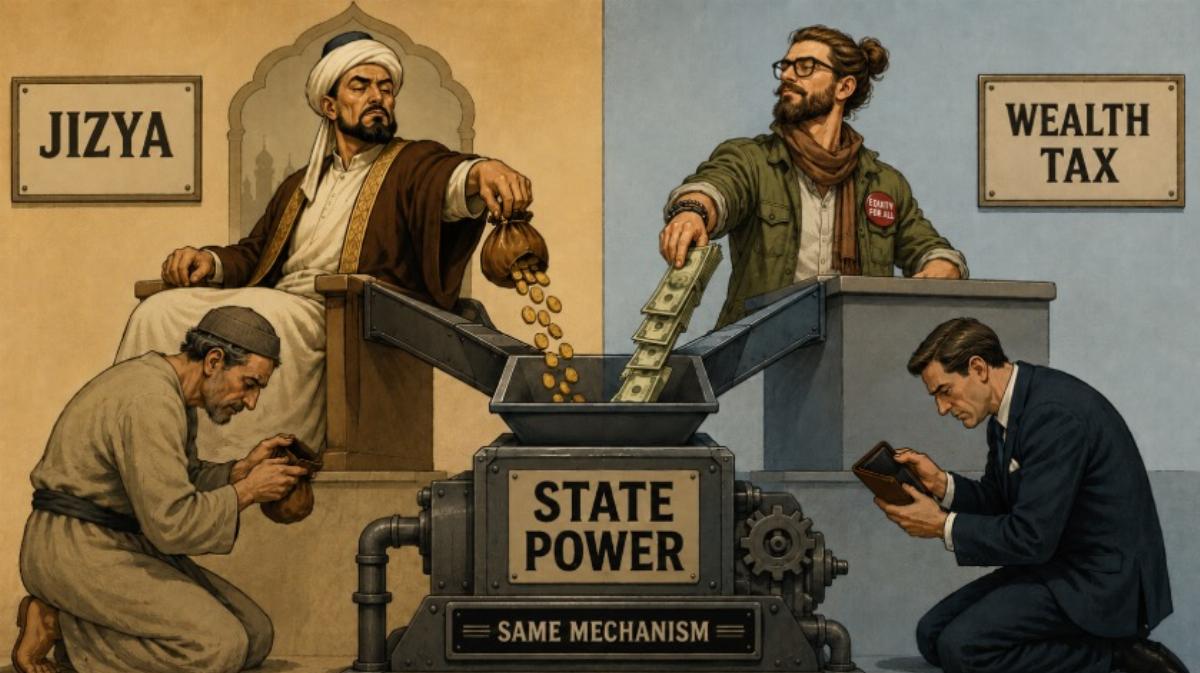
In the nineteenth and twentieth centuries, and again today under communism, socialism, and the Democratic Socialists of America, a parallel system ranks human beings by class and extracts wealth from the disfavored to redistribute to the favored. The mechanisms differ in language and ritual; the moral architecture is the same: the state designates a group as legitimate prey, cloaks the taking in the language of justice, and imposes it by force.
The doctrinal foundation of jizya is explicit. Quran 9:29 commands:
Fight those who do not believe in Allah or in the Last Day and who do not consider unlawful what Allah and His Messenger have made unlawful and who do not adopt the religion of truth from those who were given the Scripture—[fight] until they give the jizyah willingly while they are humbled.3
Classical jurists read this as requiring not merely payment but public acknowledgment of subordinate status. Ibn Kathir’s tafsir records the requirement that the payer feel himself subdued. Al-Mawardi’s al-Ahkam al-Sultaniyya, the standard Shafi’i manual of statecraft, is more specific still—the manner of payment itself was meant to enact the dhimmi’s subjugation, the Quranic term being ṣāghirūn, “made low.”4
Though religiously mandated, jizya was simultaneously a primary instrument of economic extraction, transferring wealth from a subjugated population to the Islamic state and its ruling elites. The religious hierarchy supplied the legal category and moral cover that made permanent, group-based fiscal predation “legitimate.”5
The earliest systematic administrative treatment appears in Abu Yusuf’s Kitab al-Kharaj, written for Caliph Harun al-Rashid, which frames the tax as levied in lieu of military duty and in exchange for protection. (“Nice being alive ain’t it. Too bad if something were to happen to your existence.”) Yet the arrangement was never equal citizenship: dhimmis faced legal disabilities in testimony, marriage, and public office, and the Pact of Umar institutionalized visual and social markers of inferiority.6
Enforcement was authoritarian. Non-payers could be imprisoned until the tax was collected; organized refusal broke the covenant of protection, and violators were treated as rebels subject to the rules of war, so that fighting, killing, and enslavement all became lawful.7 Rates varied by province and dynasty, but the principle held: a religiously defined population paid a levy Muslims did not, and the tax functioned as identity pressure as much as revenue.8
Bernard Lewis, whose landmark study rejected the romanticized myth of interfaith utopia, concluded that Islamic societies never recognized equality between Muslim and non-Muslim as a political principle—discrimination was inherent and institutionalized, even where rooted in principle rather than hatred. Bat Ye’or’s history of “dhimmitude” states the same claim more starkly: protection was what a superior power extends to a subjugated population, not the reciprocal rights of citizens.9
Place this beside modern redistributionist ideologies. The Communist Manifesto declares that the history of all hitherto existing society is the history of class struggles and lists as immediate measures a heavy progressive income tax, abolition of inheritance, and centralization of credit and production in the state’s hands—the goal being to wrest capital from the bourgeoisie and place it under control of the proletariat as the ruling class. Private property is treated as illegitimate accumulation to be expropriated for the collective good.10
The Democratic Socialists of America’s platform calls for aggressive wealth taxes on “rich” individuals (however that fuzzy term is defined, re-defined, re-re-defined…), corporations, public ownership of major industries, and redirection of those resources into guaranteed housing, healthcare, and education. The language is “tax the rich,” “an economy for the working class,” “people before profit.” The designated class—those who accumulated capital through markets—is treated as a legitimate object of intensified extraction so the favored class (DSA-holes?) may receive expanded state provision.11
The structural parallels are not metaphorical. Both systems divide the population into morally charged categories—believer and unbeliever, proletarian and bourgeois—and authorize the state to impose differential fiscal burdens by category, justified as the price of protection or justice. Both create incentives for conformity: conversion under jizya; capital flight or political alignment under wealth taxation and the threat of public ownership. Both treat equal citizenship as secondary to group hierarchy, and both are authoritarian in enforcement.
Under jizya, non-payment could void protected status and expose the resister to the full penalties of rebellion, including death. Under radical redistribution, resistance—by kulaks withholding grain, property owners opposing nationalization, or dissidents opposing the regime—has repeatedly produced imprisonment, exile, or execution.
Read more There Is No Good Case Against Punishing Government Program Fraud
The decisive feature is the state’s claim of moral authority to rank groups and transfer resources coercively from the ranked-inferior to the ranked-superior. The mechanism—designation, extraction, enforcement, and the language of justice—remains constant. Neither system is content with voluntary charity or market exchange; both require continuous state power to maintain the transfer.
A free society of equal citizens under law cannot coexist with either arrangement. Equal protection and equal taxation are the institutional expression of the proposition that human beings are not to be ranked by the state for purposes of extraction.
Jizya made that ranking explicit and religious. Contemporary socialism and the DSA platform make it explicit and economic. The difference in vocabulary should not obscure the shared rejection of individual equality before the law in favor of group-based fiscal hierarchy. Those who defend one while condemning the other are engaged in selective blindness. The manifesto is the same.
Image created using AI.
Endnotes
1. On historical patterns of coercion and the role of jizya as identity pressure accelerating conversion, see Mohamed Saleh and Jean Tirole, “Taxing Identity: Theory and Evidence From Early Islam,” Econometrica 89, no. 4 (2021): 1881–1919. Daniel C. Dennett Jr.’s earlier study, Conversion and the Poll Tax in Early Islam (Harvard University Press, 1950) reads the same historical record more skeptically and doubts that the tax was designed to drive conversion. Saleh and Tirole’s quantitative analysis of Egypt’s conversion records (641–1170) is the more recent and more rigorously tested account, and this essay follows their conclusion over Dennett’s where the two diverge. Scholarly comparisons of totalitarian features in Islamist and communist ideologies appear in works such as Michael Whine, “Islamism and Totalitarianism: Similarities and Differences,” Totalitarian Movements and Political Religions 2, no. 2 (2001): 54–72.
2. On Iran’s nuclear posture and the flexibility of religious rulings under Twelver Shiism, see Michael Eisenstadt and Mehdi Khalaji, “Nuclear Fatwa: Religion and Politics in Iran’s Proliferation Strategy,” Policy Focus 115 (Washington Institute for Near East Policy, September 2011). The report’s own conclusion is that Tehran’s nuclear decisions are governed by regime expediency rather than fixed doctrine, meaning the fatwa could in principle be revised in either direction; it is cited here for that point about doctrinal flexibility, not as evidence of present intent.
3. Quran 9:29 (Sahih International translation).
4. Ibn Kathir, Tafsir Ibn Kathir, on Quran 9:29; Abu al-Hasan al-Mawardi, al-Ahkam al-Sultaniyya (Ordinances of Government), on the manner of jizya payment.
5. Britannica, “Jizyah”; Encyclopaedia Iranica, “Jezya”; historical administrative practice in Abu Yusuf and later sources.
6. Abu Yusuf Yaʿqūb, Kitāb al-Kharāj, trans. A. Ben Shemesh, Taxation in Islam, Vol. 3 (Brill, 1969); traditional accounts of the Pact of Umar.
7. Abu Yusuf, Kitāb al-Kharāj; classical rulings that organized refusal breaks the dhimma and places resisters under the law of war.
8. Encyclopaedia Iranica, “Jezya”; Mohamed Saleh and Jean Tirole, “Taxing Identity: Theory and Evidence From Early Islam,” Econometrica 89, no. 4 (2021): 1881–1919.
9. Bernard Lewis, The Jews of Islam (Princeton University Press, 1984), esp. chap. 1, “Islam and Other Religions.” Bat Ye’or, The Dhimmi: Jews and Christians Under Islam (Fairleigh Dickinson University Press, 1985), for the starker “dhimmitude” framing this paragraph also draws on.
10. Karl Marx and Friedrich Engels, Manifesto of the Communist Party (1848), sec. II, “Proletarians and Communists.”
11. Democratic Socialists of America, 2021 National Convention Platform (First Draft), sections on public ownership, public banking, and taxing the rich through wealth and estate taxes, available at convention2021.dsausa.org; see also DSA’s recurring “Tax the Rich” organizing documented at dsausa.org, including Portland DSA’s 2020 preschool ballot campaign and the organization’s 2026 Tax Day materials.
Read more Straight As, Empty Minds