
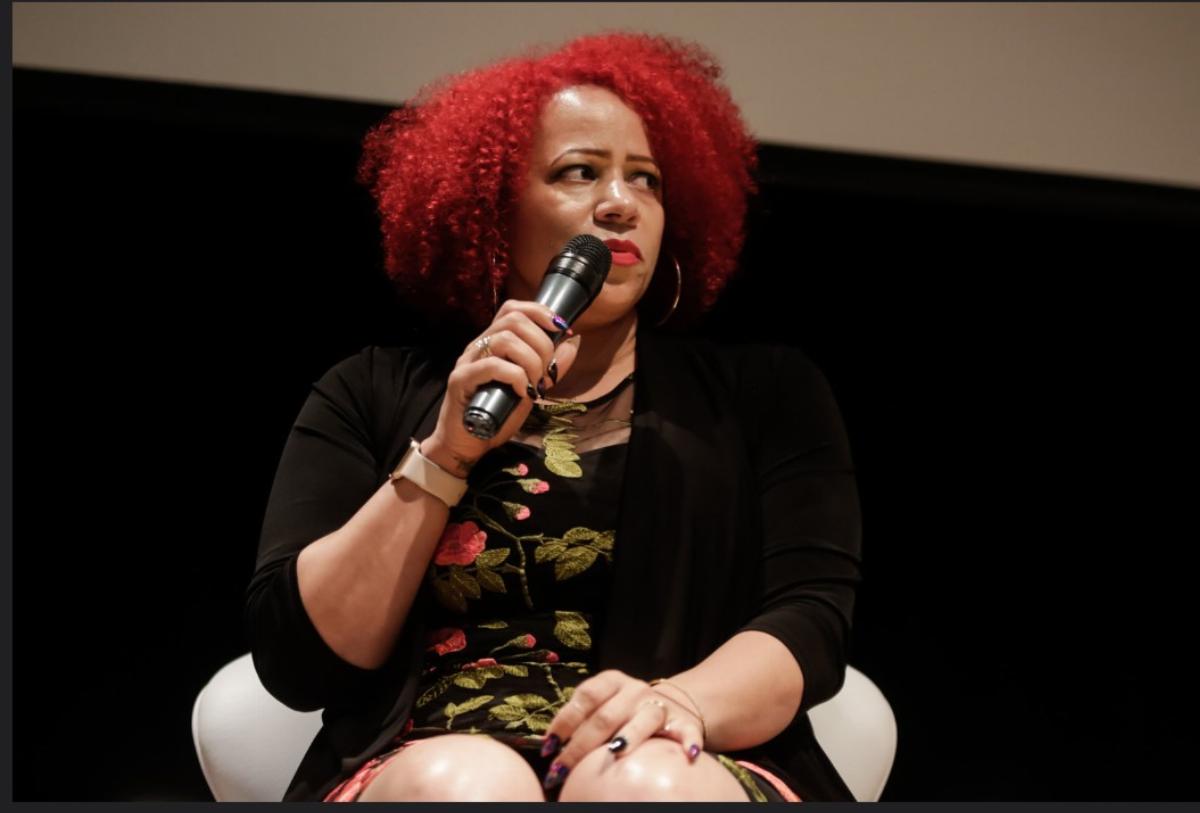
Cross-posted with Andrea Widburg’s ‘Nikole Hannah-Jones sacrificed her child to her activism.’
Read more Diesel in distress
Eric Hoffer’s dictum, “Those who would sacrifice a generation to realize an ideal are the enemies of mankind” comes to mind upon reading Nikole Hannah-Jones’s latest essay about her remorse at putting her daughter in a bad school in Brooklyn.
Ostensibly, her plan was to serve as a sort of PTA den mother to influence the black-majority school to improve, banking on her being feted elsewhere as a famed New York Times commentator and the author of the 1619 Project as the ‘nudge’ to get it done. She intended to lift up other black inner city students by sending in her own.
She found out the hard way that her daughter couldn’t write grammatical sentences, or do long division and fractions by the time she got to high school, and worst of all, laid the blame exactly where it belonged, on Hannah-Jones and her husband, both of whom had the means to get her into a good school and didn’t.
“Did you know my school was bad like this when you decided to put me here?” she asked.
Her daughter couldn’t compete to get into a good high school, there were just too many gaps in her knowledge.
The bottom-of-the-barrel public school she went to, P.S. 307 in Brooklyn, had teachers who didn’t show up, substitutes who didn’t teach, an absentee principal, and sometimes no teachers at all. Nobody could be bothered to assign homework, let alone grade it. What in-class assignments there was didn’t get graded, either. Her own efforts to communicate with her daughter’s teachers by email after being told her daughter was not proficient in any subject, asking for copies of her test scores and graded work to see what went wrong, went ignored or were responded to after long delays. Her daughter was then waved through to the next level with all A’s, despite not even making minimal proficiencies, amid claims that she had been graded on a curve.
Discipline was a nightmare. Hannah-Jones also wrote:
Toward the end of first grade, Najya started sometimes saying she didn’t like her school and complaining how chaotic it was at lunch. I decided to visit during the lunch period and was shocked by what I saw. Najya’s class and another class were sitting at their tables in the cafeteria with no lunch and no adult supervision. Children were running wild, chasing, hitting and pushing each other while the teacher’s aides and cafeteria workers stood by looking bored.
Several times, I had to instruct children to stop striking each other and to sit down, at one point physically pulling two boys apart. When I asked one of the aides why the children weren’t being supervised, she told me the lunch period was short-staffed. After I sat back down with Najya, she told me, “It’s always like this, and that’s why I don’t want to go to this school.”
So instead of pulling her kid from the obviously failing school that she couldn’t stand going to, Hannah-Jones bulled forward and let the nightmare continue, putting her in a failing public middle school called Urban Assembly Unison, a woke establishment with a ‘food justice’ club but lousy rankings, even with her firsthand knowledge of what that meant from the elementary school experience staring right in front of her from earlier.
In this progressive school, she described how disciplinary-issue troublemakers got all the attention from the teachers while students who performed their schoolwork got ignored. Her daughter described not being challenged at all and soon got bored. Hannah-Jones took her daughter to make that complaint about school resources being directed to problem children to the principal, whom she said was willing to listen, but she was helpless in the face of the ‘poverty’ of the students. Poverty, you see, and pay no attention to those Asian kids fresh off the boat who had even less wealth than the black students but still managed to excel in school.
No, the problem wasn’t poverty. But she reasoned thusly:
I said I was aware of her school’s academic rankings, but that test scores alone do not define a school.
Glancing between her and the road, I told her everything that I had said a hundred times on stages, in interviews, in discussions since I had made her a symbol of how the choices we make can help sustain — or dismantle — educational inequality. I talked about the deep inequality in New York’s schools and how, like those Black families who came before us, we had an obligation to be part of the struggle of our larger community. Even if her schools were not academically the strongest, I explained, her father and I knew that we could provide for her tutoring and any other assistance to make up for what her school may have lacked.
“So you had money to send me to one of the best schools, and you chose not to?” she said, hurling her words. “Because other kids are disadvantaged, you didn’t want to put me in a great school?”
Read more The new billionaire has no staff
Najya was asking what I’d accomplished by not choosing the “best” school for her. And the honest answer is, I don’t know. When it comes to the choices my husband and I have made about public education, these days I feel that I failed both my values and my child.
She blamed whites and Asians for not wanting to go to these failing schools, she blamed academic ‘sorting’ of worthy and unworthy students at elite schools, despite the discipline problems she saw among the ‘unworthies;’ she blamed racism; she blamed segregation, ignoring the fact that the middle school, Unison, wanted to be segregated black because of Title 1 federal funding.
The one thing she didn’t mention in her blame lineup was a big one: teachers’ unions.
The indifferent adults who didn’t answer emails, the lazy teachers who didn’t assign homework or grade assignments, or keep track of test scores, or respond to parental inquiries, the adults who stood around looking bored as children fought in the lunchroom, the teachers who didn’t show up, the principal who had better things to do than come to the school, the custodians who couldn’t be bothered to clean up the messes — were all in one way or another affiliated with the powerful teachers’ unions who run New York’s public schools, not for the kids, but for themselves.
“Not my job, mac,” as the New York saying goes.
Why didn’t she mention that problem, that problem of unions, who shield teachers from firing no matter how bad or absent a teacher’s behavior, from zero homework to zero teaching? Why didn’t she mention the bloated six-figure salaries of these lousy teachers, or the grotesque money spent per pupil of $52,000 a year for results like these?
It’s all union stuff, and New York’s public schools are run by the United Federation of Teachers, as well as the Council of School Supervisors and Administrators, and a support-staff union called District Council 37. Those unions make New York’s public schools the undesirable places that they are.
The teachers’ union in particular is loaded with bad actors responsible for this revolting outcome. Imagine a hospital with a medical union creating the same results!
And who are they?
UFT is a local affiliate and founding member of the American Federation of Teachers, run by none other than Randi Weingarten, the same Randi Weingarten who embraced COVID lockdowns and kept schools closed for much longer than they needed to be, and who embraced, promoted and spread through schools Hannah-Jones’s own ‘1619 Project’ which was loaded with false premises, and outright errors, claiming America was fatally flawed.
Might there be a conflict of interest? The AFT’s own website suggests that Weingarten and Hannah-Jones are tight, sharing a panel at an event featured on the AFT website:
The AFT’s Share My Lesson has numerous lesson plans and resources drawing from the project as well.“We are trying to get these invaluable and nuanced lesson plans about the 1619 Project directly to educators when they need it most, to help them tackle these conversations,” says Weingarten. “Our hope is that through this partnership with the Pulitzer Center, we can help further honest conversations around our country’s history and inform our present and hopefully our future in our classrooms, in our communities and in our organizations.”Weingarten acknowledged that this work is not without its detractors, and some districts have fought to exclude the 1619 curriculum from their schools, but she insists that it is crucial. “There’s nothing unpatriotic about a cleareyed view of our nation’s past,” she says. “The country has to see its history in all of its manifestations and that history cannot be whitewashed. … The 1619 Project forces those who do not want to see, to see.”
Is that why she blamed so many other people for her bad decision about her daughter’s education, yet missed the one that really did cause the problem in education?
It’s funny how she protects these unions even as she doesn’t spare herself. Some things, you see, are bigger than a mere daughter.
Image: Associação Brasileira de Jornalismo Investigativo, via Flickr // CC BY 2.0 Deed
Read more The Dems trash the Old Dominion