
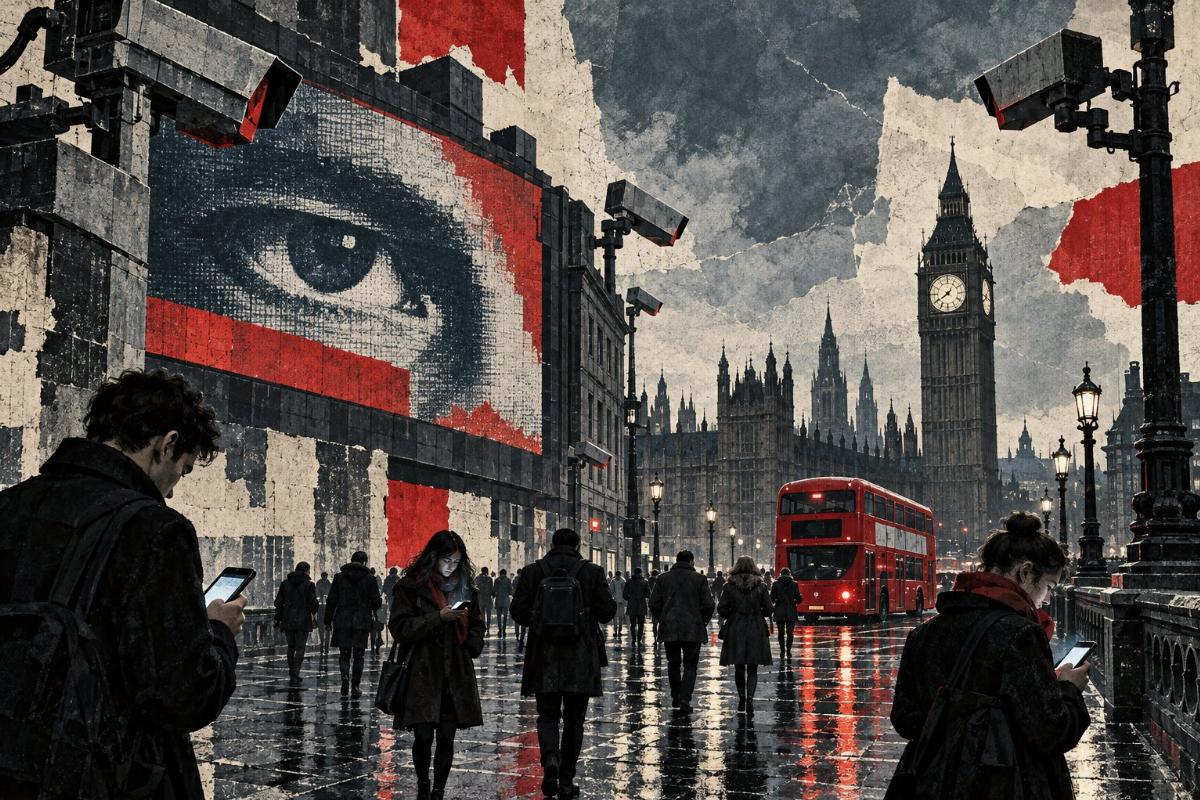
I recently read a piece of literary reportage in Cha: An Asian Literary Journal in which the writer deliberately reports himself to China’s Ministry of State Security through its anonymous informant portal.
Read more Democrats Want To Wreck America With Third-World Immigration
Little happens, but that is the point. China controls journalism through implicit dread, utilizing what scholar Perry Link terms the “anaconda in the chandelier”; the mere possibility of being reported on by friends or acquaintances is enough to enforce conformity without a single strike.
I used to regard such climates of fear as distant foreign realities. That distance narrowed hugely when I found myself facing anonymous reporting and ideological scrutiny here at home.
I never expected to encounter the pressures of self-censorship, or the prospect of anonymous informants, in my own country — least of all within England’s university-led teacher-training.
It is this kind of pressure that makes the language of V for Vendetta resonate beyond fiction.
Where British subjects once held the freedom to object, to think and speak as we saw fit, we now have “censors and systems of surveillance coercing [our] conformity and soliciting [our] submission.”
You might think this melodramatic. Perhaps, you might argue, the suppression of a handful of unpopular opinions is simply the price of social harmony in modern, multicultural Britain.
Yet in his 1938 “Broadcast to the United States from London”, Winston Churchill warns us about precisely this kind of dictatorship: “A state of society where men may not speak their minds”.
Writing in the same era, George Orwell cut straight to the core of the issue:
We have now sunk to a depth at which restatement of the obvious is the first duty of intelligent men. If liberty means anything at all, it means the right to tell people what they do not want to hear. In times of universal deceit, telling the truth will be a revolutionary act.
Here is what happened to me when I told Britain’s truth for American Thinker.
Unfit to Teach
One clear October morning, the kind where the autumn sun is bright but the air bites, I was sitting in a seminar in southern England when a hand settled on my shoulder.
A low, female voice asked me to step outside, adding quietly that I had better bring my laptop.
In a sterile, featureless office, the Director of the Institute of Education and the Programme Leader were both waiting for me.
An email sent just after dawn had summoned me without a word of explanation or context.
I was late.
What followed was a “discussion” of my politics and of articles I had published weeks earlier.
The meeting had the feel of a carefully staged interrogation. The Programme Leader took the lead in questioning me, while the Director maintained a practiced smile and typed my responses into her laptop, as though compiling a transcript for a trial.
The dynamic was unsettlingly familiar from accounts of authoritarian interrogation abroad.
The British academic equivalent, as it felt to me, of an “invitation to tea” — China’s chilling euphemism for being summoned for friendly questioning by the authorities.
Stripped of context, my articles were, I felt, weaponized against me. The discussion spiraled rapidly toward Prevent, Britain’s counter-radicalization program, “fitness-to-teach” rules, and whether I would be allowed to begin my school placement on Monday at all. The power imbalance was palpable.
My British Army training taught me to remain calm under pressure, yet their outlandish fears that I might discriminate against children still threw me, and left me struggling for words at times.
They frowned heavily as they questioned my decision to write for American Thinker, zeroing in on satirical passages about small boats and gun ownership. I found their reaction strikingly hostile.
Heaven knows how they would react to Major-General Julian Thompson, who commanded 3 Commando Brigade in the Falklands, after he recently suggested targeting migrant boats with machine-gun fire—later clarifying he meant the vessels, not the occupants.
Our discussion soon shifted from my own satire on guns and Channel smugglers to my commentary on a specific criminal case: I was accused of “dehumanizing” Hadi Alodid, a Sudanese migrant whose attack on a Northern Irishman drew national attention.
Read more With MAGA Enemies List, Jack Smith Trashes The Constitution Once Again
For context, video footage clearly shows Alodid pinning down his victim, carving out his eyes, and brandishing a kitchen knife before attempting to behead him.
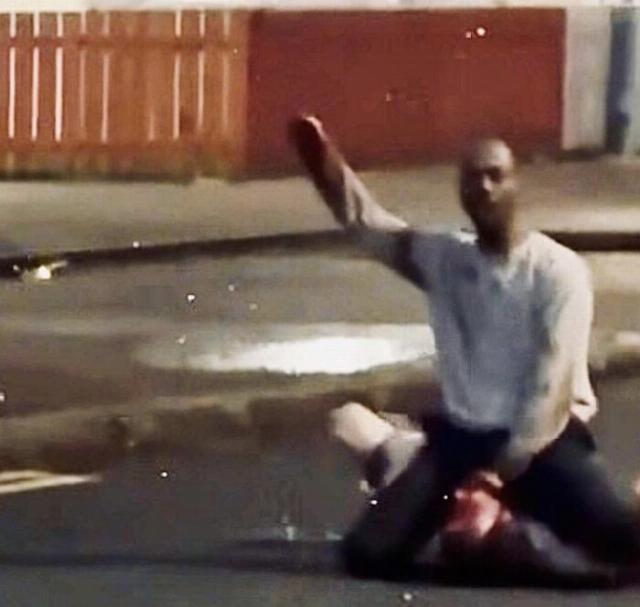
Image: Screengrab from Rupert Lowe’s IG account.
Having used the Hadi Alodid case to question my ethics, they next turned to Samuel Everett to demonstrate the consequences, citing the Teaching Regulation Agency’s decision to prohibit Everett from teaching over his comments on small boats, presenting his career-ending prohibition as an explicit warning of what public expression might cost me.
If tweets could destroy a career, what might my published journalism entail?
On the Weaponization of British Values
When we discussed “fundamental British values”, as per “Teachers’ Standards”, they invoked the Dunkirk Evacuation, comparing the heroism of 1940 with today’s illegal Channel crossings.
To me, this represents a gross distortion of history, dressed up in the language of Professional Conduct. My grandfather, who flew Hurricanes in the Battle of Britain, would roll in his grave.
Yet, while UK universities focus on policing historical memory and speech, real ideological threats go unexamined. It is a telling irony that even the UAE, an essential Allied post during the Second World War, has restricted government grants for study in Britain in recent times over fears that our campuses are becoming hotbeds for radical intolerance. Color me shocked.
Back in my meeting, whatever the merits of the university’s concerns, the way in which they were raised was another matter. The curious thing is that my Director is really a rather likeable person.
And yet, professional courtesy — simple human kindness — would have meant telling me in advance what the meeting concerned and giving me even 15 minutes to collect my thoughts before speaking. I wonder why she didn’t.
The Director’s written follow-up arrived that evening, anyhow, her signature cheerfully adorned with she/her pronouns, confirming that I could commence my school placement. How kind.
Feeling a mixture of relief and anger, I wanted to unleash a defense of fearless journalism; however, discretion being the better part of valor, I kept my reply calm and collected.
I pointed out, for the record, that Articles 9 and 10 of the European Convention on Human Rights protect freedom of thought, expression, and the press, qualified within reasonable limits.
I suppose my faculty would argue that “Teachers’ Standard” serve as one such limit, but in truth, I consider their response — and that of the UK Government — to teachers like Everett or Anita Meston to be wildly out of proportion (the latter having been sacked for her “pro-life” views).
To be clear, none of this is to deny that said “Teachers’ Standards” exist for good reason. They are meant to keep extremists, predators, and those who would discriminate against children out of the classroom. Safeguarding is non-negotiable, and no serious person disputes that.
But the leap from “this person’s political views are objectionable” to “his fitness to teach children must urgently be assessed” is a substantial and dangerous one if the two are treated as interchangeable.
With my place on the course on the line, unfortunately, I knew I had to pick my battles wisely.
Dead Poets Society
If modern teacher-training in the UK treats published journalism as a professional liability, it raises stark questions about the kind of educators England is producing.
Would John Keating, the iconoclastic English teacher played by Robin Williams in Dead Poets Society, survive a single term in modern British higher education, or would his challenge to institutional authority provoke questions about his being fit to teach?
In the film, Keating stands on his desk to urge his pupils to look at the world differently, declaring: “Just when you think you know something, you have to look at it in another way….”
His call for students to “find your own voice,” coupled with his conviction that “words and ideas can change the world,” captures the very core of my conservatism.
Yet, in a modern UK landscape where teachers’ “personal and professional conduct” is policed via subjective “fundamental British values,” one must ask: Can truly free-thinking minds still survive?
An educational system that demands ideological submission will inevitably produce teachers who replicate that conformity in their classrooms.
Read more Marxists, Deception, And Violence
“I always thought the idea of education was to learn to think for yourself.”
Image generated by ChatGPT.