
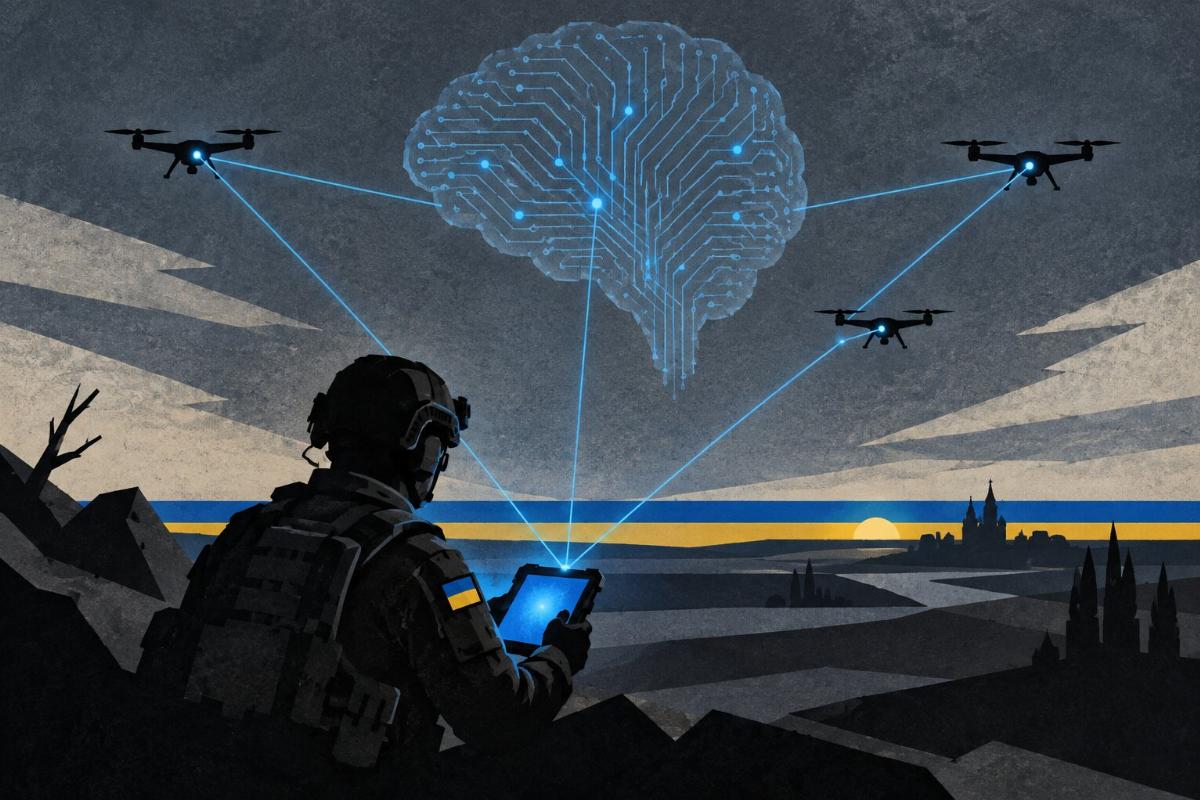
Western governments and technology firms have spent four years pouring targeting software, combat data, and cheap autonomous drones into Ukraine. The war has made the country the world’s largest live laboratory for military artificial intelligence. That is not a metaphor Kyiv rejects. Mykhailo Fedorov, then a senior digital and defense official, said the mission was to make Ukraine “the world’s tech R&D lab.”
Read more Greenland Bases Forever
The resulting risk is real. The evidence supports a proliferation problem: systems, data, and know-how moving faster than the rules meant to contain them.
What Actually Moved
The transfer is not one weapon. It is a stack. Palantir’s software has been wired into Ukrainian deep-strike planning. In 2023, CEO Alex Karp said the company was “responsible for most of the targeting in Ukraine.” By 2026 the Brave1 Dataroom, built with Palantir, had given more than 100 Ukrainian firms access to combat datasets, visual and thermal tracks, and millions of annotated frames to train models for recognition, interception, and navigation without GPS. Clearview AI’s facial recognition has been used to identify Russian personnel. Scale AI has worked satellite imagery of troop movements and damage.
Hardware followed software. Perennial Autonomy, linked to former Google chief Eric Schmidt, fielded the Hornet, a strike drone priced at about $5,000 and trained on thousands of hours of Russian-target video. Its Merops interceptor, combat-tested in Ukraine, later won a $500 million Pentagon counter-drone contract. Foundation Future Industries sent humanoid robots for a pilot in Ukraine while holding some $24 million in U.S. research contracts. On Sept. 18, 2026, the State Department notified Congress of a potential $2.7 billion air-defense package for Ukraine, including counter-drone radars, financed with European money and leftover U.S. Foreign Military Financing.
The industrial numbers explain why control is hard. Ukraine says it is aiming at roughly 3 million attack drones this year; U.S. output the year before was reported near 300,000. The defense base grew from one dominant state supplier to about 500 companies after 2022. Drone procurement rose from 1 percent of the acquisition budget in FY2024 to 6.7 percent in FY2025.
Washington Wants the IP Back
The traffic is not one way. Bloomberg and Ukrainian officials have described U.S. interest in Ukrainian AI-assisted terminal guidance, GPS-denied navigation, and the intellectual property that would let American firms copy systems already proven under fire. Kyiv has treated some of that IP as a red line.
Battlefield data is the prize. Foreign governments and technology companies are competing for what researchers call “gold dust”: strike video and sensor logs that can train the next generation of military models. Ukraine has signed a data-sharing deal with Britain and pitched the same archive more widely. The unanswered legal question is who owns a model after it has been fine-tuned on Ukrainian corpses and Russian tanks: the ministry, the vendor, or the next buyer.
The Third-Country Problem
This is the load-bearing risk. In March 2026, President Volodymyr Zelensky told the British Parliament that about 200 Ukrainian specialists were already in the Gulf teaching partners to defeat Shahed-type drones. Later figures put the deployment around 228 across the United Arab Emirates, Saudi Arabia, Qatar, Kuwait, and Jordan. Ten-year defense agreements followed. Reported demand included some 5,000 interceptors for the UAE and 2,000 for Qatar, with talks not only on airframes but on the algorithms.
Kyiv is shopping the same expertise in Japan, the Philippines, Canada, and Europe. Industry estimates of possible Ukrainian defense exports run to about $2 billion in 2026. A new export framework covers drones, missiles, ammunition, software, and integration services. Russia and its partners are blacklisted on paper. Paper is not a chain of custody.
Read more Is the new-new left beginning to devour itself?
A model weight does not have a serial number. An instructor can teach a targeting stack in a hangar and fly home. End-use rules written for Javelins do not automatically follow a fine-tuned detector.
Capture, Chips, and the Other Side of the Front
The fastest leakage path may not be a Kyiv export license. It is wreckage. Russia recovers Ukrainian drones every day. Anthropic has reported a Russia-based team trying to train a vision system for autonomous kamikaze drones on combat footage from Ukraine. In July 2026 a Russian Molniya drone carrying an Nvidia Jetson Orin module struck a gas station in Zaporizhzhia. Investigators said human operators sent it toward the site; onboard vision appears to have chosen the final aimpoint. Three civilians died, including a 19-year-old student. Nvidia says it does not sell the module to Moscow.
That is the dual-use problem in one piece of plastic. China already supplied 89 percent of Russia’s imported microchips by 2023; Chinese dual-use exports to Russia exceeded $4 billion in 2024. Roughly 80 percent of critical drone electronics in Russian systems have been described as . Iran, China, and Russia are also running AI-enabled influence and cyber campaigns with open models and gray-market compute. Those operations do not require a Ukrainian middleman.
Custody Is Weak Where Money Is Large
Ukraine scored 36 out of 100 on Transparency International’s 2025 Corruption Perceptions Index, ranking 104 of 182 countries. Classified audits obtained by The New York Times found about $1.2 billion lost in 2024 alone to fraud, waste, and mismanagement in defense procurement. Seven of the top ten contractors won new work despite defaults, criminal investigations, or arrested executives. One firm delivered none of 600 promised specialized drones, then won a contract for 1,950 more. NABU has publicized defense cases, including an alleged $1 million bribe tied to an FPV contract.
That is a custody risk. It is not proof of a terrorist pipeline. The Small Arms Survey found Western grenades were 11 percent of identified seized grenades, usually two per incident, and little evidence for Russian claims of systematic diversion of Western arms to criminals or foreign groups. U.S. inspectors have reported inventory errors on monitored items. They have not documented large-scale diversion of . Adversary figures (tens of thousands of NATO weapons on the black market, cartels on the Rio Grande) remain claims, not audits.
Autonomy is a separate danger. A Ukrainian manufacturer has described a 2024 experiment putting attack quadcopters in “Terminator” mode without a human in the loop. That is a law-of-war problem.
The Policy Question
Treat combat-trained weights like munitions, or accept that Ukraine will keep selling the lab. Demand data-rights clauses that block onward transfer, or admit that instructors and wreckage will move the capability anyway. The United States cannot claim the battlefield as a test range and then feign surprise when the model leaves the range.
The danger is that military AI is being minted faster than export law can follow it, and that the copies, the trainers, and the chips are already in motion.
Read more Waco life defenders protest Talarico rally at Baylor
Image generated by ChatGPT.