
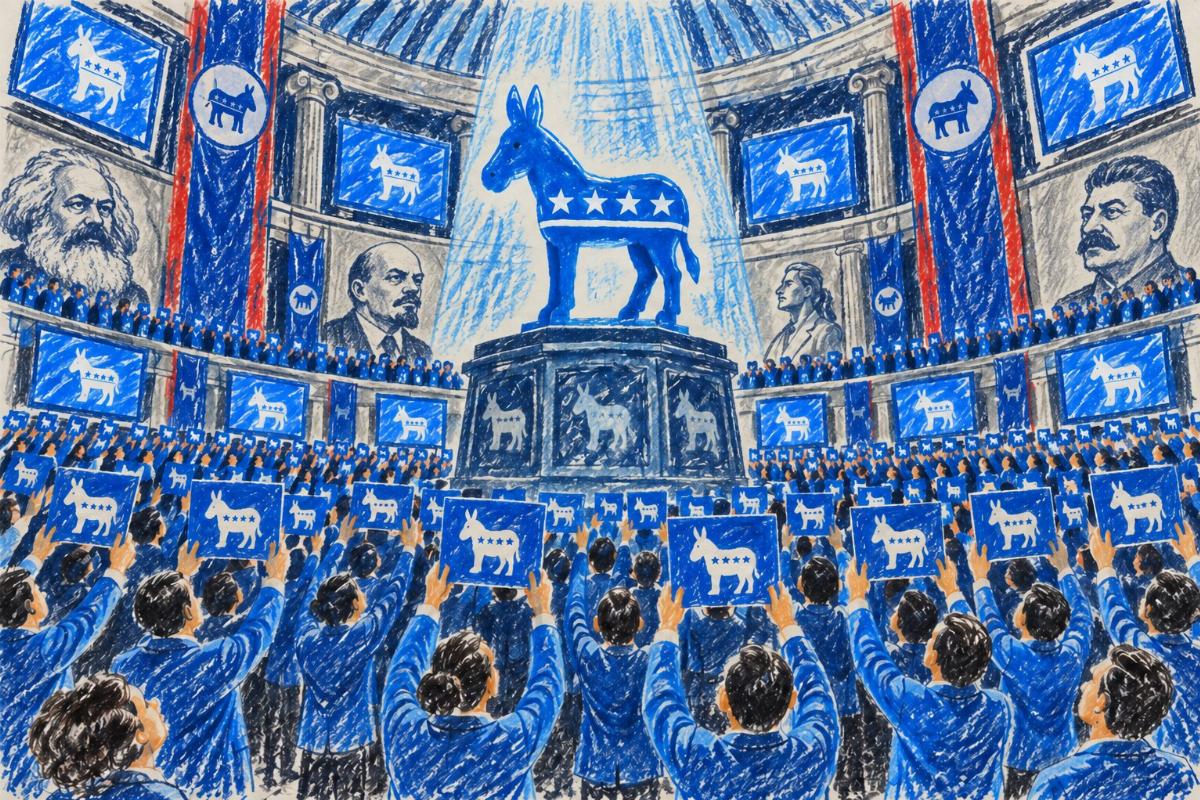
Cults are not defined solely by esoteric rituals or charismatic gurus. They are defined by a mental structure: unwavering adherence to a doctrine, rejection of doubt, radical polarization between “us” and “them,” the primacy of narrative over facts, impunity for leaders, and a mechanism of denial that protects the group’s identity at the expense of reality. Anyone who honestly examines the political behavior of the contemporary Left—from social democracy to communism—will recognize these same traits. This is not a rhetorical metaphor. It is a mode of thought that operates like a fanatical religion.
Read more The West Hasn’t Even Entered The OODA Loop
Research into cults has identified several recurring patterns. The group demands excessive and uncritical commitment to its ideology or leader. Questioning is discouraged or morally punished. A polarized mentality emerges: the world is divided between the chosen and the enemy. The ends justify the means. Doctrine takes precedence over personal experience and contradictory evidence. The member’s identity is constructed more through opposition to an adversary than through any coherent positive content. Leaders are not truly held accountable: their lies or contradictions are reinterpreted, ignored, or transformed into evidence of their moral superiority.
Added to this is psychological denial as a defense mechanism. Accepting facts that contradict the narrative would mean allowing reality to cease being what the believer needs it to be. That is why evidence fails to penetrate. Reason itself becomes an existential threat. Facts that contradict the narrative—historical failures, human costs, internal inconsistencies, empirical results—are not debated. They are reinterpreted, relativized, or attributed to the enemy. The believer simply “does not see” the evidence. He neutralizes it to avoid having to change his identity.
This process explains why certain groups can maintain contradictory claims without experiencing discomfort, why external criticism reinforces rather than weakens adherence, and why rational dialogue becomes sterile. This is no longer a debate over ideas. It is a defense of a psychological and group identity.
Now consider the Left in light of these characteristics. Its narrative—oppression, privilege, capitalism as absolute evil, ubiquitous “fascism”—functions as dogma. Facts that contradict it—the economic failures of socialism, the deaths of millions, violence committed by protected groups, demographic or crime statistics—are reinterpreted, relativized, or blamed on conspiracies by the enemy. The contradictions of political leaders do not provoke a crisis of faith: they are forgiven or concealed because the message matters more than consistency.
Identity is defined through hostility toward the adversary. Capitalism, individual liberty, liberal democracy, and Western civilization are not treated as imperfect systems that might be reformed; they become Evil itself.
This structure helps explain permanent activism and the ease with which it can slide into coercion. Terrorism, within this logic, is not an aberration; it is activism carried to its extreme. Anyone convinced that he possesses absolute moral truth and confronts a demonized enemy can come to regard any means as legitimate. Hence the ability of highly mobilized minorities to capture the media narrative, dominate the streets and, under certain circumstances, acquire institutional power. Psychological denial preserves the barrier: to accept reality would mean ceasing to belong.
Every variant of socialism shares this core. Social democracy may appear more moderate, but it preserves the primacy of the egalitarian narrative and the same difficulty in accepting the limits imposed by human nature or economics. Communism simply carries the logic to its ultimate consequences.
Read more For Trump’s UN speech, Fox News’s chyrons were misspelled and misled viewers
Why, then, does it attract so many followers? Whatever its promises—which I will examine in another article—the “believer,” to borrow Jamie Glazov’s apt expression, is someone alienated from his own society who finds in a transcendent political cause a means of escaping the burdens of the individual self. Glazov has repeatedly argued that part of the attraction of mass movements lies in self-abnegation: the possibility of dissolving an unsatisfactory identity into something supposedly greater and purer.
That is how fanatics are made.
This also helps explain the affinity with Islamism. Both can operate according to sectarian logics. Both construct identity through opposition to a common enemy—Western civilization, capitalism, individual liberty, national sovereignty. Both place a sacred narrative above facts. Both can justify extreme means. Both demand unwavering loyalty and punish internal dissent. And, importantly, both have produced cultures in which death is glorified rather than merely feared: history shows that neither socialism nor Islamism merely takes prisoners. Both have produced conversion or death, and millions of lives have been destroyed by these pathological ideologies.
This does not mean that they share every dogma. It means that they can share a mental structure. Common hatred can unite more effectively than common love. This is why we repeatedly see tactical coalitions, complicit silences, and a systematic reluctance to confront the incompatibility between Islamism and liberal values. The Left “does not realize it.” Its mechanism of denial prevents it from doing so without endangering its own identity. Neither the example of Iran—the Left’s collaboration in the revolution followed by repression of the Left once Islamism prevailed—nor other historical precedents have been enough to force recognition of what should be obvious.
The Right, conservatives, and libertarians often make a fatal strategic mistake: they treat the Left as simply another ideology, one susceptible to rational debate, facts, and compromise. They expect it to correct itself when confronted with evidence. They expect it, once in power, to respect the rules of liberty and truth. They fail to understand that the adversary is not operating within the same framework.
The difference is not merely ideological. It is vital, existential, and civilizational. A concession is not simply a temporary exchange; it can become an irreversible advance of the sectarian narrative into the realm of reality. Every cultural, institutional, or legislative conquest becomes entrenched and is rarely reversed. The Right, by failing to understand this mental mechanism, remains permanently at a disadvantage.
Understanding that the Left functions like a cult is not an exercise in name-calling. It is, in my view, a condition of political and civilizational survival. Those who continue trying to reason with people who have turned denial of reality into an identity are condemned to lose. And every loss means one fewer opportunity for a better life—and another step toward the abyss.
Read more Reading between the lines
Image generated by ChatGPT.