
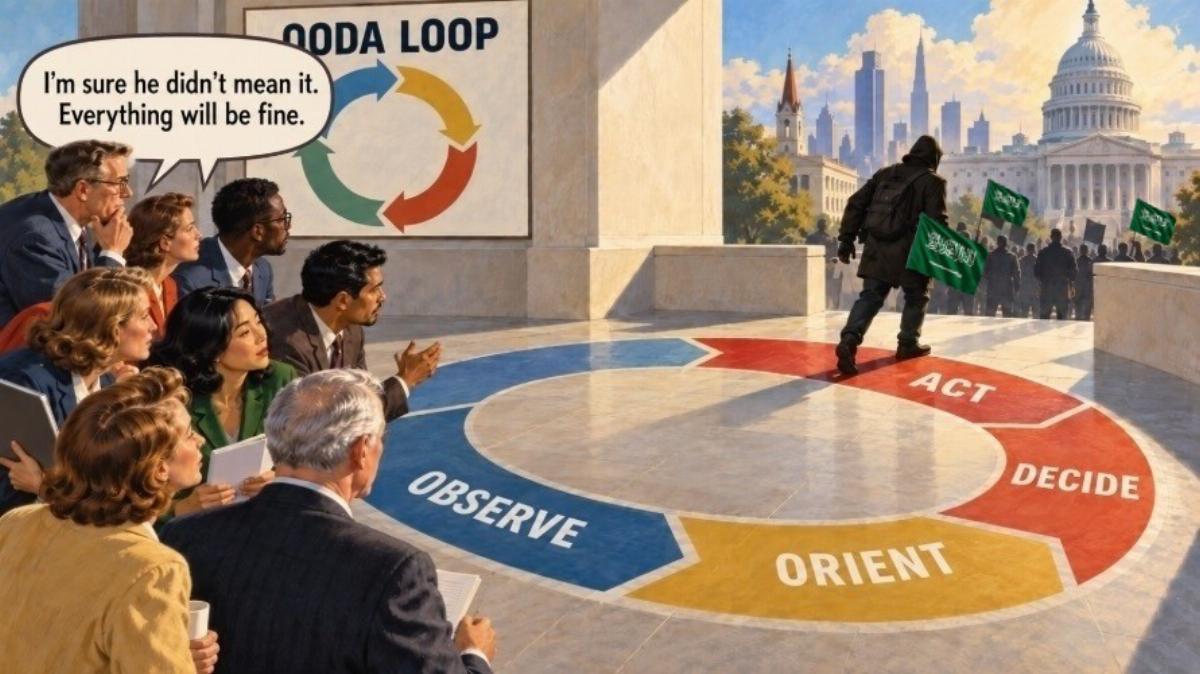
What self-defense teaches us about recognizing ideological threats before they become impossible to ignore.
Read more For Trump’s UN speech, Fox News’s chyrons were misspelled and misled viewers
When I teach self-defense, I explain that the attacker has an enormous advantage before the first punch is thrown. He knows his intentions, has selected his target, and has already decided what he’s prepared to do. His victim may still be trying to understand what’s happening.
The attacker is already acting while the defender is only beginning to observe.
Military strategist John Boyd described decision-making through the OODA loop: Observe, Orient, Decide, and Act. Information is collected, interpreted, turned into decisions, and translated into action.
This model offers a way to examine a troubling question about Western society. What happens when a civilization becomes so committed to its assumptions that it struggles to recognize evidence contradicting them?
The Failure to Observe
In self-defense, the earliest warning signs often appear before physical contact. A stranger violates your personal space, ignores your boundaries, or deliberately blocks your exit. Recognizing these behaviors creates opportunities to respond.
The same principle applies to ideological threats.
Radical Islamist organizations have openly declared their objectives, recruited supporters, celebrated terrorist attacks, and used Western freedoms to spread their propaganda. Europol recorded 24 jihadist terrorist attacks in the European Union in 2024, including completed, failed, and foiled attacks.
These are observable facts that demand serious examination.
Authoritarian socialist movements present a different challenge. Their historical record includes political repression, censorship, and the concentration of economic and governmental power. Contemporary democratic socialist movements vary considerably in their objectives and commitment to political pluralism.
The important distinction is what a movement intends to do with power, how it proposes to obtain it, and whether it respects the freedom of those who disagree.
When political institutions dismiss observable warning signs because they conflict with preferred ideological narratives, their ability to anticipate danger deteriorates.
The Danger of Misinterpreting Reality
Observation alone accomplishes very little. We must understand what we’re seeing.
This is orientation.
A student may recognize that someone is behaving aggressively while continuing to interpret the encounter as an ordinary disagreement. His expectations interfere with his judgment.
Western societies face similar questions when confronting movements whose stated objectives challenge liberal democratic principles.
Religious freedom, freedom of expression, equality before the law, and political pluralism depend on institutions willing to protect them. Movements advocating religious authoritarianism or one-party political rule raise questions about how those freedoms would survive under their authority.
The challenge is particularly difficult when movements seek political influence through lawful democratic participation while rejecting essential democratic protections in their proposed systems.
A society that interprets every political movement through its own commitment to tolerance risks misunderstanding groups that reject those principles.
Our assumptions deserve the same scrutiny as the threats we encounter.
As I explain in my article on situational awareness, people can overlook important information when their expectations prevent them from recognizing a developing problem.
Read more Reading between the lines
That vulnerability exists in institutions as well as individuals.
When the Attacker Is Already Acting
An attacker may have completed his decision-making process before his victim becomes aware of the danger. The defender must identify what is happening while simultaneously confronting its consequences.
Ideological movements can develop similar advantages through years of organization, recruitment, propaganda, and institutional influence.
Recognizing these developments requires examining specific organizations, their documented objectives, and their methods. It also requires distinguishing peaceful political advocacy from intimidation, coercion, and violence.
Western governments possess substantial counterterrorism capabilities and have prevented attacks. Yet successful intervention in one case offers no guarantee that emerging threats elsewhere will be recognized.
Political institutions also face the difficult task of identifying gradual changes that threaten democratic accountability.
Restrictions on political opposition, intimidation of journalists, and attacks on judicial independence are observable developments. Their cumulative consequences may become apparent only after institutions have lost much of their ability to resist.
The Responsibility to Act
Self-defense requires judgment. Every decision creates consequences, including the decision to do nothing.
The same applies to democratic societies.
Protecting citizens from terrorism, preserving freedom of expression, and maintaining independent institutions require informed decisions and continuous reassessment.
The response must fit the actual threat. Poorly conceived action can create additional dangers, just as hesitation can allow an existing threat to develop.
In self-defense training , rigid assumptions frequently fail when circumstances change. Effective responses require accurate observation and the willingness to adapt.
The OODA loop helps explain why this matters.
A society that cannot examine uncomfortable information will struggle to orient itself. Poor orientation produces decisions based on an increasingly inaccurate understanding of reality.
Eventually, events may force decisions that could have been made under far more favorable circumstances.
The warning signs matter most while there is still time to respond.
The question facing Western democracies is whether their institutions can recognize threats to their foundational principles, confront evidence that challenges their assumptions, and make decisions before the available options disappear.
Image created using AI.
Tsahi Shemesh is an Israeli-American IDF veteran and the founder of Krav Maga Experts in NYC. A father and educator, he writes about Jewish identity, resilience, moral courage, and the ethics of strength in a time of rising antisemitism.