
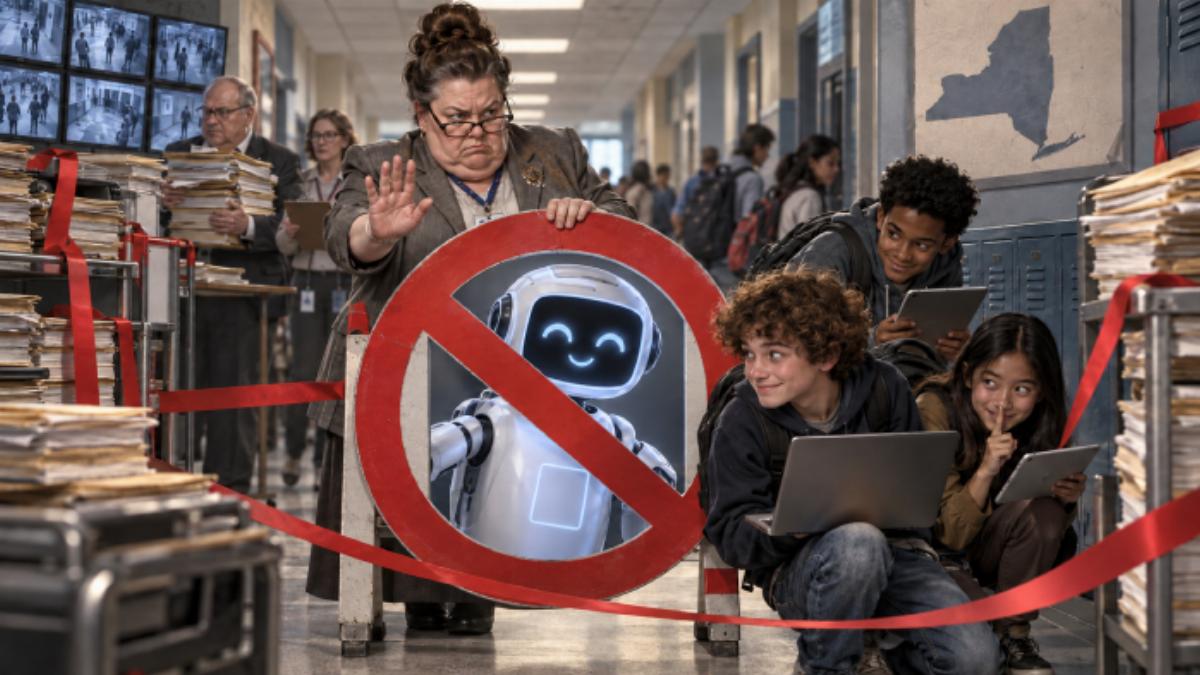
Despite evidence to the contrary, New York’s school AI ban has been enacted, and I bet it will have the opposite of its intended effect. A societal ban does not eliminate the cause or the effect. Historically, bans have accomplished two things: creating more jobs for bureaucrats and creating underground markets.
Read more Democrats still want to keep black folks on their plantation
In New York, I suspect we will start seeing more jobs created to chase down eighth-graders and their parents who circumvent the ban to complete a homework assignment. Considering the new AI ban, who is going to chase down students who use AI for a school assignment?
Why do bans have the opposite effect from what was intended? Because bans never get rid of the cause—only diminish the effect, and sometimes not even that. Might this be the case with New York’s ban on AI? There is now, in effect, an inquisition of school-aged kids using AI for school-related purposes. So what happens if a student gets caught using it?
Bans enacted throughout history serve inquisitors’ purposes rather than the people affected by them. Now there is an AI inquisition coming to a town near you. What is surprising is that the inquisitors imposing bans on AI at select grade levels grew up using the internet, high-powered computers, and calculators to solve problems their predecessors—and teachers—did not grow up with, have access to, or understand at the time.
When they wanted to find information, no one told them to create original thoughts—no, they Googled it. So do these school kids: different names, similar functions.
Students are told to think critically for themselves. In reality, many of those imposing the AI ban are old enough to remember using the internet to find ideas and resources and calculators instead of pen and paper to work out difficult math problems. They were also the first group of consumers to use social media to connect with friends and share ideas online. They likely remember downloading music from friends and family without paying.
Here is the problem: Bans imposed on the general public are not always out of concern for the general public. If you ban AI tools in the name of students’ originality, it will unfortunately create an underground market. Such markets form whenever people want a banned product or service and believe they must circumvent the ban to obtain it.
If middle school students obtain AI assistance through underground markets, will they be prosecuted, chased down, and fined? The AI inquisitors are essentially telling middle and high schoolers not to use tools powered by the same technology that increasingly runs social media and other applications. It is impossible because the AI ship has already sailed. We are in an AI world—it is what it is.
Read more Shelly Headen doubles down
In effect, the underground markets this AI ban creates will expand demand for bureaucratic jobs. The resources spent policing eighth-graders who use AI as a learning tool could be spent more effectively.
Who will monitor and police those who attempt to circumvent the AI ban? Whenever there is a mandated ban, it creates jobs that are not pegged to the marketplace’s supply and demand. These are jobs taxpayers have to pay for—in this case, third parties watching students’ AI use in and outside of schools.
The new AI vigilantes will be charged with finding attempts to circumvent the ban, which will cost taxpayers more than educating students on how and when to use AI tools for learning. Well, at least they can say that AI created new jobs—albeit AI-vigilante bureaucrats. However, these were not the jobs people were hoping for, especially since demand for AI skills in the future workplace is on the rise.
We know that when people prize banned products that are not readily available through legal means, some will find ways of making illegal transactions—even for AI homework assistance in this case. When students illegally pay for AI or AI-assisted homework help from an underground provider, we are moving in the opposite direction from the one intended—all in the name of creativity.
Here is another fact: Banning AI for students—or banning anything, for that matter—almost always creates an environment in which bad actors quickly create illegal markets to replace legal ones. Since time immemorial, when a decree bans a product, markets have gone underground.
Banning firearms, gasoline-powered leaf blowers, free music downloads, plastic bags in grocery stores—whatever it is—does not make the demand disappear. The product or service finds its way back into society notwithstanding the ban. When it comes to policing parents who allow their children to use AI for homework, we have to ask: Is the juice worth the squeeze?
Read more Talarico is not winning in Texas