
In its next term, the Supreme Court will take up “assault weapon” bans. Such bans refer specifically to the AR-15 rifle family and similar semiautomatic rifles. Not only are they emotional rather than rational, but they’re also an attempt to circumvent the Supreme Court’s Heller and Bruen decisions, which held, among other things, that the Second Amendment is not a second-class right and that controversies must be decided under the Strict Scrutiny standard, the highest standard of judicial review.
Read more Feminine devolution
A primary issue is the “in common use” standard.
But apart from a handful of late-19th-century jurisdictions, the historical record compiled by respondents does not demonstrate a tradition of broadly prohibiting the public carry of commonly used firearms for self-defense.
From “What Part of Common Use Don’t You Understand?” Mark W. Smith in the Harvard Journal of Law and Public Policy:
Because the “in common use” test looks to arms that are in common use today, that test automatically and necessarily protects existing technology, and addresses any contemporary societal concerns stemming from such modern technology. Lower courts are not free to disregard Heller’s “in common use” test and instead substitute a “dangerousness” test of their own devising. Doing so is merely “interest balancing” in a different guise, which is prohibited by both Heller and Bruen in Second Amendment challenges to gun-control laws.
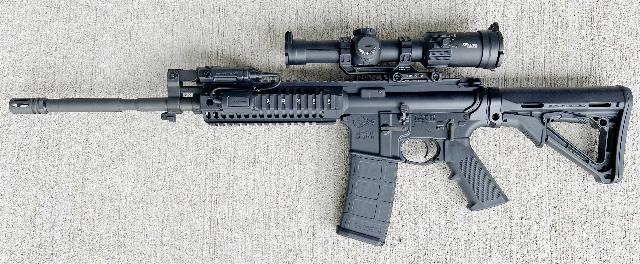
Graphic: An AR-15 variant. Author.
That argument against “assault weapons” is that they are so uniquely dangerous that public safety requires their banning. There is no such thing in firearm nomenclature as an “assault weapon.” It is an invented term intended to dishonestly conflate classes of automatic weapons such as the military assault rifle with semiautomatic rifles that superficially resemble them. AR-15s outwardly resemble the military, select-fire M4, but there the similarity ends. AR-15s are among the most popular and commonly used guns in America, and fire an intermediate, not a “high-powered” cartridge.
How common are they?
A second iteration of the National Firearms Survey by Prof. William English at the McDonough School of Business, Georgetown University found 461 million guns owned by 88 million Americans, including more than 40 million “modern semiautomatic rifles,” most of which are surely AR-15 variants.
“The new survey also shows at least 25 percent of American gun owners currently own an AR-15 type rifle, 12.9% currently own other similarly styled semi-automatic rifles, and 30.0% – approximately 26.4 million adults – currently own at least one firearm in one of these two categories,” noted CCRKBA Chairman Alan Gottlieb.
Clearly, AR-15s and similar guns are constitutional under the Heller and Bruen “in common use” test.
Read more Communism: We saw that movie
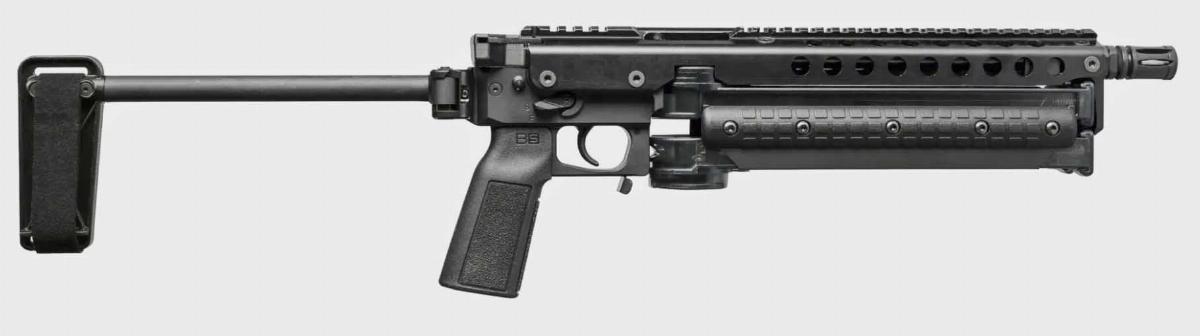
There is, however, concern by some Second Amendment defenders that the “common use” standard is too restrictive, even vague. Should a new type of gun be invented, a gun that promised to be very popular, how could it ever come into common use against the efforts of anti-liberty/gun cracktivists, who would attempt to strangle it in its cradle? Such a gun might be the recently invented KelTec KP-50 braced pistol. It’s a semiautomatic gun, firing an even less powerful cartridge than the AR-15.
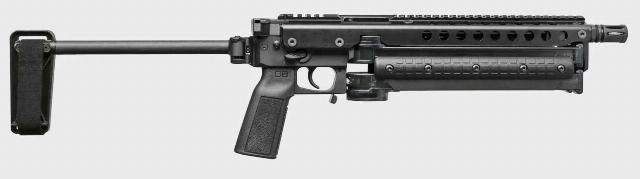
Graphic: KelTec KP-50.
Would this require an entirely new Supreme Court jurisprudence that could take many years—from Heller to Bruen took 14 years—to vindicate what the Constitution and Court clearly recognize as an unalienable right? Is the constitutionality of a weapon useful for self-defense, which the Court recognizes as the foundation of the Second Amendment, not dependent on militia connections, dependent on the number of that weapon in circulation? If so, how many? What is the minimum threshold of “in common use?”
That’s a valid concern, but is unlikely to be a significant factor in the Court’s coming deliberations. In a nation of nearly 350 million, 40 million is a significant number, and is surely low. Surveys are samples, which, done properly, can be reasonably accurate. Many gun owners are reasonably distrustful of surveys of their guns and use patterns. They’ve seen that shifting political winds are commonly the difference between lawful gun ownership and being charged with federal felonies for guns or accessories which were legal a day ago. They commonly refuse to participate in surveys, or downplay the numbers and types of guns they own.
It’s likely the Court majority—the three female leftists will surely vote for bans—will hold the bans unconstitutional, defeating another attempt by anti-liberty/gun cracktivists to ban any class of gun, thereby establishing precedent for banning them all.
That will be a very good thing. Considering our contemporary political turmoil and the threat posed by internal Communists, Americans may need every gun they can get. The truism that you can vote your way into communism, but must shoot your way out, holds true.
Become a subscriber and get our weekly Friday newsletter with unique content from our editors. These essays alone are worth the cost of the subscription.
Mike McDaniel is a USAF veteran, classically trained musician, Japanese and European fencer, lifelong athlete, firearm instructor, retired police officer, and high school and college English teacher. He is a published author and blogger. His home blog is Stately McDaniel Manor.
Read more It seemed like a good idea at the time