
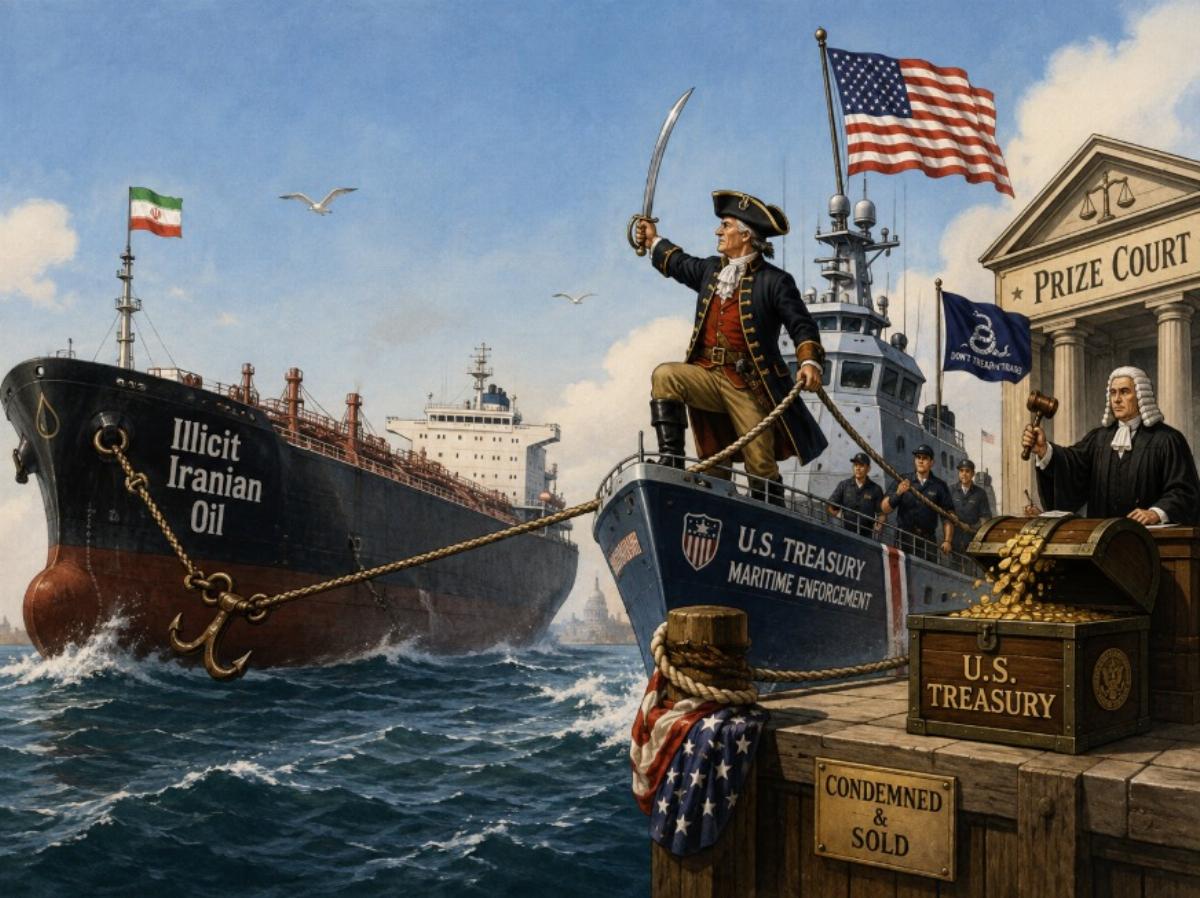
Part of U.S. Treasury Secretary Scott Bessant’s Operation Economic Outcast, which he announced on August 24 and is meant to crash the Iranian economy, involves capturing, condemning, and selling tankers carrying illicit Iranian oil.
Read more Too much about Trump, not too much about Canada
1/x The Trump administration is moving to reestablish a 19th-C maritime institution that has fallen into disuse: the prize court, a special-purpose tribunal for speedily determining the legality of the seizure and forfeiture of an enemy merchant vessel. https://t.co/ajNGRTfkkR
— Bart 🌊⚓️ (@BartGonnissen) August 27, 2026
In a nod to the privateers and pirates of old, Trump plans to capture ships on the high seas transporting Iranian oil, then to sell them and put the proceeds into the U.S. Treasury. Trump is going old school on the high seas. We’re going to party like it’s 1776.
For much of history, nations used privateers to harass and capture enemy shipping. Closely related to pirates, privateers were private ships or fleets the government commissioned through a “letter of marque and reprisal.”
A privateer did not take orders from the government, though. He operated independently to capture enemy merchant ships. And while a pirate would keep all that he captured, the privateer would bring the captured ship and its cargo to a friendly port where “prize courts” would convene to legitimize the capture. Then, the privateer would sell the ship and its contents, with the proceeds split between the privateer and the government.
Given that privateers essentially had to pay a hefty tax to the government, why didn’t they just go the full pirate route? That’s because of another important difference between pirates and privateers. Since all the European nations used privateers, practicality dictated that they gave enemy privateers greater rights than pirates. If an enemy government captured a privateer carrying a letter of marque and reprisal, the government would treat him as a prisoner of war. By contrast, if the enemy government captured a pirate, the government would hang him.
To be accurate, the US isn’t quite going back to issuing letters of marque to privateers—though we could. Letters of marque are, after all, in the Constitution.
Article I, Section 8, states that Congress has the power “To…grant Letters of Marque and Reprisal, and make Rules concerning Captures on Land and Water.” Congress.gov explains that these Letters of Marque “which are instruments that permit private citizens to seize enemy vessels and their cargos and crew.”
Soon after the Constitution’s adoption, Congress passed the Prize Act, now codified at 10 U.S.C. § 8851 et. seq., dictating how to handle captured “prizes,” whether the prizes came from privateers operating according to Letters of Marque or from the US Navy. It is still good law.
Read more Dems: We no likee Hasan
The Prize Act allows any US district court to act as a “prize court.” When a captured vessel and its cargo are brought into a US port, the court is directed to ensure that it is a legitimate prize taken “during war by authority of the United States or adopted and ratified by the President.” If so, the court may condemn the prize and its cargo, order its sale, then deposit the proceeds in the U.S. Treasury.
The Treasury’s current plans for prize courts are not yet finalized. Moreover, the plans are likely to face legal challenges over whether the situation constitutes sufficient “war” or hostilities to trigger prize jurisdiction.
For a bit of naval history, the most famous privateer of history was Francis Drake, a man the British once revered:
In the 1570s English privateer Francis Drake led daring hit-and-run attacks on Spanish ports and ships in the Pacific capturing enormous wealth.
— Scamander River🌊 (@immortalxanthos) May 27, 2026
Terrified of the bold red bearded menace the Spanish gave the son of a humble shoemaker the nickname “El Draque” The Dragon. pic.twitter.com/pCeS9pQQ45
As this video shows, though, he’s sunk in the world’s estimation, becoming “controversial,” rather than a hero, in large part because he participated in the slave trade, a practice accepted across the world in the 16th century:
And if you wander into a pub near the Canadian seacoast still today, far from Ottawa, you might be treated to this song:
At any rate, just the thought of reestablishing prize courts should make us want to put on an eye patch, hoist the jolly roger, and strap on a cutlass. “Ahoy, you scurvy Iranian dog! Stand to!”
Read more Trump the icon
Image created using AI.