
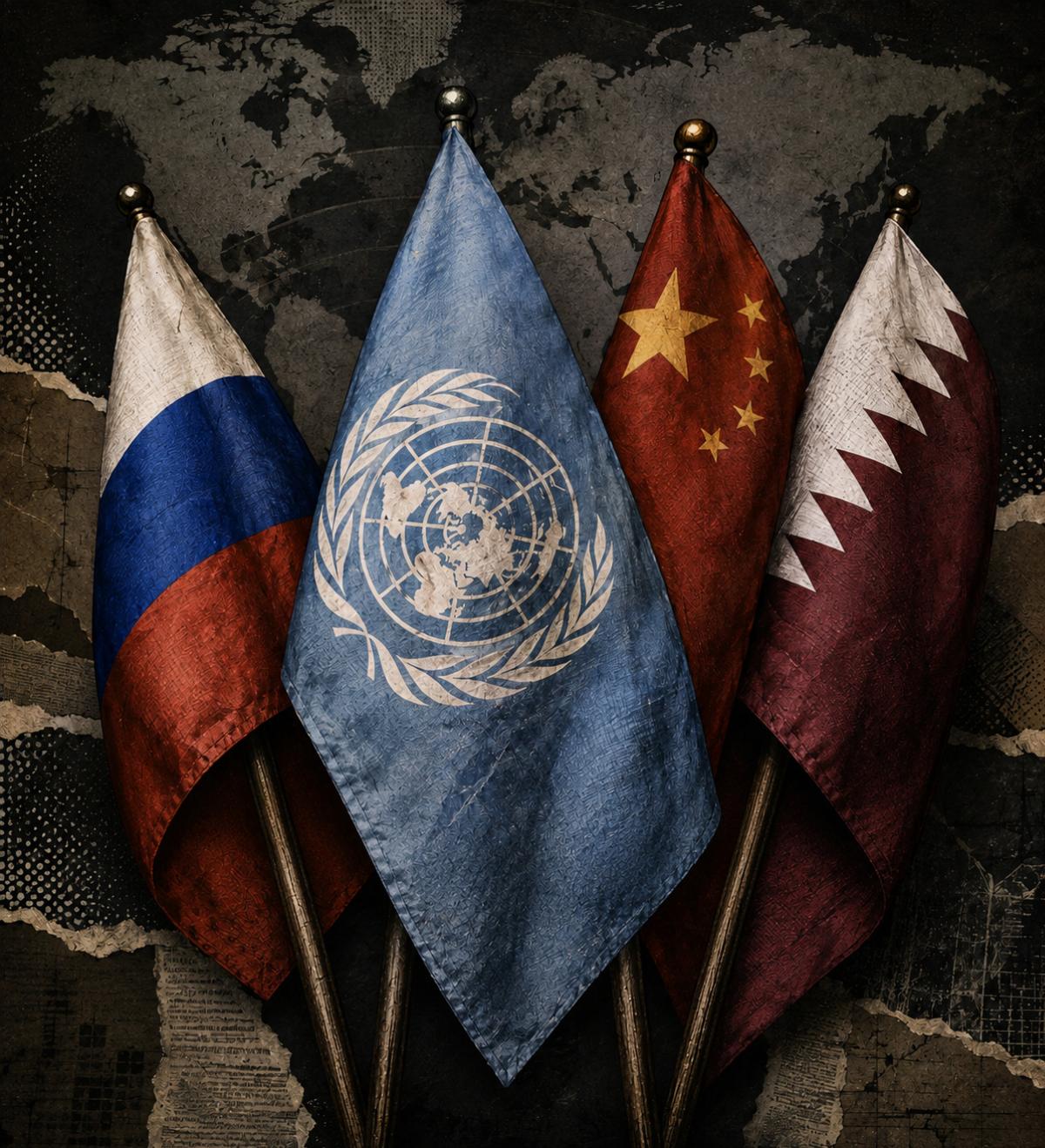
Several UN special rapporteurs face growing questions about their independence. Among them, Ben Saul has drawn particular scrutiny. A law professor at the University of Sydney, Saul became the UN Special Rapporteur on the promotion and protection of human rights and fundamental freedoms while countering terrorism in November 2023. His mandate is to examine how states fight terrorism while respecting human rights. Several international experts now doubt whether he does so impartially.
Read more Rep. LaMonica McIver is facing justice
A pattern critics recognize beyond South Asia
Saul’s critics are not confined to South Asia. Moroccan lawmaker and political analyst Lahcen Haddad took aim at Saul’s writing on Western Sahara in May 2026. Haddad argued that Saul’s reading of the International Court of Justice’s 1975 advisory opinion was simplistic. The real issue, Haddad wrote, was “the transformation of an ideological interpretation into absolute truth.” He accused Saul of treating a contested, evolving legal question as settled fact. That critique suggests Saul’s pattern of asserting legal certainty where none exists is not limited to a single region or dispute.
The China funding question
A May 2026 report by the Geneva-based UN Watch, titled “,” examined 13 Special Procedures mandate-holders. It documented politicized appointments, selective targeting of democracies and troubling funding arrangements. On Saul specifically, the report highlighted one-sided criticism of Western powers and a documented silence on China’s own record.
According to the report, Saul’s office received $150,000 from China in 2024. UN Watch Executive Director Hillel Neuer pressed the point on Sky News, asking how Saul could call himself independent while his office took money from Beijing. The funds went to Saul’s office rather than his personal accounts, but the report noted a lack of detailed public accounting. Crucially, Saul’s office has issued no statements condemning China’s mass detention of Uyghur Muslims — the same “counterterrorism” framing that falls squarely within his mandate.
Anti-Israel rhetoric and antisemitism concerns
UN Watch’s report goes further than the China funding question. It accuses Saul of whitewashing antisemitism and defending extremists, and it describes his public commentary as one-sided anti-Israel rhetoric that denies Israel’s legitimate security concerns. Neuer expanded on this in his Sky News interview, saying Saul’s statements reflect a distinct anti-American, anti-Western, and anti-Israel ideology, and that these positions tend to travel together among radical-left activists.
The report points to Saul’s response to the killing of senior al-Qaeda leader Ayman al-Zawahiri as illustrative. Saul condemned the U.S. strike as unlawful, a position UN Watch cites as evidence of selective concern: swift criticism of a Western counterterrorism operation against a designated terrorist, paired with continued silence on China’s campaign against the Uyghurs. That asymmetry, the report argues, undermines Saul’s claim to assess counterterrorism practices by a single, consistent standard.
Targeting India after Pahalgam
These funding and ideology questions carry particular weight in India. On April 22, 2025, Pakistani terrorists linked to Lashkar-e-Taiba massacred 26 people, mostly Hindu tourists, in Jammu and Kashmir. Survivors described a religious filtering process: Victims were asked their faith or told to recite the Islamic declaration of faith, and those who could not were shot.
Read more Catholic priest says he doesn’t like the word ‘God’
Seven months later, on November 24, 2025, Saul co-signed a joint OHCHR statement with more than a dozen other UN experts. While the statement opened by condemning the Pahalgam attack, its substance focused almost entirely on India’s response. It cited unverified reports and it characterized demolitions of properties linked to terror suspects as collective punishment, and described the blocking of social media accounts as disproportionate.
What the statement did not do was engage with why those measures were taken: a massacre in which victims were separated by religion and executed, carried out by a Pakistan-based terror group with a documented record of cross-border attacks. Indian officials have pointed out that the properties demolished belonged to identified, proven militants, not uninvolved residents, and that the security response followed an attack explicitly designed to provoke communal violence.
A wider pattern of selective scrutiny
The UN Watch report places Saul’s record within a broader trend it documents across the 13 mandate-holders it examined. It states that Alena Douhan, the Special Rapporteur on unilateral coercive measures, received more than $1.3 million in funding from China, Russia, and Qatar, and that her visit with these regimes consistently favored the authoritarian governments over their victims. Separate UN Watch findings, not part of the report itself, put George Katrougalos, the expert on a “democratic and equitable international order,” at receiving $100,000 from China in 2025. Meanwhile, Saul has called the United States a “gangster state” and argued that decolonization, not Western liberals, created human rights.
The Code of Conduct for Special Procedures mandate-holders gifts or benefits that could influence their work. Special rapporteurs are unpaid volunteers, and accepting institutional support is not itself improper. But when an expert accepts funding tied to a government he never criticizes, then singles out a democracy’s response to a religiously targeted massacre for scrutiny, that combination invites the question Neuer and Haddad have separately raised: independence from what, exactly?
An independent counterterrorism rapporteur should examine both the terrorist act and the state’s response with equal rigor. The combination of undisclosed funding, a documented pattern of anti-Western and anti-Israel framing, and Saul’s public statements after Pahalgam has left that independence open to serious doubt.
Read more Wave goodbye to Russia’s space program
Image generated by ChatGPT.