
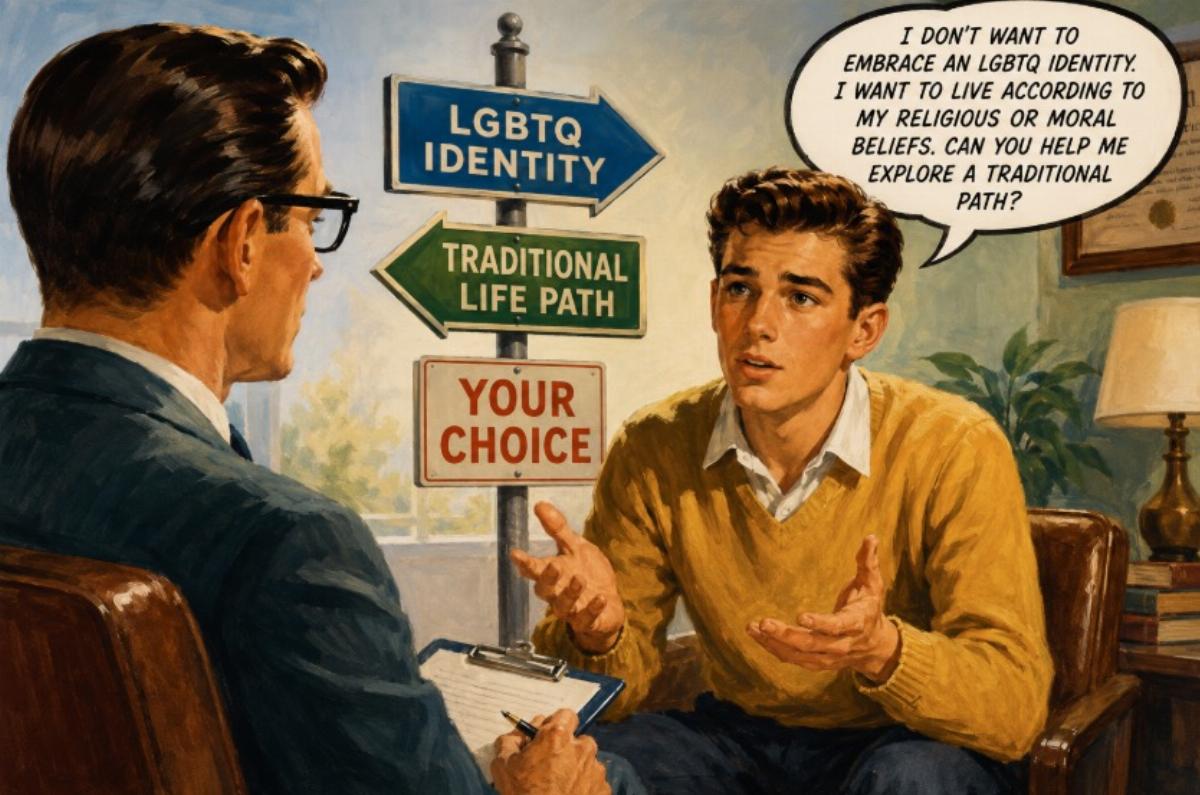
The first stop for young people questioning their gender or sexual identity is most often a counselor. Two questions: 1) Should a young person with moral or religious convictions be able to receive supportive counseling in pursuing a traditional life path? 2) Should counseling programs be allowed to train therapists to help those who want to pursue a traditional life path without jeopardizing their accreditation?
Read more The Cultural Divide, The Crisis Of Womanhood, And The Revitalization Of Motherhood
Given the enormous increase in the number of young people who are self-identifying as LGBTQ and the influence of these counselors on our young people, providing clients with free choice is crucial.
Counseling is supposed to help clients pursue their own goals. Yet, what happens if a young person says to a therapist, “I don’t want to embrace an LGBTQ identity. I want to live according to my religious or moral beliefs”? Will the therapist be able to help?
Will the therapist feel pressure from the state licensing board and decline to assist or try to guide the young person to accept an LGBTQ identity?
There is plenty of business for therapists these days, as almost thirty percent of U.S. Gen Z women (ages 18–27) are self-identifying as LGBTQ, and there are higher percentages for both sexes at elite universities (Gallup 2024). According to the Trevor Project, an LGBTQ crisis hotline, roughly half of those who are questioning their sexual identity or gender have therapists.
Because of their perceived expertise, these therapists have tremendous influence over clients as they try to decide what their true feelings mean.
Can therapists receive training in helping guide those who are questioning their identity yet desire to live a traditional life? Apparently not. There are two major accreditation programs and several specialized accreditation programs.
The major programs are CACREP, the Council for Accreditation of Counseling and Related Educational Programs, and MPCAC, the Master’s in Psychology and Counseling Accreditation Council. There are also specialized accreditors, such as NASP, the National Association of School Psychologists. It appears that all of them are committed in one way or another to the ACA (American Counseling Association) Code of Ethics.
The Code of Ethics says that they “strongly oppose conversion, reparative, or any coercive therapies intended to change a client’s inherent identity, as these are recognized as psychologically harmful.”
The question is, what is their “inherent identity”? Is there any type of physical test available? No. What if a person is questioning his or her inherent identity?
Is a simple discussion with a client who desires a traditional path in life a conversion, reparative, or coercive therapy? Is a simple discussion psychologically harmful? If the client wants to discuss occasional thoughts or feelings with a therapist but wants to live a traditional life aligned with religious values, can the therapist help?
Can a therapist help a person explore, for example, why certain triggers exist, how to make real connections, or whether anxieties can be managed?
The idea of “inherent identity” is based on the notion that one’s sexual identity is immutable and that, once “uncovered” and declared, it can never change. This premise is obviously false.
Why else would there be five times as many former lesbians as current lesbians and more than a third as many former male homosexuals who are now leading traditional lives?
Read more The Late Jason Arday: Just Another Dead Body For The Left To Use
The Supreme Court in Chiles v. Salazar recently decided, 8–1, to block a Colorado restriction on “talk therapy” on the ground that preventing those discussions with a minor was a violation of free speech based on viewpoint regulation.
The impact, though, seems to have been limited. A few months after the decision, in May 2026, Colorado passed an amendment to its conversion-therapy ban in order to comply with the ruling, redefining conversion therapy as “directing a patient toward a predetermined sexual orientation or gender identity outcome, or eliminat[ing] or reduc[ing] attractions toward individuals of a particular sex or gender.”
So, what does that mean for the young person who wants to lead a traditional path in life and seeks therapy? Can the talk therapy include helping that person pursue a traditional life path or manage unwanted attractions? According to Colorado law, it seems not.
The United States is “one nation under God.” For those of us who believe this is more than a slogan, limits on free speech in helping people live according to God’s plan are problematic.
The notion of inherent identity is dehumanizing and antithetical to the Biblical principle of free will; i.e., it is a denial of a person’s agency to choose. The Rebbe, Rabbi Menachem Mendel Schneerson, of blessed memory, wrote about the LGBTQ challenge, “one has the capacity to choose the right behavior and it is entirely a matter of one’s will and determination.”
Religion has been a key component for many in the therapeutic process. The Brothers’ Road organization is a classic example for men, lending faith-based support to their journey.
A widely seen, touching video series follows a man here in Israel on his journey. It follows him from a gay life, through faith in God, to marriage with a woman and the birth of their first child (Ani Yosef—Hebrew for I am Joseph).
The current culture is bombarding our young people with LGBTQ acceptance and celebration. Many who are getting caught in this cultural storm, unsure of their gender or sexual identity, want to explore whether there are ways to pursue a traditional path.
What can be done to change the situation so these young people have a choice and can find a counselor who can help them pursue the path they desire? Why are we paying for counseling schools through grants and student aid to indoctrinate our counselors with solely LGBTQ support and confirmation?
Why isn’t there an accreditation program that supports counseling programs that include a traditional path, as faith-based or conservative religious universities want to provide?
Given the number of young people who are questioning their gender or sexual identity, the stakes are enormous individually, for their families, and for the nation. If we change the counseling, we change the culture.
Image created using AI.
Yehezkel (Gary) Schiff is President of Jewish Family Forever, jewishfamilyforever.org.
Read more The Tyranny of Voter Apathy