
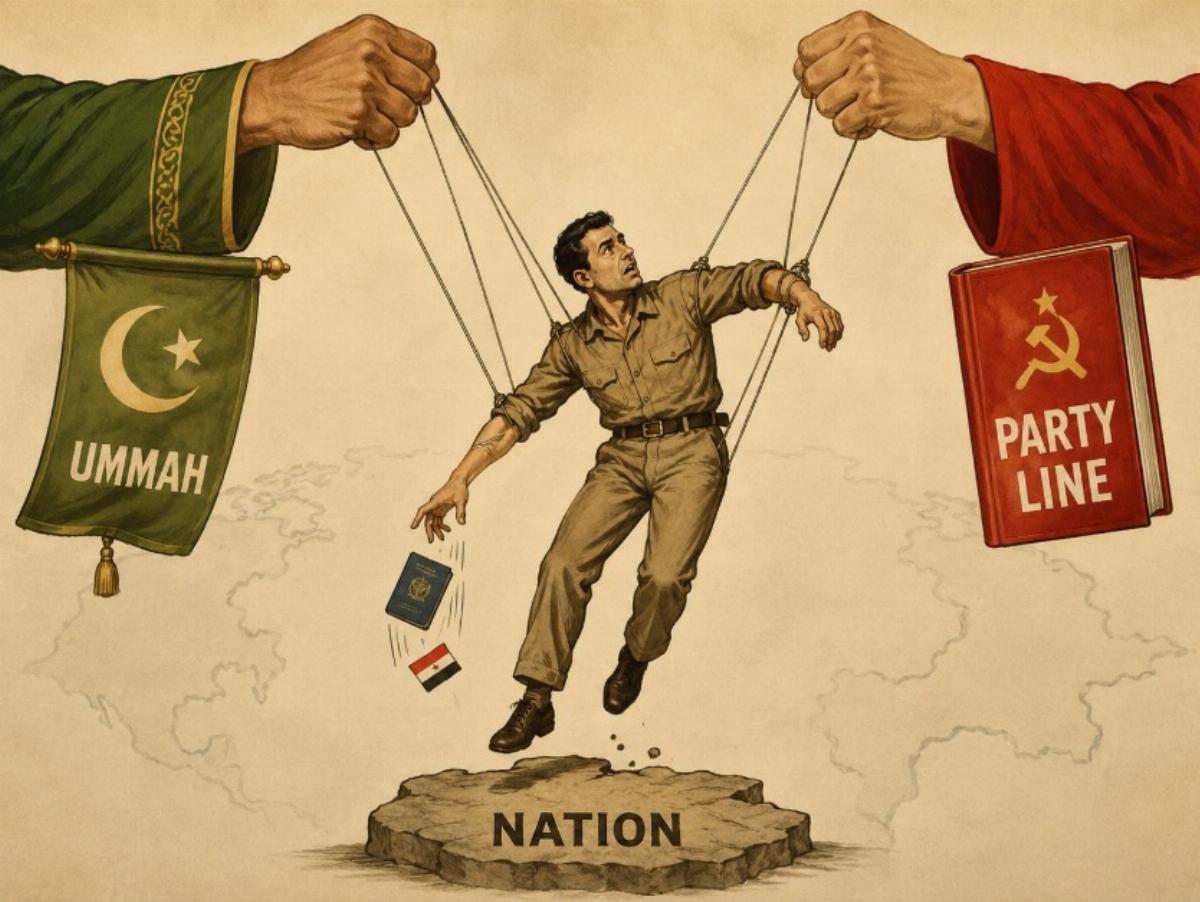
In revealing the commonalities of the Reds and the Greens in the Red-Green Axis, we have elucidated the shared goals of communists and Muslims, including violence, monopoly rule by elites, slaughter, etc. (See the full list of essays exposing these commonalities at the end of this article.) Here we explore how transnational loyalty overrides national borders.
Read more Shaming the Shameless: A Fool’s Errand
Islamic political systems and Marxist-Leninist communism both subordinate national loyalty to a transnational community defined by doctrine, and both have shown that this subordination is not just words. When the higher loyalty and the national one have actually come into conflict, adherents of both traditions have been called to choose the higher loyalty, and have done so.
The ummah is the primary community in Islamic political theory: a single body of believers, bound by faith rather than territory, whose obligations to one another do not stop at a border. A stark demonstration came in November 1914, when Ottoman Sultan Mehmed V, acting in his capacity as caliph, proclaimed jihad against the Entente powers.
Five fatwas issued by Sheikh ul-Islam declared the war an individual religious obligation binding on Muslims everywhere, including the roughly 140 million living under British, French, and Russian rule, appealing to a loyalty that ran through the caliphate rather than the empires governing them.
The proclamation reached Muslim communities thousands of miles from Constantinople. On New Year’s Day 1915, in the Australian mining town of Broken Hill, two Muslim cameleers, Badsha Mehmed Gül and Mulla Abdullah, opened fire on a trainload of picnickers, killing four people before being killed themselves.
Gül cited the Sultan’s declaration directly as his motive. A call issued in Constantinople had reached a small Muslim community on the far side of the world and produced violence against the country in which the men resided.
Marxist-Leninist communism built the same structure by statute rather than fatwa. The Communist International’s Twenty-One Conditions, adopted in 1920, bound every affiliated national party to the Comintern’s discipline; Condition 16 made every decision of its congresses and executive committee binding on all of them, regardless of national circumstance.
The test of the doctrine came in 1939, when the Molotov-Ribbentrop Pact required French Communists to stop treating the war as an anti-fascist cause and instead denounce it as a meaningless conflict between rival imperialist powers, none worth a worker’s loyalty. The Comintern ordered Maurice Thorez, general secretary of the French Communist Party, to desert.
On October 4, 1939, while France was at war and Thorez was serving in its army, he deserted, fled through Belgium, and reached Moscow. A French military tribunal convicted him in absentia and sentenced him to death. The leader of a major national party had abandoned his country’s army, under his own government’s flag, on instructions from an authority outside it.
The parallel is not that the doctrines reason alike. In fact, the grounds are entirely different, for one is theological, the other historical and organizational.
The commonality is that both constructed a transnational authority capable of issuing a command that superseded the claims of citizenship, and that command was followed by real people at real cost: death by gunfire in one case, a death sentence in the other.
Neither history is symbolic. Both are documented instances of the higher loyalty overriding the national one when the two came into open conflict.
The mechanism outlived the Ottoman caliphate’s 1924 abolition. After the Islamic State declared a caliphate in June 2014, more than 40,000 people from over 110 countries left their countries of citizenship to join it, according to the Soufan Group’s tally, framing the move as hijra, an obligation of emigration to the land of true Islamic authority rather than an act of foreign enlistment.
The reverse direction operated too. On July 18, 1994, Hezbollah, acting on the orders of the Iranian government, bombed the Jewish community center in Buenos Aires, killing eighty-five people in a country with no territorial dispute with either Iran or Israel. Argentine courts found Iran responsible.
The target was chosen by religious-communal identity, not by any conflict between Argentina and its attackers. Islamic State’s recruits and Hezbollah’s operation ran on different transnational authorities, Sunni caliphate and Shia clerical rule, but both moved on the same premise, namely, that Islam’s claim on its members outranks the borders either side of the operation crossed.
Communist internationalism persisted past the Comintern’s 1943 dissolution, carried by successor networks rather than a single directing body. On June 27, 1976, members of the Marxist-Leninist Popular Front for the Liberation of Palestine and West Germany’s Revolutionary Cells, a secular far-left group with no religious program, hijacked an Air France flight and diverted it to Entebbe, Uganda, where they separated Jewish and Israeli passengers from the rest and held them under armed guard, supported logistically by Idi Amin’s government and by matériel tracing to Soviet-bloc suppliers. The operation crossed four countries and was carried out by nationals of none of them, directed by militants whose operative loyalty ran to an international revolutionary cause rather than to Germany, “Palestine,” or Uganda.
Five Cambridge-educated Britons recruited in the 1930s specifically for their ideological commitment to communism—Philby, Burgess, Maclean, Blunt, and Cairncross—passed secrets to Moscow for decades from inside British intelligence and the Foreign Office. Burgess and Maclean fled to Moscow in 1951 when exposure loomed; Philby, suspected that year but not confronted, operated another decade before his own 1963 defection. Foiled plots against prominent targets leave their own trail of arrests and prosecutions.
If the documented tier runs this deep, the undocumented one beneath it—an uncaught courier, minor logistical support that never draws investigation, a member who simply chose the cause over his country without any act rising to notice—is deeper still. The named cases are a floor, not a full account.
Read more Communist China is storming Harvard
The objection that classical jurisprudence generally requires Muslims to obey the laws of a country where they can safely practice their faith, dar al-’ahd, the abode of covenant, or that communist practice stressed building socialism in one country, does not unsettle this. Civic obedience is the default for ordinary times, not a competing claim of equal standing.
Classical exegesis of Quran 8:72 distinguishes religious brotherhood, owed to the ummah everywhere, from political and military allegiance, tied by the same verse to residence in the Islamic polity, so the default was conditional from the start. A caliphal proclamation like Mehmed V’s could suspend it because it was never absolute.
“Socialism in one country” was itself a Comintern-managed doctrinal position, adopted by Stalin over Trotsky’s objection and enforced through the same international apparatus responsible for Thorez’s desertion five years later; it redirected tactical priority without renouncing the claim that party discipline superseded national ones. Both objections describe how the transnational community manages ordinary affairs, not evidence that it ever suspended its supreme claim.
Transnational loyalty overriding national citizenship is a demonstrated mechanism, applied even at severe cost, e.g., a colonial subject who killed and died for a Sultan’s proclamation on the other side of the world, and a party leader who deserted his country’s army and was sentenced to death for it. Both doctrines got exactly the kind of loyalty they claimed to be owed, from people willing to pay for it.
Image created using AI.
Previous essays in this series
- The Mohammunist Manifesto
- The Mohammunist Manifesto’s Wealth Redistribution Agenda
- The Mohammunist Manifesto’s Inequality Before the Law
- The Mohammunist Manifesto—The World as a Binary
- The Mohammunist Manifesto—Monopoly Rule By Elites
- The Mohammunist Manifesto—Public Or Private, Nothing Is Beyond Our Control
- The Mohammunist Manifesto—The Promise of ‘Transitional Phase’ Slaughter
- The Mohammunist Manifesto—Trojan-Horsing Society’s Institutions
- The Mohammunist Manifesto—Rejection of Pluralist or Limited Government
Endnotes
1. Ottoman Sultan Mehmed V’s November 1914 jihad proclamation and the accompanying fatwas: Erik Jan Zürcher, ed., Jihad and Islam in World War I (Leiden University Press, 2016); Mustafa Aksakal, “Ottoman Origins of the 1914 Jihad,” War in History 18, no. 2 (2011): 184–199. The Sheikh ul-Islam was the Ottoman Empire’s highest official authority on Islamic law, appointed by the Sultan and responsible for issuing fatwas on matters of state; the office’s endorsement was what converted the Sultan’s political declaration of war into a binding religious obligation on Muslims generally, not just Ottoman subjects.
2. The Battle of Broken Hill (January 1, 1915): contemporary accounts in the Barrier Miner and The Argus (January 1915); the attackers raised an Ottoman flag and left notes citing the Sultan’s jihad declaration. Some recent scholarship argues economic hardship and personal grievance were significant contributing factors alongside the religious motivation; see the reassessment in the Journal of Muslim Minority Affairs 42, no. 4 (2023).
3. On the binding subordination of national parties to Comintern discipline: Conditions of Admission to the Communist International (the “Twenty-One Conditions”), Second Congress of the Comintern (1920). Condition 16 declares all decisions of the Comintern’s Congresses and Executive Committee binding on every affiliated party. Primary text at marxists.org/history/international/comintern/2nd-congress/ch04.htm.
4. Maurice Thorez’s October 1939 desertion, his in absentia conviction and death sentence: “Maurice Thorez,” Encyclopaedia Britannica. Thorez remained in Moscow until 1944, when Charles de Gaulle granted amnesty and France restored his citizenship the following year; this reflected the PCF’s dominant role in the armed Resistance after the Comintern’s line reversed following Germany’s June 1941 invasion of the USSR and the pragmatic necessity of the party’s cooperation in postwar government, not a reconsideration of the 1939 desertion itself, for which the conviction was never overturned.
5. V. I. Lenin, Preliminary Draft Theses on the National and Colonial Questions (1920), written for the Second Congress of the Communist International. Primary text at marx2mao.com/Lenin/DTNCQ20.html.
6. Soufan Group, Beyond the Caliphate: Foreign Fighters and the Threat of Returnees (October 2017), documenting more than 40,000 foreign fighters from over 110 countries who joined the Islamic State.
7. The July 18, 1994 AMIA bombing in Buenos Aires: American Jewish Committee, “Remembering the AMIA Bombing” (2024); Argentine federal courts ruled the Iranian government responsible and Hezbollah the operational perpetrator; U.S. Department of Justice indictment of Samuel Salman El Reda (2023).
8. The June 1976 Entebbe hijacking, carried out by the Marxist-Leninist Popular Front for the Liberation of Palestine–External Operations and West Germany’s Revolutionary Cells, with logistical support from Idi Amin’s government and training tied to Soviet-bloc networks in South Yemen: Jeffrey Herf, Undeclared Wars with Israel: East Germany and the West German Far Left, 1967–1989 (Cambridge University Press, 2016), ch. 10.
9. The Cambridge Five (Kim Philby, Guy Burgess, Donald Maclean, Anthony Blunt, and John Cairncross), recruited beginning in the early 1930s specifically for their ideological commitment to communism and operating inside British intelligence and the Foreign Office for decades, Philby until his 1963 defection to Moscow: declassified British security service files and Philby’s own 1963 confession, released by the UK National Archives; standard account in Ben Macintyre, A Spy Among Friends: Kim Philby and the Great Betrayal (Crown, 2014).
10. Karl Marx and Friedrich Engels, Manifesto of the Communist Party (1848), final paragraph: “Working men of all countries, unite!” Primary text at marxists.org/archive/marx/works/1848/communist-manifesto.
11. Stalin’s December 1924 doctrine of “socialism in one country,” articulated against Trotsky’s theory of permanent revolution and adopted as Comintern-managed policy by 1925–26: “Socialism in One Country versus Permanent Revolution,” Seventeen Moments in Soviet History (Michigan State University), soviethistory.msu.edu/1924/industrialization-debate.
12. On dar al-’ahd (the abode of covenant) and the classical and modern basis for civic obedience by Muslims residing securely under non-Muslim rule: Wahbah al-Zuhayli’s discussion is summarized in “Divisions of the World in Islam” and related juristic literature; on classical tafsir of Quran 8:72 distinguishing universal religious brotherhood from political and military allegiance tied to residence in the Islamic polity, see the commentaries of Ibn Kathir and al-Qurtubi ad loc.
Read more Where socialists are made