
Broadly speaking, there are three classes of people most of us fall into, and they form what I term the Reality Triangle:
Read more Washington Keeps Sending ‘Proof of Life’ About the Redskins And Chief White Calf
- Pragmatists—People who make decisions based on what works in the real world. Outcomes drive them.
- Opportunists—People who act based on advantage—personal gain, leverage, timing, or self-interest.
- Idealists—People who act based on principle—moral frameworks or philosophical commitments.
However, there is a fourth, much smaller and, to my mind, darker group of people: True Believers, who are existential threats because their calculations of self-interest are subordinate to their emotional commitment, making them resistant to, or even activated by, evidence to the contrary.
Societies function well when people remain responsive to reality. Outcomes, incentives, and consequences induce corrections. Societies become destabilized when people unresponsive to those mechanisms acquire enough influence to shape the behavior of everyone else.
That may be happening now in American politics, with the Democrat party discovering that it has less control over its political future than it believes. For generations, political influence generally flowed through a standardized institutional structure:
Party → Candidates → Media → Voters
The party helped determine which candidates emerged. The media helped shape the political conversation. Candidates sought votes by appealing to voters within that system.
But a different model is rapidly gaining sway:
Influencer → Community → Political Identity → Voters → Candidates
That distinction represents a shift in where political power originates. The political influencer builds community first. The community develops its own language, heroes, villains, grievances, and political identity. That identity then shapes what candidates the voters demand. The political party may find itself responding to a political movement it did not create and therefore cannot control.
Political parties are increasingly becoming downstream from political communities they didn’t create. That should concern anyone who believes political power ought to be accountable. The unsettling part is not that a social media streamer has influence. It is that he can now build a political community outside the party and acquire enough influence to make the party accommodate it. Yet that may be precisely what the new digital political ecosystem has created.
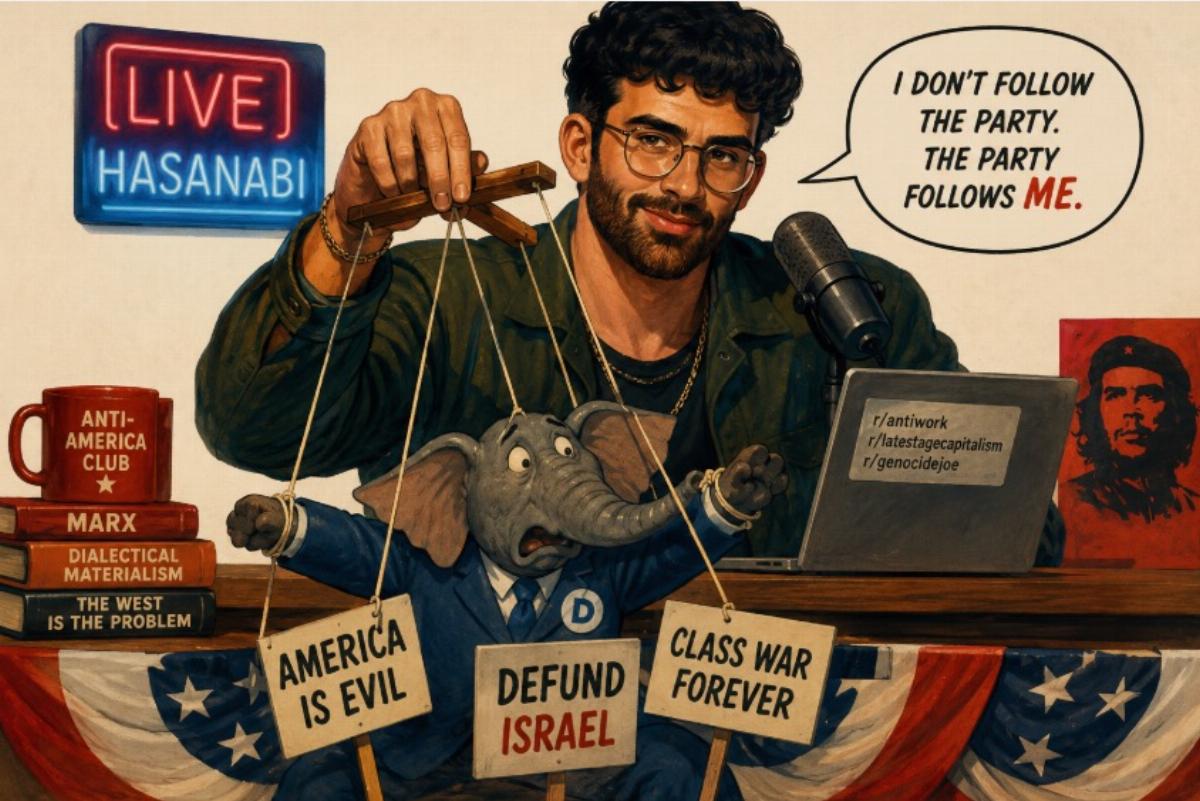
Hasan Piker provides a useful case study.
Hasan Doğan Piker, known online as HasanAbi, is a Turkish-American political commentator and one of Twitch’s most-watched streamers. Raised mostly in Istanbul, he graduated from Rutgers University. His streams blend political analysis, news reactions, gaming, and audience interaction, making him a major influence on a specific audience and a rising star on the left.
The clearest takeaway in Piker’s political messaging is that he frames major issues—foreign policy, labor, culture, media, and elections—through a materialist, anti-imperialist, left-populist lens. His appeal is particularly strong among digitally native young men who prefer interactive political commentary to traditional media and are entranced by confrontational, anti-establishment rhetoric.
But Piker’s significance is not simply the millions who watch him daily. It is what happens inside the community he has created. Traditional political media tells you what happened; streamers create an alternate universe in which viewers spend enormous amounts of time surrounded by people who share the same political assumptions. The same arguments, grievances, and conclusions are reinforced repeatedly. Political identity becomes not merely something a person believes but something he experiences as part of a community.
We used to call that model brainwashing.
Digital platforms have changed everything. Americans have traditionally resisted this kind of political socialization because independent institutions, competing media, religious organizations, civic groups, and individualism provided competing sources of identity and information. A person might encounter an idea at church, at work, from a newspaper, from a neighbor, or from a political party. No single source necessarily controlled the information environment.
That is different inside a highly engaged digital community where the community itself becomes the information environment. Once that happens, the political influencer is no longer merely persuading people; he determines what viewers see as credible.
That brings us back to the Reality Triangle. What makes someone a True Believer rather than simply an extreme Idealist? It is not the extremity of the belief. An Idealist can hold deeply unpopular beliefs and still change his mind when reality proves him wrong. The distinction is what happens when belief collides with evidence.
Read more The Cyclospora Panic of 2026
That is the test we should apply to Piker.
Does contrary evidence cause him to reconsider, or does it simply become another reason to attack the people, institutions, or facts that produced it? Does reality remain capable of changing the conclusion, or has ideology become all that matters?
True Believers run the gamut from high-functioning evil geniuses to those who can’t string ten words into a coherent sentence. Intelligence is not the distinguishing characteristic. True Believers are the pathological exception to the norm: people for whom belief itself overrides reality.
This is where the political implications become starkly relevant, revealing how the Democrat party increasingly has to contend with political actors who exist outside its institutional hierarchy yet possess something the party itself can no longer generate: an intensely engaged political community.
Democrats want these people inside the party. They may believe they are recruiting young political actors and can moderate them once they become candidates. They’re discovering instead that the party is recruiting itself into their political movement.
There is an old cautionary tale about a young woman who “rides the tiger.” She enjoys the thrill and believes she is in control. But eventually the tiger turns and devours her. The lesson is simple: once you climb onto a tiger, control is an illusion.
That is the predicament facing Democrats today, and it’s profound: the party once helped shape the candidate and the message. Now, the influencer can shape the community, the community can develop the political identity, and that identity can determine which candidates receive its energy.
Democrats have a choice: resist that movement, attempt to absorb it, or follow it. The danger is that the third option eventually makes the party subordinate to a movement it can no longer control.
This may help explain something that otherwise seems difficult to understand about the modern Democrat party. Its movement to the left may not have been the party’s choice. Pressure may have come from political communities that developed outside the traditional party structure, forcing the party to respond.
The party no longer creates the demand; it may simply have no other choice but to acquiesce.
That is why Piker matters. The question is not whether he is influential; clearly he is. Nor is it simply whether his politics are extreme. The larger question is whether America is entering an era in which political identity is increasingly formed outside traditional political institutions—and those institutions are then forced to accommodate the communities that form it.
If so, the Democrat party’s problem is considerably larger than Hasan Piker. It may be discovering that the party no longer shapes the movement; the movement is shaping the party.
God Bless America.
Image created using AI.
Author, Businessman, Thinker, and Strategist. Read more about Allan, his background, and his ideas to create a better tomorrow at 1plus1equals2.com.