
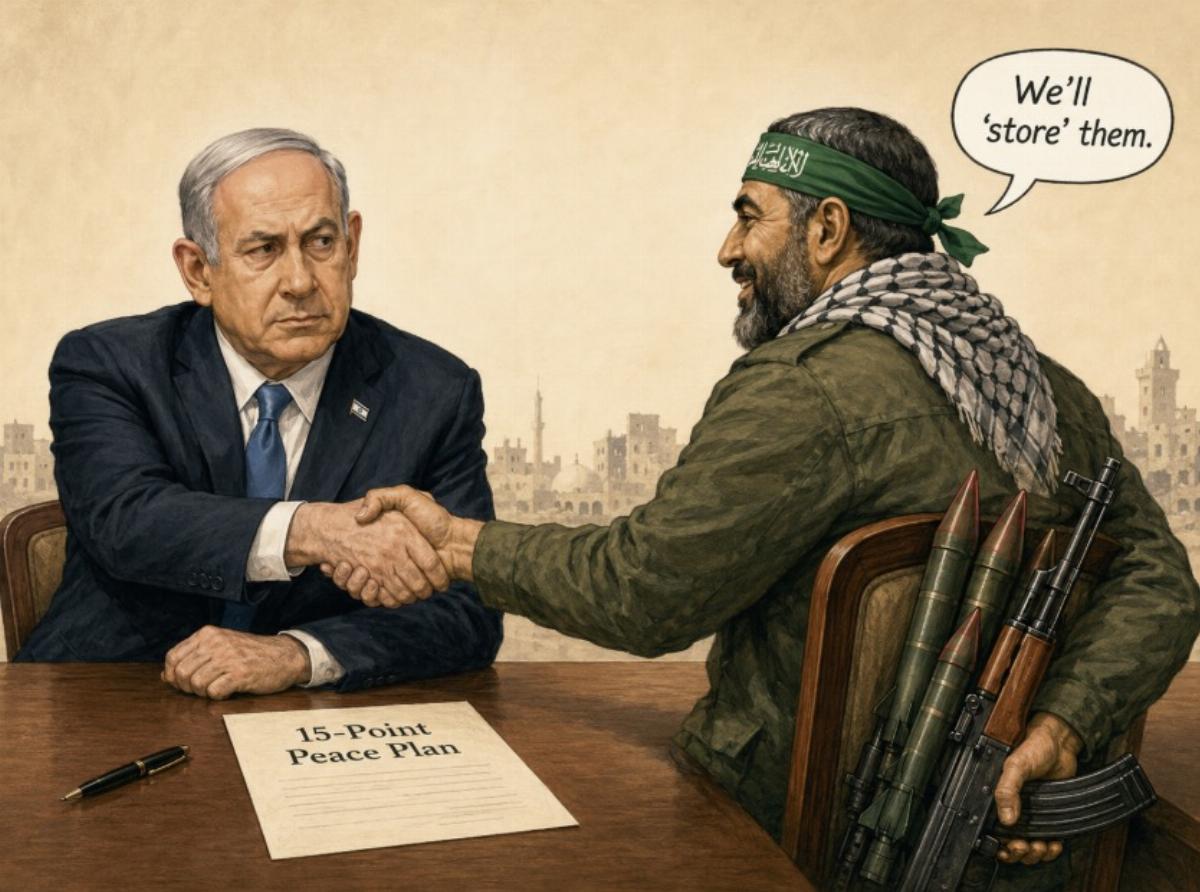
Despite President Trump’s lauding the 15-point agreement that was supposed to bring peace to Gaza, ending the conflict looks more distant every day. The world likes to blame Israel for the delays in the process because Israel makes a popular punching bag, but it’s important to remember key points that support the Hamas and Israel positions.
Read more SPLC: The first domino falls
Let’s remember how this disaster began: Hamas perpetrated the October 7, 2023, attack. Although Hamas likes to blame its actions on Israel’s occupation of Gaza, Israel turned Gaza over to the Palestinians nearly 20 years ago.
There is no occupation.
The next point to make about Hamas is that Israel, the United States, and the European Union have designated Hamas a terrorist organization bent on the destruction of Israel. Can it “change its stripes” and suddenly become not only peaceful, but also willing to agree to peace with Israel?
In earlier negotiations, Hamas repeatedly changed the terms of agreements that were supposedly settled. Why does anyone think it is serious about making a firm commitment at this time?
If we look at the terms of the most recent agreement presented by Trump, there are clearly problems with executing it.
First, Hamas is choosing to interpret the agreement in a totally unsatisfactory way. It is demanding that Israel withdraw its troops while Hamas is “handing over its weapons” (that is, before it even disarms). Hamas has specified that it should be allowed to keep certain types of weapons. There is no way that Netanyahu will allow Israel to become vulnerable unless Hamas relinquishes all of its weapons first:
The group has avoided using the term ‘disarmament.’ It says it agreed to hand over its weapons for storage under a US-backed Palestinian technocratic administration that would govern Gaza under the supervision of the Board of Peace.
Does “handing over weapons for storage” sound anything like relinquishing the weapons to you? No Palestinian group should be trusted to take custody of those arms; there will be plenty of pressure on it to give them back to Hamas.
Hamas also demanded that Israel pull back behind the yellow line when the disarming begins. But the Board of Peace issued a couple of clarifications:
After the Board of Peace meeting with the Israeli government, the Board of Peace issued a statement seemingly clarifying that sequencing problem.
Read more Joe Biden: a prayer for the wounded
‘Contrary to inaccurate reports, we note that the withdrawal of the IDF beyond the Yellow Line will take place only once decommissioning is complete, as Hamas committed to the mediators,’ it said.
‘This applies to light weapons, heavy weapons, and the tunnels alike.’
It’s no surprise that Hamas is already trying to change the terms of the agreement.
Yossi Kuperwasser, a brigadier general in the IDF reserves and the director of the Jerusalem Institute for Strategy and Security, made another significant point:
‘There’s one point missing in these points of the new agreement. The first article of the [October 2025] 20-point plan was that Gaza is going to be de-radicalised. There’s no reference to de-radicalisation here.
‘So we are left with a radical Hamas governing Gaza and still very forceful, capable of rearming itself.
‘If we withdraw from Gaza under these conditions Hamas is going to be on the footstep, on the doorstep of the same villages and communities that it attacked on October 7th.’
Identifying strategies to de-radicalize will be a difficult task. At the very least, Hamas schools should be required to change their curriculum so that children are not taught that their goal is still to destroy Israel.
Some people accuse Netanyahu of getting caught between the radicals in his government and Israeli election issues when it comes to resolving these matters. But his decision, for starters, to refuse to act until Hamas completely disarms is understandable.
Read more Parent fights private school that booted his kids after hard leftward turn
It could be a matter of life and death.
Image created using AI.