
Some people are born entrepreneurs. I have an ex-friend (we had a falling out over BLM) whom I’ve always imagined was selling washcloths to doctors when he came out of the womb. As a teenager, he started mowing lawns and was so busy he had to hire other kids to do the mowing for him. He ended up being a service provider who was too successful to actually provide the service himself.
Read more Greg Abbott fights the kudzu of creeping Islamism at Texas airports
From there, he started a company teaching entrepreneurship, took a stab at restaurants, and later bought an education company he eventually sold for eight figures. Honestly, the guy’s like Midas incarnate.
His story is far from remote. Although we all know about guys like Michael Dell and Daymond John, for every one of those guys, there are dozens more whose names we’ve never heard of. Guys like Jim Scott, a college dropout who started a ski-focused limo company, followed by a moving company, followed by a beverage company.
And if you think you’re not familiar with Scott’s success, think again. His Good2Grow licensed-character drinks are a staple in stores across America. As a matter of fact, your kids probably have some of their character-themed bottles on their shelves right now.
Sadly, I’m not one of those people. Although I traipsed through waist-high grass filled with raccoon-like creatures with giant teeth looking for lost golf balls in high school, the only thing I had to show for my efforts was stacks of ball-filled egg cartons I could never sell.
I most certainly have the entrepreneurial bug, but in my case, rather than being characterized by a beautiful butterfly that brings beauty to the world around it or a busy bee that pollinates and, as a result, feeds the world, I’m the moth that gets lost in the plastic lampshade, can’t find his way out, and the next morning is found trapped in a spider’s web. I’ll not bore you with the sad details….
But here’s the thing: My story, just as much as Dell’s, John’s, and Scott’s, is the story of America. What I mean by that is that America is the story of opportunity, the story of possibilities, and the story of empowerment. It’s not that you can’t have success without failure—some do—but the reality is that failure, and the resiliency it builds, is the fertilizer from which success eventually grows.
Human nature is such that not everyone will succeed. Although tens of millions of kids play ball in America, only a few thousand will ever make a living doing so. Contrast that with entrepreneurship. While a relatively small percentage of people have the physical skills to play pro sports, vastly more can look around, examine their lives and those of their friends and community, see what problems exist, and formulate a solution. They can do so understanding that, if they’re successful in solving problems, vast opportunities might exist for them that they otherwise might not have had.
So far, none of what I’m saying is particularly unique. Countless websites, university programs, and youth organizations seek to foster entrepreneurship. Which is good, because entrepreneurship is a key element of the prosperity that America enjoys. But the thing about entrepreneurship is that, while it’s necessary to build a society with widespread economic freedom and prosperity, it’s not sufficient.
And that matters because today we hear politicians and influencers tell us that capitalism is evil, that governments should basically provide everything, and that successful capitalists should be taxed to the hilt to pay for it. That’s a recipe for disaster.
Curiously, many successful entrepreneurs—guys like Jeff Bezos, Mark Zuckerberg, Bill Gates, and Mark Cuban—have become billionaires many times over but somehow pour their support and money into un-American, leftist causes. It’s almost as if, while they’re pretending to care about the little guy, they fund programs and people whose leftist ideologies undermine the very things that allowed them to become successful in the first place….
And by that I mean the American system of individual freedom, free markets, private property, and, most of all, limited government. Without those things, America would never have become the most powerful and prosperous nation in history.
Read more Communists are running pretty people to garner the female vote
And all of that is under attack. From community supermarkets to public housing to “free” transportation, government “solutions” are making a comeback in the American political lexicon.
But the problem is, government doesn’t generate actual solutions. “For proof, look no farther than Samuel Langley, the university professor and establishment darling upon whom the American government heaped the equivalent of millions of today’s dollars in the pursuit of flight, only to see his full-scale aircraft fail while the Wright brothers, neither of whom had high school diplomas, achieved the first successful powered flight.
Government action—the cradle-to-grave kind being proffered (AKA Communism)—is finding new footing in America, and it’s generally hiding behind a Democrat or DSA mask. Make no mistake: “community this” or “government that” are the gateway drug to Communism, and its widespread application will be the end of the American experiment and, eventually, of America herself.
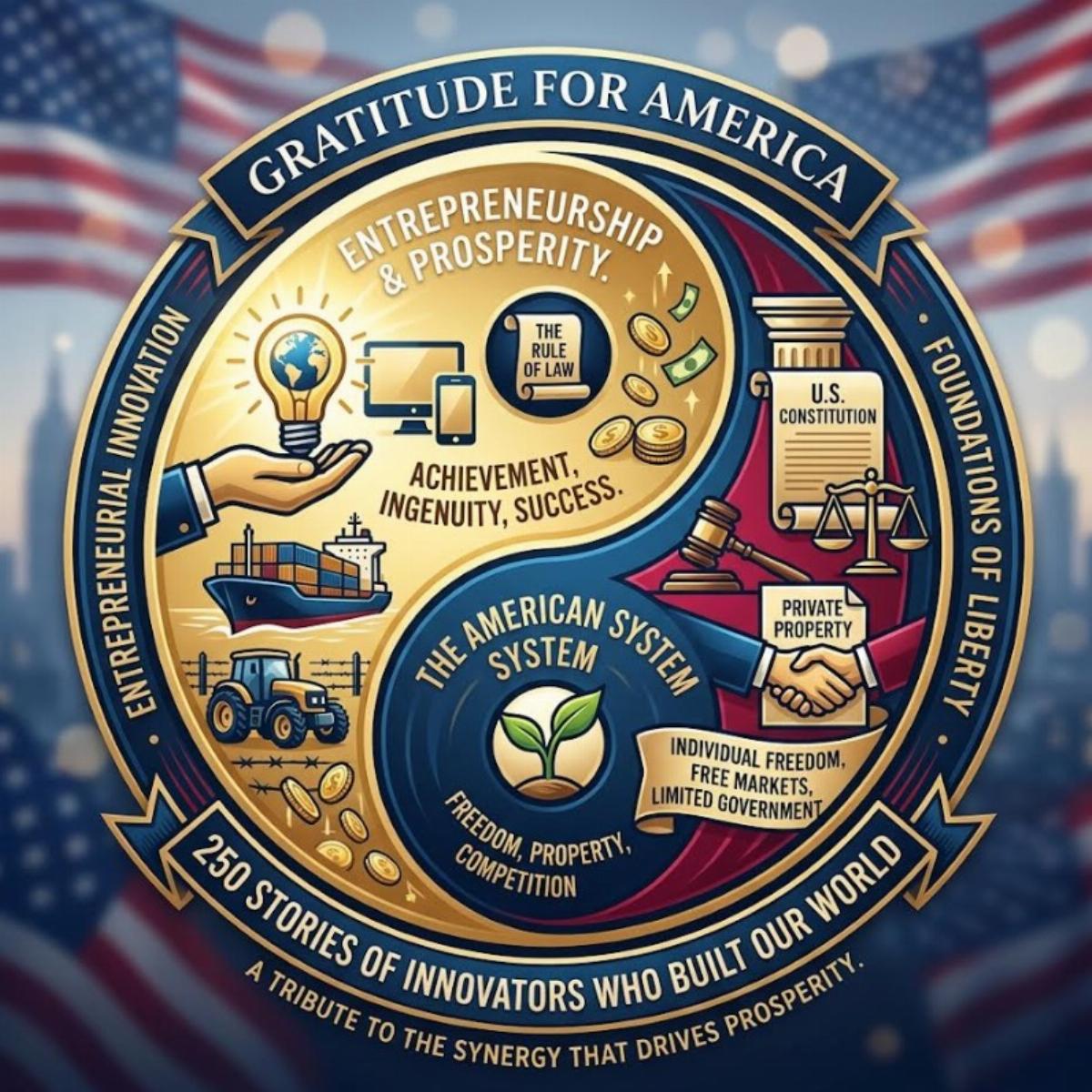
Well, I, for one, am not interested in seeing her disappear. While I spend a good deal of time writing about the evil of the left, I’ve created something that I hope will actually…help. It’s called Gratitude for America.
The reality is, countless efforts showcase entrepreneurship, but far fewer focus on the most important—and least recognized—part: the indispensable yin-and-yang relationship between the American system and entrepreneurship. Entrepreneurship cannot drive widespread prosperity in a tyranny. It can do so only when citizens understand that everyone is supposed to play by certain rules, that individual freedom and private property are protected, and that competition is the best way to define success.
GFA is an effort to showcase the American entrepreneurs who built so much of the world we live in. With America celebrating its 250th birthday, I’m putting that idea into practice through GFA’s 250 for 250 Initiative: 250 stories of the entrepreneurs, inventors, and innovators whose ideas helped create the world we live in today.
Whether it’s Joseph Glidden, whose barbed wire helped tame the West; Steve Jobs, who drew on Xerox PARC’s pioneering graphical user interface work to help bring computer accessibility to the masses; or Malcom McLean, whose shipping containers, which dropped cargo-loading costs by roughly 97%, dramatically reduced overall cargo-handling costs, most aspects of our modern lives were forged from the minds, sweat, and perseverance of American entrepreneurs.
My goal is to showcase that reality, inspire gratitude for it, and then spur Americans to turn away from the dark side as they recognize how essential individual freedom, private property, and free markets are to their prosperity. Not all of them will become entrepreneurs, but the more Americans who understand that it’s freedom that drives prosperity and not government, the less sway leftists championing a government-delivered “better” world will have.
I’m not the only one out there championing this reality, but I think I might be the only one doing so by inspiring gratitude. In a world where Instagram “influencers” use AI to sell a variety of fictions to millions of gullible and envious followers, I’d prefer to inspire with stories of actual people who did real things and, in the process, changed the world in ways we can see in our everyday lives.
Gratitude for America…showcasing the people and ideas that built a world too many of us take for granted….
Read more A hugely popular chick-lit romance reveals a simmering hatred for men
Follow Vince on X at @ImperfectUSA.
AI image created by Vince Coyner.