
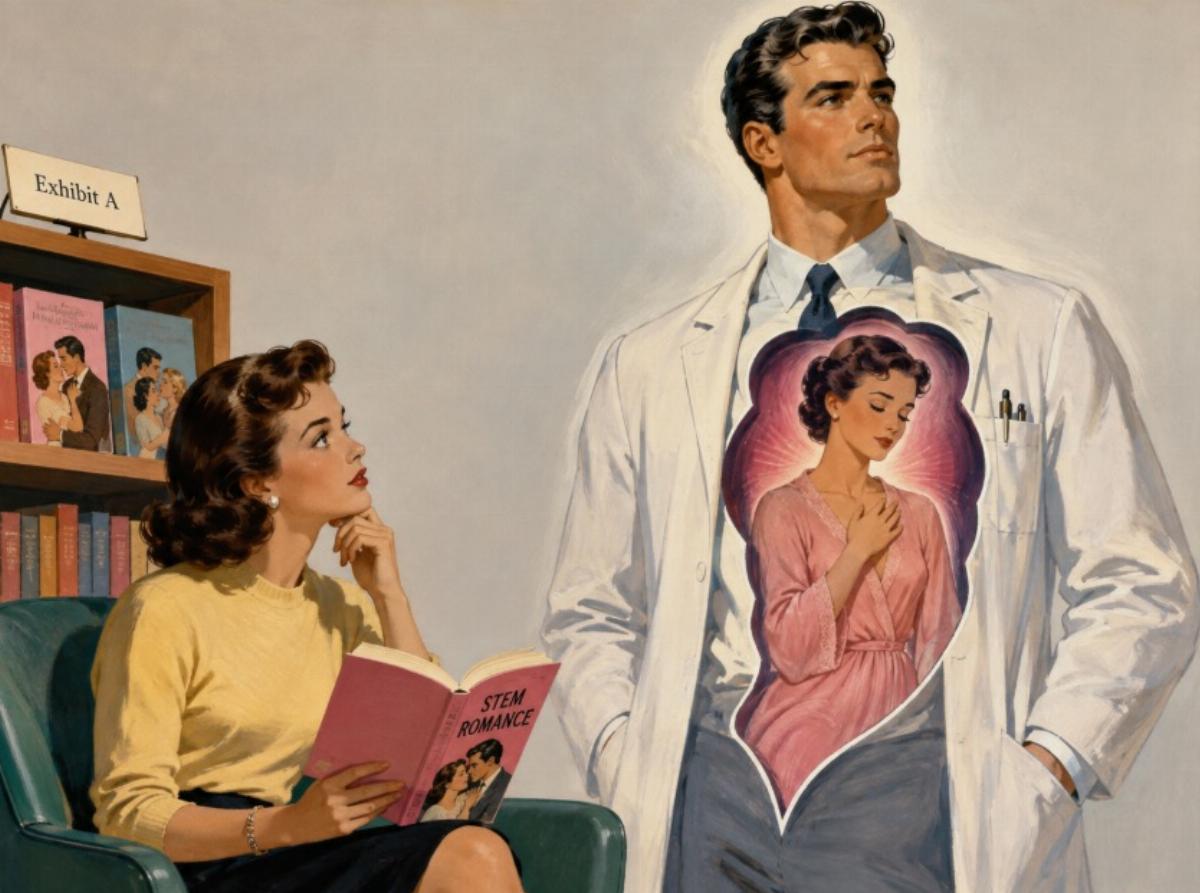
Popular culture increasingly tells women that the ideal man is not really masculine at all. He may have the height, muscles, deep voice, sexual equipment, and protective instincts of the traditional romantic hero, but emotionally, he is expected to think, feel, intuit, communicate, and nurture like a woman.
Read more The Mohammunist Manifesto—Trojan-Horsing Society’s Institutions
Ali Hazelwood’s hugely popular Love, Theoretically is Exhibit A.
The novel is a “STEM romance,” meaning that science, technology, engineering, or mathematics is central to the characters and story. It has a 4.4 rating on Amazon from over 42,000 readers and a 4.1 rating on Goodreads from over 729,000 readers. Amazon’s editors ranked it as one of the Best Books of 2023.
In Love, Theoretically, Elsie, the heroine, is an overworked adjunct physics professor desperate to get a research job at MIT, only to discover that her nemesis and inevitable love interest, Jack, is one of the most important men in the department. She’s a theoretical physicist; he’s an experimental physicist, and they met when she was a fake (albeit non-sexual) girlfriend to his younger brother.
That’s a decent setup for what reviewers raved was a super-smart romance—basically Pride and Prejudice updated with, as I will explain, way too much Bridget Jones.
Open the book, and you see what reviewers had to say about Hazelwood’s first STEM romance, all promising something smart. Here are just two:
“A literary breakthrough…. The Love Hypothesis is a self-assured debut, and we hypothesize it’s just the first bit of greatness we’ll see from an author who somehow has the audacity to be both an academic powerhouse and [a] divinely talented novelist.” —Entertainment Weekly
“Smart, witty dialogue and a diverse cast of likable secondary characters…. A realistic, amusing novel that readers won’t be able to put down.” —Library Journal (starred review)
And you know what? Love, Theoretically was smart. Lots of physics jokes and puns, well-developed characters, and a steady hand on the tiller when it came to the plot, which is a rehash of Pride and Prejudice: boy and girl meet, boy and girl unreasonably dislike each other, boy and girl fall in love.
It was also a fountain of leftism and misanthropy. Here are just a few of the endless throwaway references to the virtues of leftist values and disdain for straight white men.
After earnestly explaining that she doesn’t actually sell sex to her fake boyfriends, Elsie adds, “Not that there would be anything wrong: sex work is legitimate work, and people who engage in it are just as deserving of respect as ballerinas, or firefighters, or hedge fund managers.”
When Elsie explains how she ended up on the non-sexual fake girlfriend app, she whines that “And in between TA’ing Multivariable Calculus, forming an opinion on loop quantum gravity, and trying not to punch my all-male fellow grads for constantly assuming that I should be the one making their coffee, I found myself making a profile.”
Elsie’s friend praises her hard work by assuring her, “But you forsook a social life—and oftentimes personal hygiene—to elevate yourself above the sea of mediocre white men that is theoretical physics.”
Read more Edwina Currie reveals why the Big Tent doesn’t work for conservatives
The best beauty standard?
“You look like Taylor Swift circa 2013,” she told me, pleased, finishing side-curling my hair.
“I was aiming more for AOC circa 2020.”
“Yeah.” She sighed. “We all were.”
The entire academic STEM field, we learn, is a macho nightmare:
Because when you’re a woman talking about your research, there are anywhere between one and a million STEMlords ready to exploit every little weakness—every little sign that you’re not a lean, mean science machine. The you people want is sharp, impeccable, perfect enough to justify your intrusion in a field that for centuries has been “rightfully” male. But not too perfect, because apparently only “stone-cold bitches” are like that, and they do not make for congenial, affable colleagues. STEM culture has been a boys’ club for so long, I often feel like I can be allowed to play only if I follow the rules men made. And those rules? They downright suck.
The future for these young women is as grim as you might expect:
Cece sighs. “Okay, you know what? That was a hard question. Let’s just daydream about the future.”
“Sure.” I lean back in my seat. “Income inequality? Nuclear proliferation? Climate change?”
Of course, Elise and Jack laud the wonders of Planned Parenthood:
“Okay, good.” I can’t stop yawning, but I force my lids open. “I’m on the Depo shot. I get it from Planned Parenthood, otherwise I couldn’t afford it.”
“Planned Parenthood’s good people.”
Then there’s Jack himself. On the one hand, he’s the most manly of men: physically imposing, divinely handsome, possessed of a deep voice and infinite charm. On the other hand, his emotional character is entirely feminine: intuitive, exquisitely sensitive, and endlessly nurturing. The heroine is emotionally crippled, and he alone possesses the unconditional love and insight to save her.
There is scarcely a recognizably male romantic hero here. Jack is a female emotional ideal stuffed into the body of a fantasy man.
That matters because this is a hugely popular, widely read novel. It tells young women that the ideal man is essentially a leftist woman, except with big muscles and a Herculean-sized package in his undies. The French concept of vive la différence—celebrating the complementary nature of men and women—is gone.
The classic romance novel, beginning with Jane Austen, was premised on two normal people with emotional blind spots or character flaws they had to overcome because reality forced them to confront their failings. Then Bridget Jones came along, and the dynamic changed: Suddenly, the flaws and failings were what made the female character lovable. She only had to embrace them rather than go through a moral crisis to improve.
So, if you’re wondering why so many young leftist women report serious unhappiness and mental-health problems, and why they seem increasingly disenchanted with men, popular culture, as seen in a book like Love, Theoretically, is worth examining. Even as women crave romance and spend big bucks on it, the books feeding that craving are Trojan horses for a worldview that disparages actual masculinity while offering women an impossible substitute: a female psyche wrapped in the male body of their dreams.
Read more Noose hoaxes: supply and demand
Image created using AI.