
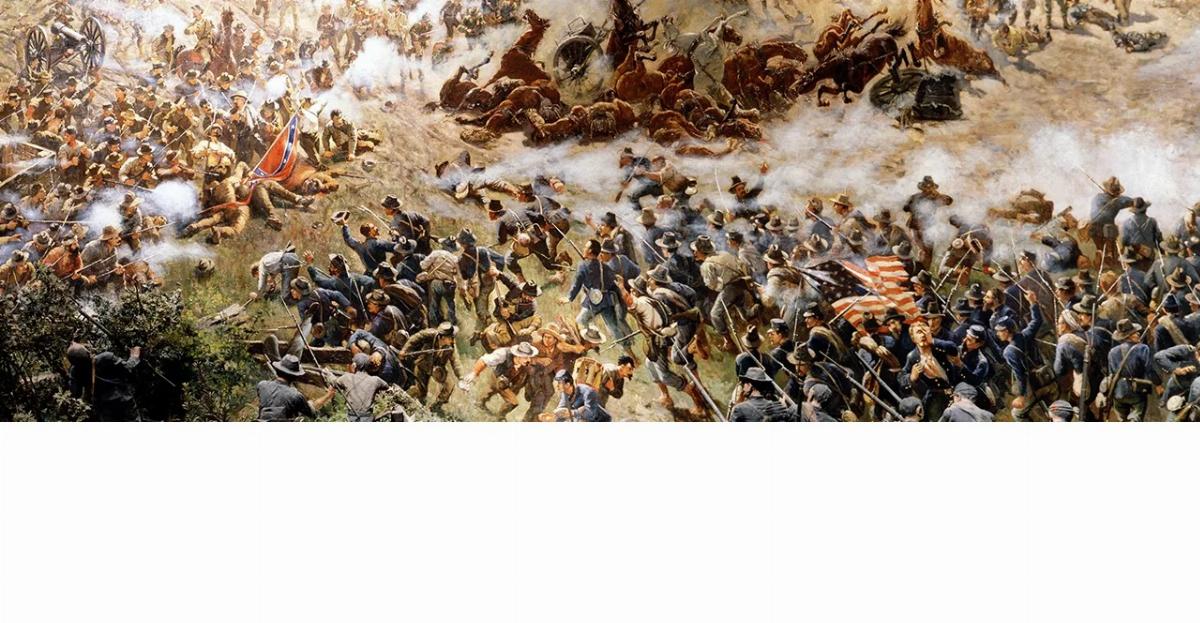
Matt Walsh recently put out a video in his series on history, this one titled: “What Schools Don’t Teach You About the Civil War.” You can find it on YouTube. It’s worth an hour of your time. It’s worth it because, today, attempts to reinterpret history are proliferating. So-called progressives and outright leftists seek to reinterpret our nation’s history in very ugly and false ways. That’s true about the Civil War. Of course, Walsh isn’t a progressive or leftist. Far from it. He’s conservative and old school. His take on the Civil War repackages the “Lost Cause” arguments.
Read more Who cares most about you?
Getting at the truth of historical events is always challenging. If you’re of a certain age and grew up in the South, public schools taught Walsh’s interpretation of the war. Or key aspects of it. I’m of a certain age and was born and raised down South. Walsh breaks little new ground.
For those unfamiliar, following the South’s defeat, southern scribes and prominent politicians — mostly Confederate veterans — decided that northern historians weren’t going to have the final say on the origins and rationale for the war. Hence, they wrote competing narratives aimed at defending and ennobling the act.
Lost Cause apologia created a Don Quixote — minus his tilting at windmills. The southern Quixote was high-principled and gallant, best exemplified by Robert E. Lee. Lee was used to personify the war as noble, though star-crossed. After all, by war’s end, the South was devastated. Hundreds of thousands of Confederate soldiers died or were wounded. Southern state economies didn’t fully recover for nearly a century. All the death, destruction, and futility — all the enduring suffering — needed justification.
As with most Lost Cause histories, Walsh focuses on Lee’s brilliance, highlighting his impressive victory at Chancellorsville. He doesn’t mention Lee’s abject failure at Gettysburg. James Longstreet — Lee’s second in command — practically begged Lee not to order Pickett’s Charge, to no avail. Lee never again went on the offensive. Nor did his tactical genius avail against the relentless Ulysses Grant.
Among southern apologists, Lincoln was the primary culprit for the war, though that simply isn’t borne by facts. Had Lincoln acknowledged the southern states’ “right” to secede, goes the argument, four years of bloodshed would have been avoided. More on secession in a moment.
Lincoln was unambiguous as a presidential nominee and upon assuming office: Slavery was constitutionally protected in the states where it existed. He wouldn’t seek its removal, though he abhorred the institution and opposed its extension. He hoped with time that slavery would wither away. Indeed, with the subsequent mechanization of agriculture, it probably would have, though southern apartheid (Jim Crow) would have happened, continuing well into the 20th Century, as it did. It took the Civil Rights Act of 1964 to bury Jim Crow.
Southerners, led by firebrands of John C. Calhoun’s stripe, decided that Lincoln’s election was a threat — or the culmination of northern threats to their way of life; that’s economic and cultural. Slavery was central, though.
Little effort was made to distinguish Lincoln from abolitionists. With the Lincoln-Douglas debates, Lincoln became famous — or infamous, in southern eyes — for eloquently opposing slavery. Walsh is correct. Lincoln didn’t advocate for race equality. But his slavery opposition stoked southern outrage regardless. His Cooper Union address — centering on stopping slavery’s expansion — further riled southerners.
This “gorilla,” as Lincoln’s detractors often derided him, wasn’t good for his word. He’d collude with radicals to end slavery, thereby upending the Antebellum South. That doesn’t explain why border slave states Delaware, Maryland, Kentucky, and Missouri remained loyal. Or why Virginia’s western mountain counties broke away from the commonwealth to create West Virginia.
Lincoln’s determination to leave slavery alone where it existed was more than legalism; it was practical. The nation’s 16th president grasped that backing abolition would shatter the Union. Walsh is right: Lincoln’s paramount aim was to preserve the Union. E pluribus unum wasn’t just an airy motto. Keeping the nation together was vital. Struggling together as a nation to resolve the seminal issue of slavery was worthwhile.
Per Lost Cause lore, Grant is caricatured as a drunk. Walsh doesn’t even mention Grant, the indispensable second to Lincoln in securing victory.
Grant and William Tecumseh Sherman are portrayed by Lost Cause advocates as butchers. Grant was just lucky, not good, and not the equal — if not the better — of Lee in the field. Grant enjoyed material and manpower advantages that any fool general could win with.
If that was so, why did a parade of Union generals, beginning with George McClellan, not exploit those advantages to expedite the war? Grant keenly appreciated the North’s resource advantages. Like Lee, he had a warrior’s instincts. Both men were clear-sighted and possessed iron wills. If Lee had been in Grant’s shoes, he would have commanded similarly.
Read more Socialism: Are Americans looking for love in all the wrong places?
As with other Lost Cause apologists, Walsh appears to accept secession as a right. States entered freely into a compact and could exit freely.
Walsh cites that secession wasn’t exclusively a southern idea. New England states flirted with it during the War of 1812. The Hartford Convention wasn’t a secessionist enclave, though the idea was floated.
Walsh doesn’t mention President Washington (a Virginian) dispatching federal troops to put down the Whiskey Rebellion in Western Pennsylvania. Nor does he mention President Andrew Jackson’s (a Tennessean) response to the Nullification Crisis in South Carolina. Both centered on questions of national supremacy. The latter foreshadowed the 1861 crisis that led to war.
If a state is free to leave the Union at will — if its leaders and citizens object to the results of an election or policies, or a state just decides that secession serves its interests — then why have a nation? Under Walsh’s and Lost Cause interpretations, the United States is practically a club where members can check out when it suits.
The Constitution and the United States were intended to form a more perfect union. States ceded their independence and specific powers to create the national government. They formed a nation, not a club. They agreed to a federal system whereby the national government assumes delegated roles and powers, while the rest remains with the states. The system provides checks and balances within the national government and between the national government and states. The federal judiciary counterbalances, aiming to settle differences.
The more perfect union certainly hasn’t worked perfectly. Many of us argue that since the “progressive” era, excesses of power have aggregated to the national government. An epic rebalancing is in order.
If the national government becomes oppressive — if it descends into tyranny — recourse exists. Recourse is found in the Declaration of Independence, which reads:
[W]henever any Form of Government becomes destructive of these ends, it is the Right of the People to alter or to abolish it, and to institute new Government.
[W]hen a long train of abuses and usurpations, pursuing invariably the same Object evinces a design to reduce them under absolute Despotism, it is their right, it is their duty, to throw off such Government[.]
Does Walsh believe that thirteen rebellious southern states had compelling, genuine cause to secede? Lost Cause champions often insist that the rebellion wasn’t primarily about protecting slavery. But it was.
Said Lincoln in his final inaugural address (March 4, 1865):
It may seem strange that any men should dare to ask a just God’s assistance in wringing their bread from the sweat of other men’s faces; but let us judge not, that we be not judged.
Strange, indeed, and such was the fundamental cause of an immense conflict.
J. Robert Smith can be found at X. His handle is @JRobertSmith1. At Gab, @JRobertSmith. Also at Truth Social, @JRobertSmith. He blogs occasionally at Flyover.
Read more Not the same old ship anymore!
Image: Library of Congress