
Despite being retired for several more years than the 26 I served in the Marine Corps, I look forward to occasionally attending military ceremonies where pomp and ceremony are always displayed. I recently attended the change-of-command ceremony involving two distinguished naval officers—one was the ship’s outgoing commanding officer (CO); the other the incoming.
Read more The season of the primary
Having served in a command position decades earlier, I understood how the ceremony involves an element of emotion on both sides. For the outgoing CO, it is the sadness of leaving a “family” of crew members he has trained and who have responded by serving him well. Despite the professional relationship he maintained with his “family,” he cannot help but reflect upon what he has learned about each member’s personal and professional life as he molded them in a way—to borrow a recruiting line from the US Army—to “be all you can be.”
For the incoming CO, it is a time of facing the challenges and responsibilities of a new command. While the outgoing CO’s professionalism was evident by the crew’s professionalism, nonetheless, in this particular case, the incoming CO has a daunting challenge before him. For he will have to hone his leadership skills to further sharpen the crew’s capabilities as it takes on a new ship’s mission. That mission will be explained, but let me first share why I was invited to the event.
The lead ship of a class bearing the name of an amazing naval leader—Admiral Elmo R. Zumwalt Jr.—is named after my late father. At the age of 49, he became the US Navy’s Chief of Naval Operations (CNO), serving from 1970–1974. He was the youngest CNO in the Navy’s history, taking command at a most difficult time. He initiated what was known as “Project Sixty.” The project informed the Secretary of the Navy (SevNav) that within 60 days Zumwalt would have a proposal of what initiatives needed to be undertaken to improve its performance. These included improving reenlistment rates, which were at an all-time low, as well as meeting the challenge posed by the Soviet Navy and rebalancing mission focus between sea control and power projection. SecNav approved the plan and my father immediately implemented it.
Concerning his effort to improve Navy life for enlisted personnel, he established study groups to identify sailors’ concerns, putting in charge those who had already reported they were leaving the service as he knew they would be honest in what they reported.
My father was an officer who always gave his sailors priority, becoming known as the “Sailor’s Admiral.” During his four year term, he issued a total of 121 changes—known as Z-grams—that implemented changes to improve life in the Navy for them. The success of his changes was demonstrated as re-enlistment rates tripled. He modernized the Navy by retiring many of its older ships, putting the maintenance money saved into research and development for new ones. While he modernized the Navy, ironically, 52 years later, it is facing a similar problem of aging vessels today.
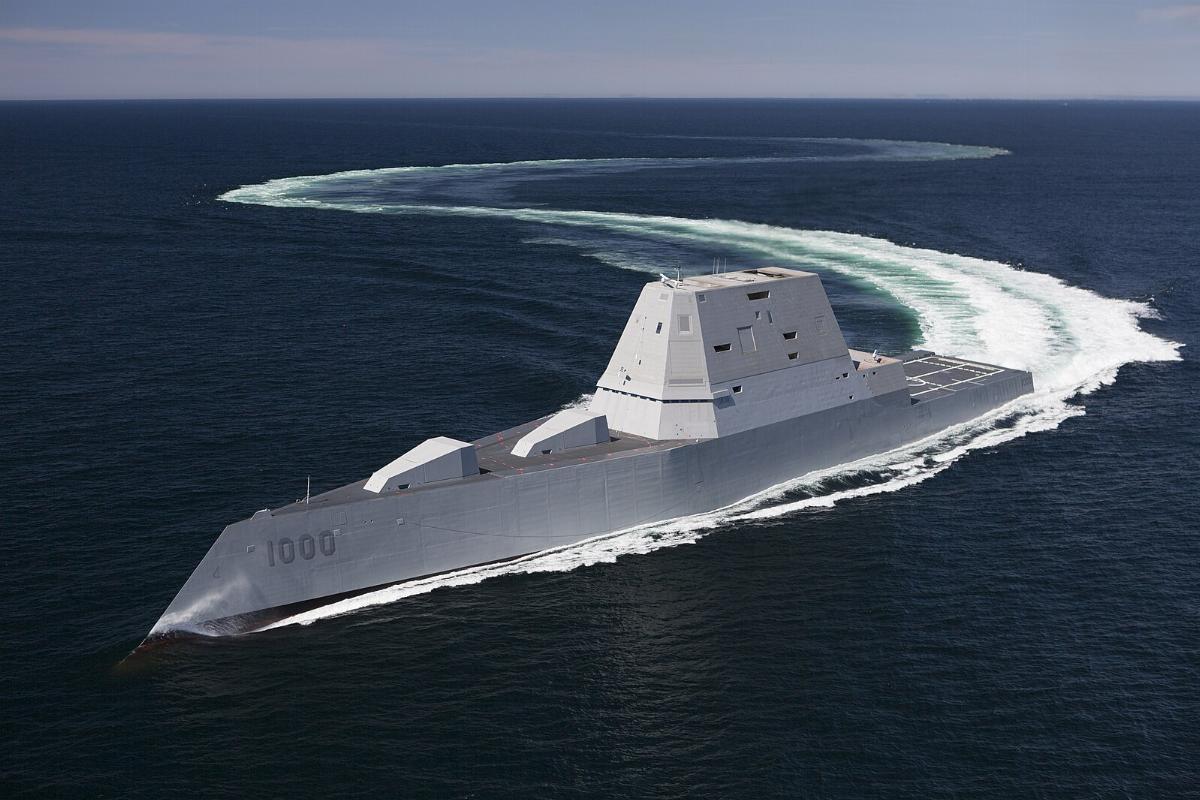
My father passed away on the second day of the new millennium, at age 79. It would be years later that one of the Navy’s newest ships was named after him—the USS Zumwalt (DDG-1000). While I admit to my bias, the ship was much like my father due to its uniqueness.
USS Zumwalt (DDG-1000) was the first stealth destroyer to sail the seas, allowing her to access shallower waters. While giving off a greatly-reduced radar profile. She is electric driven, with a unique tumblehome wave-piercing hull design, and was armed with two 155-mm guns on the bow. These guns were capable of providing naval gunfire support (NGFS) for our Marines at a range four times greater than that previously provided by our retired battleships.
Read more The deregulation of the abortion pill has been a disaster
While USS Zumwalt was commissioned in 2016, she has undergone numerous CO changes but, in 2023, she was pulled into drydock to undergo a major mission change. Unfortunately for the Marines, they lost her NGFS capability as her two forward guns were removed. The guns were replaced with a hypersonic missile system. Its installation should be completed within the next three months.
With the hypersonic missile system, USS Zumwalt is called “the Navy’s premier offensive surface combatant.” It is to be armed with twelve Intermediate-Range (approximately 1,700 miles) Conventional Prompt Strike (CPS) missiles. The missiles will be able to strike high-value, time-sensitive targets.
The CPS is a boost-glide hypersonic weapon traveling at five times the speed of sound or more, having an unpredictable depressed trajectory maneuvering ability that current air defense systems are incapable of stopping. There are two other ships of the Zumwalt class that, by 2029, will also be so armed. The three ships will create a major concern for China should it attempt to invade Taiwan. It will be challenged to locate these ships as their hull design gives them, despite their 14,000 ton displacement, the radar profile of a much smaller platform.
And the hypersonic missile systems may be just the beginning of their defensive game-changing role. Their power systems offer twice as much as other destroyers, thus allowing them to be outfitted as well with directed-energy systems.
The destroyer class prior to the Zumwalt class is the Arleigh Burke class. The ships of its class have an estimated lifespan of 35 years, although many are undergoing maintenance to extend their service. Thus, as the first of its class, the lifespan of USS Zumwalt (DDG-1000) would have been at least that long.
However, after being fitted for her new mission with the hypersonic missile system, USS Zumwalt is not the same old ship anymore. DDG-1000 will ultimately transition into the most formidable maritime threat in the world. When she takes to sea in the months ahead, she will be marveled as such by friendly nations just as much as she will be feared by unfriendly ones.
Read more How conservatives avoid another ‘Red Scare’ drubbing
Image: Public domain.