
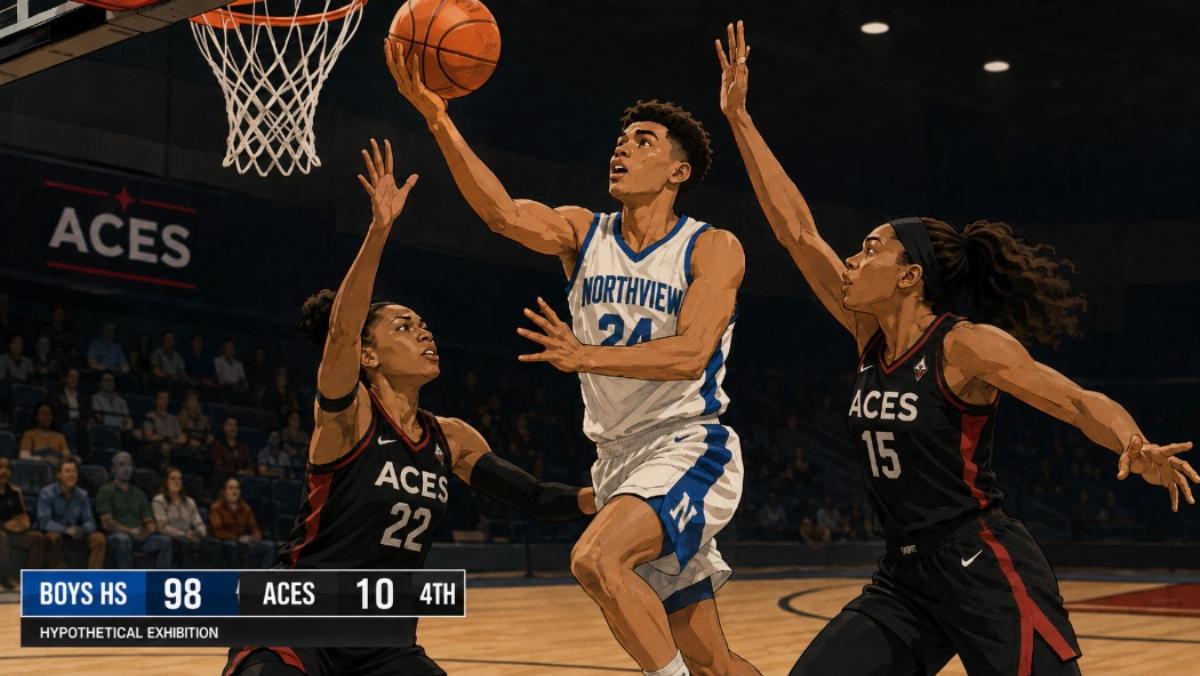
Clay Travis recently issued one of the most provocative challenges in modern sports: a $10 million offer to the Las Vegas Aces, the reigning WNBA champions, to play a boys’ high‑school basketball team.
Read more Marxists, Muslims, and surrender
The terms were simple. If the Aces won, they would take home $10 million. If the boys won, the teenagers would receive the prize. Travis even pledged that all pay‑per‑view profits would be donated to charity. It reveals something deeper about the current state of women’s sports—a tension between public messaging and biological reality that leagues, administrators, and even some athletes are unwilling to confront.
The Travis challenge is not just about basketball. It is about whether professional women’s teams are willing to publicly test the claim that men and women are interchangeable on the court. Accepting the challenge risks exposing a truth that many already know: there is a biological divide between male and female athletes, and it is not a matter of opinion—it is a matter of physiology.
This divide was made unmistakably clear in 2017, when the U.S. Women’s National Soccer Team—the most accomplished women’s soccer team in the world—played a closed‑door scrimmage against the FC Dallas U‑15 boys’ academy team. The boys won 5–2. These were not grown men, not college athletes, not professionals. They were 15‑year‑old boys, still years away from physical maturity. And yet their speed, explosiveness, and reaction time overwhelmed the adult women’s team.
This scrimmage was not intended to be a public spectacle. It was a training exercise. But it became a cultural flashpoint because it demonstrated something undeniable: even elite women cannot match elite boys in raw physical output. That is not disrespect. It is biology. And biology does not bend to ideology, slogans, or political pressure.
This brings us back to the WNBA—and the NBA’s role in all of this. The NBA subsidizes the WNBA by roughly $10 million per year, a fact widely acknowledged in sports reporting. Yet despite this financial relationship, the NBA has remained completely silent on the broader debate about biological males in women’s sports, and on the growing concerns raised by female athletes themselves.
The silence is telling. It suggests that the league understands the stakes but is unwilling to risk controversy. Speaking up would require acknowledging the biological divide. Acknowledging the divide would require defending sex‑based categories. And defending sex‑based categories would place the NBA at odds with certain activist groups, media narratives, and political pressures. So instead, the league says nothing.
Read more A successful air-only campaign
But silence has consequences—and those consequences fall hardest on young girls.
Where are the adults protecting them? Where are the coaches, administrators, and league officials willing to stand up and say that girls deserve fairness, safety, and a level playing field? Too often, they are nowhere to be found. Instead of defending girls, many adults retreat into quiet corners, afraid of backlash, afraid of labels, afraid of losing their jobs or sponsorships.
This failure of courage was on full display recently when two 16‑year‑old girls were reportedly berated by a coach and co‑owner of an Oregon women’s basketball program for wearing shirts supporting Sophia Cunningham’s stance on protecting women’s sports. These were minors. They were expressing a mainstream viewpoint held by millions of Americans. And yet they were confronted, intimidated, and reduced to tears by an adult who should have been safeguarding them.
This is the heart of the issue: the biological divide only goes one way. Boys and men enter women’s sports—not the other way around. Girls are asked to compete against athletes with male‑level strength, speed, and power. Girls are the ones losing podium spots, scholarships, and opportunities. Girls are the ones facing increased risk of injury. Girls are the ones being told to “be quiet” when they raise concerns.
And yet the very institutions tasked with protecting them—schools, leagues, governing bodies—often choose silence over responsibility.
The Oregon incident is part of this pattern. Together, they reveal a troubling truth: many adults in positions of authority are more afraid of political backlash than they are committed to protecting young female athletes, and girls deserve better than silence.
If professional women’s teams will not play boys’ teams for $10 million, then girls should not be forced to compete against biological males in their own leagues. That is not discrimination. That is common sense. And it is time for adults—men and women alike—to rediscover the courage to say so.
Read more Justice for mutilated ‘transgender’ patients
Image created using AI.