
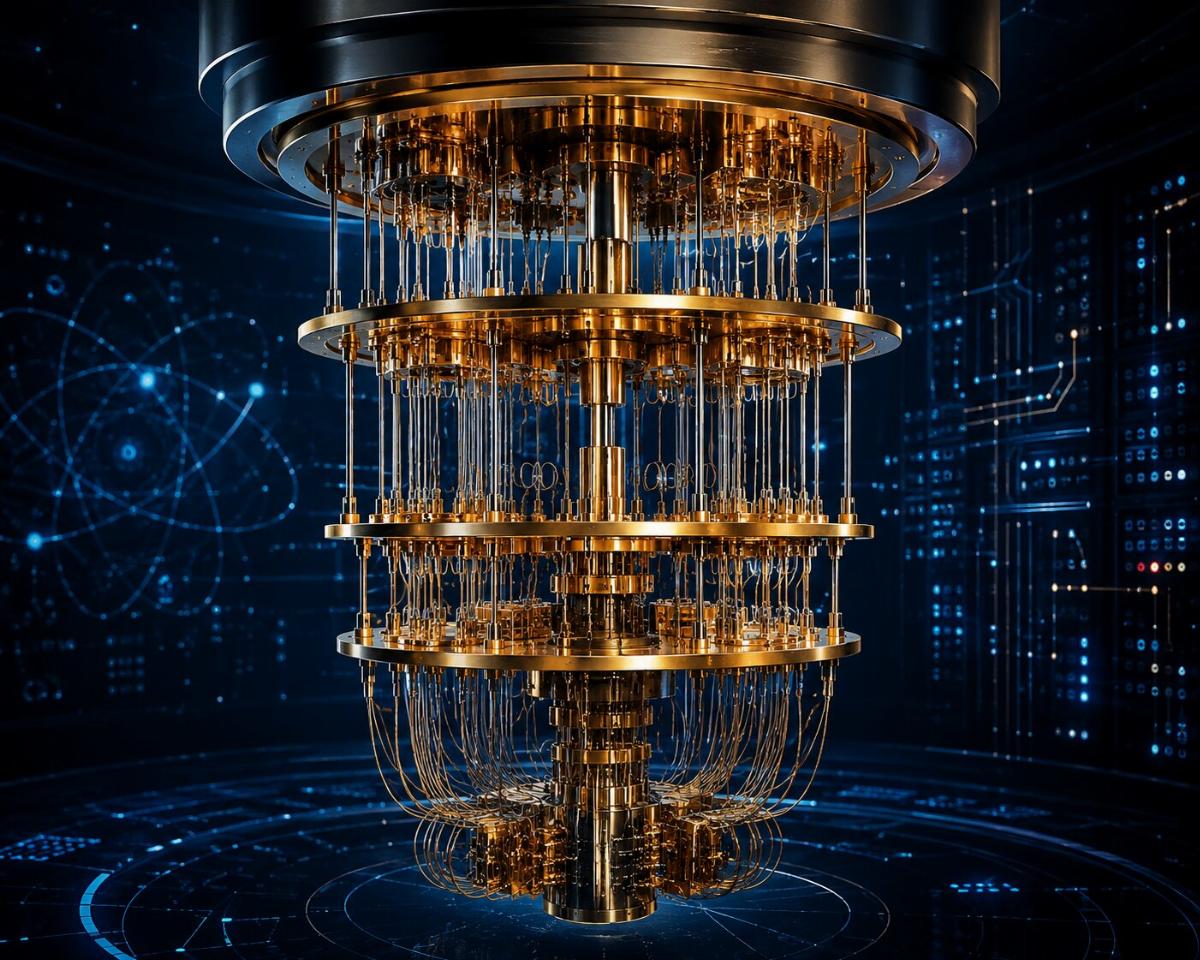
The ENIAC, built by the University of Pennsylvania in 1946 and used to calculate the parameters for America’s first hydrogen bomb, weighed 30 tons, performed 5,000 additions per second, and consumed 200 kilowatts. Today, cellphones are millions of times faster and use 1–5 watts. Quantum computing, still in its early stages, promises similar scaling within a few decades.
Read more The Strategic Blind Spot
Nations are already racing for supremacy in quantum computing—well-suited to complex tasks such as designing new molecules, solving cutting-edge problems in math and physics, and analyzing weather systems, logistics, resource planning, and economic modeling. By 2035, quantum computing could be a $1.3 trillion industry.
President Donald Trump has taken several steps, including public-private partnerships, to keep America ahead:
- In 2018, he signed the National Quantum Initiative Act into law, authorizing $1.275 billion to accelerate quantum research. The law created a federal program coordinated by the National Institute of Standards and Technology (NIST), the National Science Foundation (NSF), and the Department of Energy (DoE). It also established the National Quantum Coordinating Office and the National Quantum Initiative Advisory Committee to guide policy and research.
- In June of this year, Trump signed two executive orders to accelerate domestic quantum computing. The first calls for developing a quantum computer capable of performing significant scientific calculations—not just benchmark demonstrations—by 2028. The second directs federal agencies to begin adopting post-quantum cryptography to protect against cyberattacks by 2031.
- The Department of Commerce has announced letters of intent to acquire stakes in nine leading quantum research companies, with $280 billion allocated to support semiconductor manufacturing and research.
- The equity purchase will be made under the CHIPS and Science Act of 2022. The portfolio includes IBM and GlobalFoundries, which fabricate specialized semiconductor wafers and quantum processing units (QPUs). Atom Computing and Infleqtion, which design full-stack quantum machines (the entire layer of technologies that make quantum computing usable, including error-correction protocols, cloud access, and end-user software), are also in the portfolio.
Other notable projects include the Department of Energy’s Genesis Mission, in partnership with IBM, and the Defense Advanced Research Projects Agency’s (DARPA) $1.25 million agreement with PsiQuantum, a company working toward million-qubit computers that will solve critical problems across industries and achieve utility-scale quantum computing.
The Genesis Mission operates 15 quantum computers. A select group of industry leaders and research institutions uses them to integrate quantum, AI, and classical computing to solve complex problems. For example, IBM, the Cleveland Clinic, and the Oak Ridge National Laboratory have collaborated to calculate molecular configurations for fusion-energy fuels. The PsiQuantum deal is for testing and evaluating hardware, systems, and software.
So, what exactly is quantum computing, what differentiates it from classical computing and AI, and how does it derive its immense power? Classical computing uses bits, each of which can take the value 0 or 1, off or on, like a switch. In combination, millions of such switches perform the complex calculations modern computers are capable of. Artificial intelligence, a data-intensive process, performs statistical pattern recognition on massive databases and uses those patterns to create new material.
Quantum computing draws on quantum mechanics, developed in the early decades of the 20th century. Light and subatomic particles like electrons behave both as particles and as waves, and quantum theory, instead of seeking either/or explanations, accepted and built on that dual nature. Measuring quantum systems, such as light or a subatomic particle, causes them to collapse into a definite state. Similarly, quantum computing uses qubits—quantum bits—which can be 0 and 1, off and on, at the same time, collapsing to one state when measured.
It is impossible to fully understand quantum computing without the physics and math. But with a mental model—necessarily imperfect—we can develop an intuitive sense of it. Imagine a 3×3 grid in which each cell can be either 0 or 1. There are 29 = 512 possible patterns the grid can take. Let us suppose that one of those patterns, based on relationships among the values in various cells, is the solution we are seeking.
Classical computing would assign a bit to each cell and run an algorithm based on the required relations between the cells. The more efficient the algorithm, the fewer candidate patterns it will examine before zeroing in on the solution. A theoretical “worst” algorithm would get the answer by brute force, running through all patterns.
Read more Mamdani’s Finger-Pointing At Netanyahu Is Sheer Projection
Here’s how quantum computing could be seen as tackling the problem, using the phenomena of superposition, entanglement, and interference. Each cell in the grid is assigned a qubit, which can exist in a superposition of the 0 and 1 states. The grid of qubits is now treated as a whole that contains the possibility of all patterns. Now, quantum gates—we will not go into the details of how they work—are used to entangle the qubits. The state of each cell gets linked to those of others, allowing the manipulation of relationships across the grid as a whole.
Because quantum states behave like waves, the probability amplitudes for different patterns can reinforce or cancel one another. As the computation proceeds, interference amplifies the amplitudes of certain patterns and weakens those of others. Finally, the quantum state of the grid is measured, collapsing it into a single pattern. Because the algorithm has amplified the probability of the desired pattern and suppressed others, that pattern is overwhelmingly likely to be the solution.
To present it another way: instead of running through a deck of cards to find the right one that fits certain rules, quantum computing hangs the cards on a grid of strings by suit, number, and so on, and plucks or dampens specific strings. The vibrations reinforce or cancel each other, leaving one card vibrating more strongly than the rest. This is the one most likely to fall, and the likeliest solution to the problem.
This approach enables high-speed parallel computing and the creation of multidimensional spaces for modeling, so quantum computing can solve complex problems faster. However, there are practical hurdles:
- Qubits are fragile and can lose or change their state, a phenomenon known as decoherence. Most quantum computers overcome this by relying on superconductivity, which requires cooling the hardware to near absolute zero. Light- and laser-based systems are being researched as room-temperature alternatives, but this will take time.
- Quantum computing requires semiconductors of extremely high purity—99.999% or higher.
- Decoherence and the probabilistic methods of problem solving require that quantum computing systems plan for error detection and correction.
- There is a high risk to digital security because quantum systems can break public-key encryption. An Israeli expert says current cybersecurity protocols will be rendered useless.
Quantum computing remains in an experimental phase, with 100 to 200 operational labs worldwide. Even so, stable, fault-tolerant systems are expected by the 2030s. Real-world use is currently limited to advanced molecular modeling, chemical simulations, and physics research, and is likely to remain so for at least a decade. However, companies are already pairing classical supercomputers with quantum processors to tackle complex tasks.
The major players in quantum computing are either hardware innovators or full-stack cloud ecosystem developers. IBM Quantum maintains the world’s largest quantum ecosystem, powered by its superconducting technology. Google Quantum AI’s processor uses two-dimensional grids to group qubits and suppress errors. Amazon Braket provides a cloud service that enables developers to access quantum hardware. Other companies, such as IonQ, Quantinuum, and PsiQuantum, are working to manipulate qubits to improve accuracy.
Quantum computing could eventually lead to faster cloud services, healthcare breakthroughs, and advances in digital security. For now, quantum computers will largely be used to enhance supercomputers’ power. However, just as the power of room-sized computers of the past became available on smartphones, quantum computing will eventually become accessible to all. It’s clearly the next technological horizon.
Read more The New Way for Conservatives to Win Elections
Image generated by ChatGPT.