
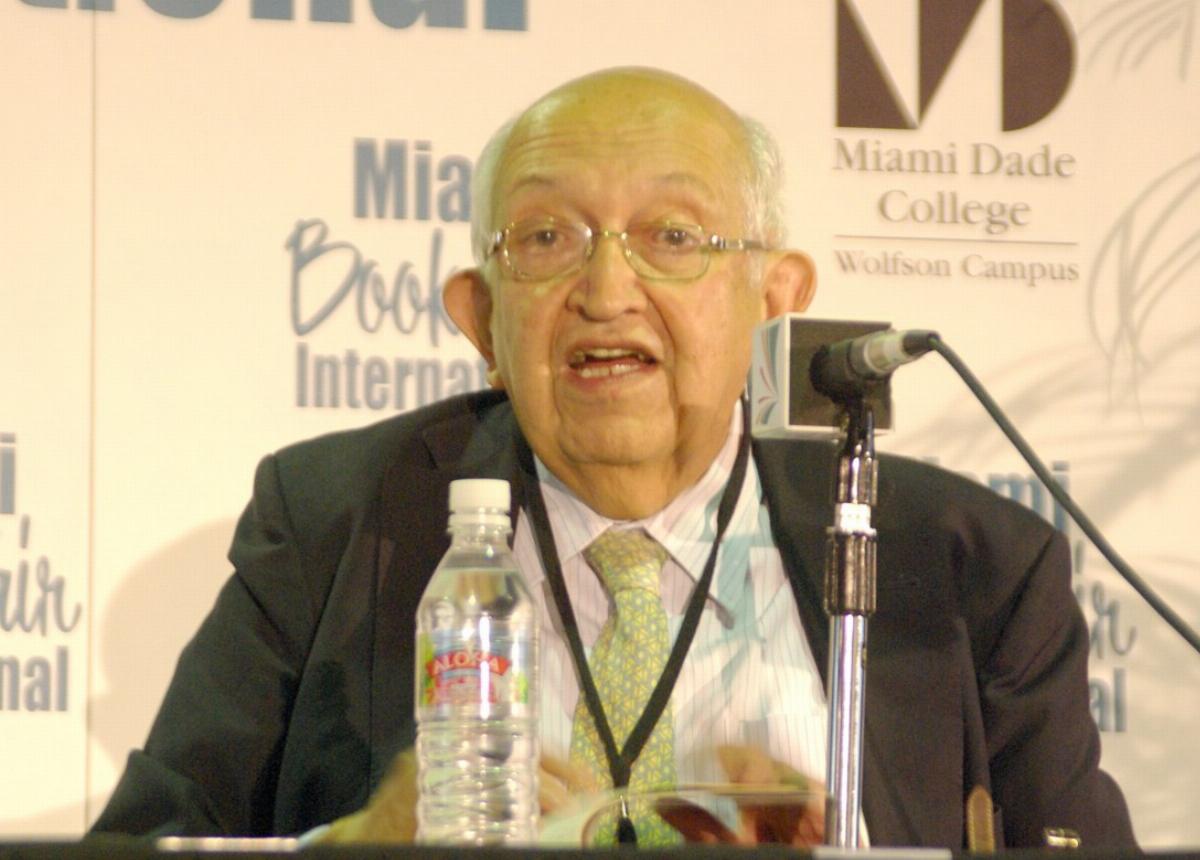
A great journalist died in his native Colombia yesterday — Plinio Apuleyo Mendoza, whose works made a spectacular difference in the political direction of the lands to our south.
Read more Finally, a president is stopping EU looting of US companies!
He, along two other impressive journalists, Carlos Alberto Montaner, and Alvaro Vargas Llosa, wrote the 1996 Guide to the Perfect Latin American Idiot, which was a bestseller, and published in English in 2001, dissecting the nature of Latin America’s radical leftists and their culture of victimology, anti-Americanism, liberation theology, romance with violence and Che Guevara, resource nationalism, and other maladies which did so much to keep the region artificially backward.
It went off like a bunker-buster on the smelly little orthodoxies of the radical left.
I first saw the announcement from his co-author, Vargas Llosa, who lamented the loss of the great man:
Lamento la tristísima partida de Plinio Apuleyo Mendoza. Fue un gran amigo y un extraordinario compañero de batallas. A pesar de la diferencia de edad, me honro en haber sido coautor, junto a él y a Carlos Alberto Montaner, de varios libros que sirvieron de perfecto pretexto para…
— Álvaro Vargas Llosa (@AlvaroVargasLl) July 29, 2026
Grok translate:
I deeply regret the heartbreaking departure of Plinio Apuleyo Mendoza. He was a great friend and an extraordinary comrade in battles. Despite our age difference, I feel honored to have been co-author, alongside him and Carlos Alberto Montaner, of several books that served as the perfect pretext for traveling to many countries in order to address diverse audiences with the aim of convincing them that the cause of freedom is the only one that brings prosperity to nations. A great conversationalist, an entertaining teller of anecdotes, a brilliant observer of reality, with an agile and dazzling pen, Plinio leaves behind an enduring legacy. From here, I extend my deepest condolences to Patricia, his loyal and admirable wife, also a dear friend, and to his beloved daughters. Plinio’s work and memory will live on more vibrantly than ever.
The Colombian literary and journalistic world lost one of its most influential figures on Monday. Writer, journalist, and diplomat Plinio Apuleyo Mendoza died at the age of 94, bringing to a close a career spanning more than seven decades devoted to literature, political analysis, and reporting. His death was confirmed by journalists and people close to him, although the cause has not yet been disclosed.
Through a body of work that blended fiction, essays, and journalism, Mendoza left a lasting mark on Colombian and Latin American culture. His name became permanently associated with that of Gabriel Garcia Marquez, one of his closest friends, with whom he shared much of his youth and later co-authored one of the most important books of conversations exploring the Nobel Prize winner’s life and ideas.
By circumstances, he was close to Garcia Marquez, who was a leftist, but he himself did not share Garcia Marquez’s politics at all, and it’s probably noteworthy that Garcia Marquez never let his politics into his great literary or nonfiction works, either. Or for that matter, friendships. All of this speaks well for them both.
This is what had an impact:
Mendoza also gained widespread recognition in political essay writing with Manual del perfecto idiota latinoamericano (Manual of the Perfect Latin American Idiot), published in 1996 and co-authored with Cuban writer Carlos Alberto Montaner and Peruvian author Alvaro Vargas Llosa, the eldest son of Mario Vargas Llosa, himself a Nobel laureate in Literature, who wrote the foreword to the book.
Published three decades ago, the book was conceived as a direct response to the interpretation of Latin America popularized in Eduardo Galeano’s 1971 classic Open Veins of Latin America. While Galeano argued that the region’s underdevelopment stemmed from centuries of colonial and imperial exploitation, Mendoza and his co-authors contended that such an interpretation fostered a culture of victimhood that ignored Latin America’s own internal responsibilities.
Written in a satirical, provocative, and openly liberal tone, the book criticized populism, state intervention, and revolutionary rhetoric, which its authors argued had hindered the region’s development.
It sparked intense controversy upon publication and became a key reference for liberal political thought in Latin America by offering a sharply contrasting vision to one of the most influential works of the Latin American left.
Read more Stylin,’ stylin,’ stylin,’: Get a load of the new conservative president of Peru
“I was once a man of the left, but reality convinced me otherwise. I refuse to be labeled as right-wing. I am a liberal—not by party affiliation, but by conviction. I believe in political and economic freedom; I believe in individual liberty,” Mendoza said in an interview with Colombian newspaper El Espectador several years ago.
What he did with his two co-authors, who reportedly met one another in a random taxi ride after a conference, was skewer and expose the clownish, malevolent forces of the left, which culminated in the rise of Hugo Chavez, who adored Galeano’s hideous book, and gave a copy to President Obama. The widespread appeal of the book, which has never been out of print, served to educate the public and had to have aided the rise of the great wave of libertarian conservatives now taking over Latin America. His book lit the fuse, just by exposing leftists and their shibboleths.
It went from this to this:
Que no quede ni uno solo. pic.twitter.com/LfQTw6u9Xd
— Emmanuel Rincón (@EmmaRincon) July 29, 2026
… and he lived to see the changes.
I never met him but Alvaro Vargas Llosa told me what he was like:
You would have greatly enjoyed meeting him and getting to know him, Monica. He was cultured, funny, a great guy to talk to about anything and everything, and, of course, a very courageous man who stood up for the right things when it was highly unpopular to do so.
— Álvaro Vargas Llosa (@AlvaroVargasLl) July 29, 2026
Why is his death noteworthy? Because it brings up his famous book, and some will want to read it.
And why should the book be read and reread? Because the U.S. is going through an inexplicable wave of radical leftists rising to power among the Democrats and their party, threatening to dismantle the U.S, if god forbid, one of them gets elected president or enough of them get elected in Congress and appointed to the high courts.
This book is bound to offer clues as to what is happening and set the stage for how to change that forever.
Google ai and Wikipedia lays out its chapters this way:
Retrato de familia (Family Portrait): Introduces the profile, mindset, and traits of the archetypal “idiot” intellectual in Latin America.El árbol genealógico (The Family Tree): Explores the historical and philosophical roots of leftist and populist dogmas in the region.La biblia del idiota (The Idiot’s Bible): Targets Eduardo Galeano’s famous work Open Veins of Latin America as the blueprint of economic fallacies.Somos pobres: la culpa es de ellos (We’re Poor: It’s Their Fault): Analyzses the culture of blaming capitalism, imperialism, and foreign powers for local underdevelopment.El remedio que mata (The Remedy That Kills): Examines how state expansion and heavy intervention worsen the crises they aim to fix.«Crear dos, tres, cien Vietnam» (Create Two, Three, Many Vietnams): Discusses the romanticized infatuation with guerrilla warfare and violent revolution.Cuba: un viejo amor ni se olvida ni se deja (Cuba: An Old Love Is Neither Forgotten Nor Forsaken): Dissects the persistent intellectual blind spot regarding the Castro regime.El fusil y la sotana (Rifles and Cassocks): Critiques liberation theology and the blending of violent political insurrection with religious faith.«Yanqui, go home» (Yankee, Go Home): Focuses on regional anti-Americanism and scapegoating.Qué linda es mi bandera (How Pretty Is My Flag): Explores toxic nationalism and superficial civic pride.El idiota tiene amigos (The Idiot Has Friends): Looks at sympathetic Western and European intellectuals who excused Latin American totalitarian movements.¡Ahí viene el lobo feroz! (Here Comes the Big Bad Wolf!): Addresses exaggerated fears of market economies and globalization.Los diez libros que conmovieron al idiota latinoamericano (The Ten Books That Moved the Latin American Idiot): A satirical bibliography of foundational texts shaping this political mindset.
It’s sarcastic, biting, and hilarious and has a really funny section at the end listing really stupid quotes from leftist Latin American intellectuals which make them look like boobs, and funnier still, the authors include quotes from themselves from their leftist pasts.
Now that a great conservative wave is sweeping through Latin America, quite likely as a result of this book, it’s possible to think that Plinio Apuleyo Mendoza died with a peaceful smile on his face. He left a great legacy, wrote a book that changed history.
One can only hope that it becomes more well known here in the English-speaking world, which could use a heaping helping of it.
As for the great writer who thought for himself and lived a stellar life: Rest in peace.
Read more Mamdani launches his government groceries: What could go wrong?
Image: Rodrigo Fernández, via Wikipedia // CC BY-SA 3.0 Deed