
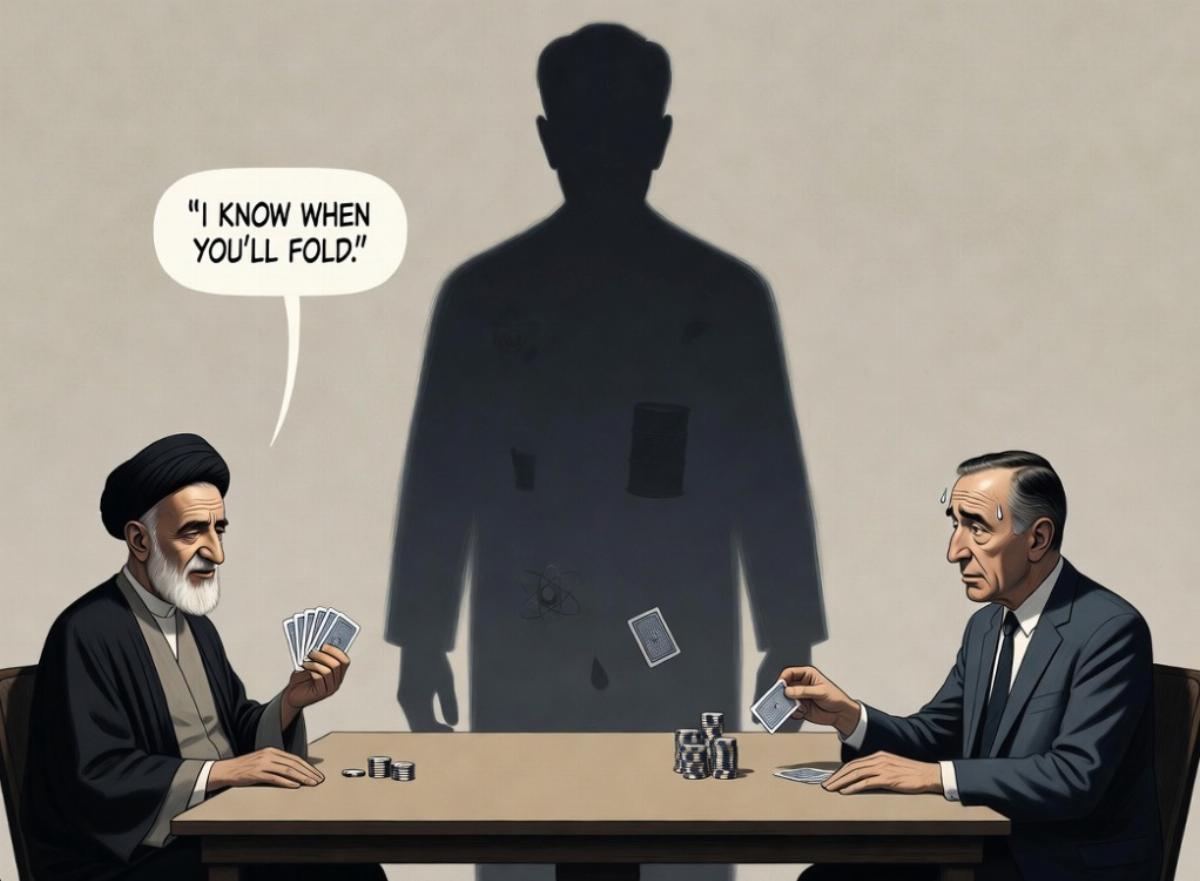
Welcome to today’s seminar. By the time we’re done, you’ll grasp Iran’s favorite negotiating trick: saying one thing, meaning another, and watching Western diplomats pretend they didn’t notice.
Read more Solar panels and geography
Armed to the teeth but incredibly vulnerable, Iran has played a losing hand with the West like a gambler who has memorized every tell in the room and understands that Western negotiators fold long before the cards hit the table. Here’s the truth: Iran lacks the conventional military and economic strength to project decisive power against major nations.
Iran’s perceived trump card is that it provides about 4% of the world’s oil and even less natural gas. It is also attempting to create leverage the world can never allow it to have by turning an international waterway into a toll booth that controls an even larger share of the energy the West needs, and if successful, would embolden other nations to do the same for their waterways. Most of Iran’s remaining leverage comes from the instability it directs through its proxies and that the West has largely tolerated. That’s effectively it.
One obvious objection to this claim about Iran’s limited strength: What about Iran’s nuclear program? Doesn’t the prospect of nuclear weapons change the entire equation?
It does raise the stakes, but it’s still a negotiating tool rather than an actual force. Even before a weapon exists, the program itself creates leverage. Every additional centrifuge, every increase in uranium enrichment, every underground facility increases diplomatic urgency. Whether the ultimate objective is a bomb or a bargaining chip, the program’s existence influences perceptions long before any weapon could be deployed.
And right now, Iran’s pursuit of nuclear weapons may be yesterday’s news. Why? Because the jig is up, everyone’s wise to Iran’s intentions, and the world, frequently timid, aloof, and rarely in sync, will likely deny Iran’s ascent into the nuclear club.
All the mullahs’ efforts—their spinning centrifuges, enriched uranium, and deep bunkers—will not see them prevail. Iran also knows that at least with this president, nuclear weapons for Iran are his red line. That point of pressure, effectively, no longer exists.
Yes, Iran has ballistic and drone arsenals, engages in hostage diplomacy, conducts cyber-attacks, and maintains an extensive network of regional allies and proxies. None of these capabilities, alone, would allow Iran to defeat or coerce the U.S. Iran believes their significance lies not in their ability to win wars, but to shape negotiations and create pressure points. Collectively, they create enough friction, uncertainty, and disruption to distract Western governments from the larger strategic picture and to generate leverage far greater than their military value alone.
Here’s the paradox: Iran’s leverage is objectively limited. Yet it has projected and repeatedly negotiated as though it were the stronger party. Why? Because military power and economic power are only part of negotiation. Iran’s sociopathic psychology matters more, leading to:
Iran Understands Us Better than We Understand Iran:
Iran’s leaders know Western governments are constrained by:
- election cycles
- media pressure
- aversion to casualties
- economic disruption
- energy prices
- diplomatic infighting
- fear of escalation
Iran’s leaders have spent decades studying us. Iran is negotiating against democracies that must constantly justify every action to a distrusting electorate. Iran doesn’t have those constraints and pushes our hot buttons hard. Why not? We have trained Iran over decades to understand America’s pressure points, leading Iran to become masters of political torture.
Iran’s Four-Hundred Level Negotiation Strategy:
Rule One—Negotiate Over Possibilities:
Negotiate over future possibilities, not what you already have. Leave the other side to ponder what you might do. Threats are more valuable than actual capability.
Examples:
- Nuclear enrichment—scares everyone who projects what Iran would do with one or more nuclear devices.
- Missile development—state that you have no interest in long-range weapons and then demonstrate that you already have that capability.
- Strait of Hormuz—turn an international waterway into a bargaining chip to protect even more important strategic ambitions.
- Proxy escalation—continuously enlarge the other side’s problems and calculus with endless attacks and provocations by “independent“ actors.
A fait accompli no longer has much negotiating value. An emerging capability forces the other side to imagine multiple possibilities; Iran exploits that difference.
Read more (I Can’t Get No) Indictment
Rule Two—Manufacture Dependence:
Create problems only you can solve. Iran repeatedly manufactures crises that only Iran’s cooperation can solve.
Examples:
- Proxy attacks
- Shipping disruptions
- Militia violence
- Hostage diplomacy
Iran has learned that the West rewards restraint quickly, but like gas prices, removes those rewards ever more slowly.
Rule Three—Raise the Price of Resistance:
Raise the cost of saying no. Iran cannot defeat America; it only has to make American policymakers conclude that confrontation is too expensive politically. Deplete America’s very expensive (and slow to replenish) stockpile of advanced weaponry. Tick up oil prices to increase domestic political pressure to end hostilities. Maintain urgency and a popular sense that Iran controls the levers of power, not us.
The objective isn’t military victory for Iran; it’s our exhaustion.
Rule Four—Force the Other Side to Negotiate Against Itself:
Make your opponent negotiate against himself. Western negotiators frequently enter talks seeking tangential ends:
- Stability
- De-escalation
- Diplomatic success
- Avoiding kinetic actions
Iran simply waits while the pressure builds almost entirely on us.
Why This Keeps Working:
Iran is patient. Western governments rotate every few years, while Iran believes in divine providence. Politicians think in terms of election cycles. Iran sees time as its ally; we feel it as a liability.
The Real Commodity Iran Sells
Iran does not primarily sell oil. Iran’s real export is uncertainty. Oil traders, insurance companies, and shipping companies price it in. Governments are reactionary, as are financial markets. Iran, with only a modest share of global economic output, exerts influence far beyond its size because uncertainty itself has become its most valuable commodity.
Why Western Negotiators Keep Misreading the Room
Western diplomats often think this way: “If we reduce Iranian insecurity, Iran will moderate.” They do so even though, for decades, Iran’s actions have not reflected that. Its leadership treats concessions as confirmation that pressure works. Thus, concessions have worked the opposite of what we intended because we don’t share the same rulebook.
Lessons We Should Learn That Extend Beyond Iran
Iran isn’t unique. History shows that weaker actors can succeed against stronger ones by better understanding their negotiating strength. Negotiation is often less about relative strength than understanding what the other side fears losing most. Iran is unusually adept at exploiting that principle.
Iran did not become influential because it possesses overwhelming military or even economic strength. It derives its influence from the lesson it learned that Western governments can’t seem to absorb: negotiations are rarely won by the side with the strongest hand. They are won by the side that best understands what the other player cannot afford to lose.
These lessons extend beyond Iran. Whether we’re discussing geopolitics, immigration, federal spending, or deterring America’s adversaries, the same principle applies. Negotiations are rarely won by the player holding the strongest cards. They are won by the player who recognizes everyone else’s tells—and knows precisely when they’ll fold.
God Bless America.
Image created using AI.
Author, Businessman, Thinker, and Strategist. Read more about Allan, his background, and his ideas to create a better tomorrow at 1plus1equals2.com.
Read more Socialism goes mainstream in America, and no one is stopping it