
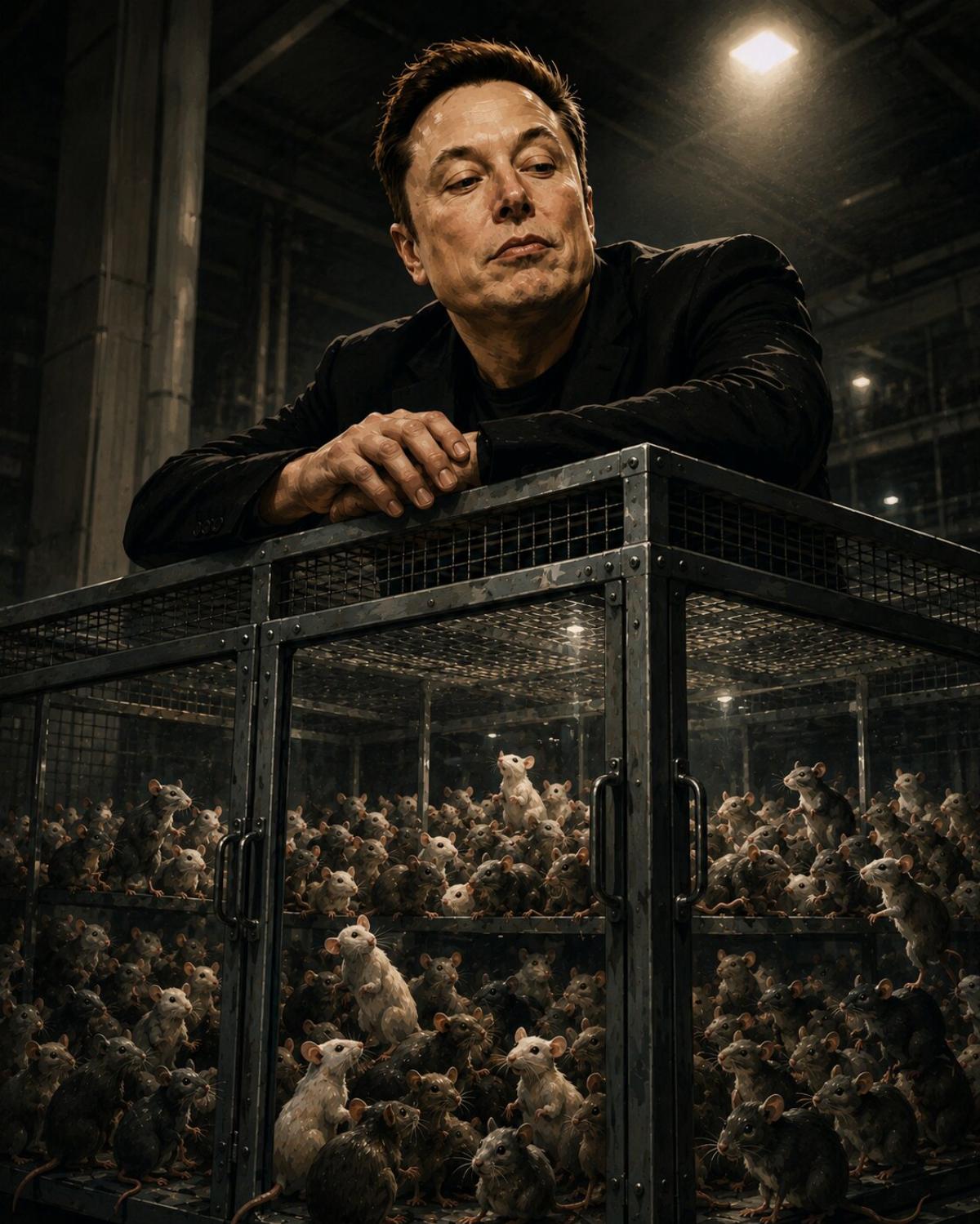
Elon Musk has spent months repeating a promise that sounds like utopia: artificial intelligence and robotics will create such massive wealth that humans will no longer need to work. Robots will do the work. Abundance will be universal. Universal basic income will be enough for everyone. Humanity, freed from the burden of effort, will be able to dedicate itself to what truly matters.
Perhaps Musk is right about the economics. Automation is advancing at a speed that would have seemed like science fiction ten years ago. Artificial intelligence models already perform tasks that previously required years of specialized training. The industrial robots of Tesla and dozens of competing companies are redefining what it means to produce. It is perfectly plausible that in the coming decades a very small fraction of the human population will be able to generate enough wealth to sustain the rest. The question Musk does not answer — and that no one in Silicon Valley seems willing to ask — is not whether that is possible. It is what will happen to humanity when it does.
To answer that question, there is no need to speculate. The experiment has already been done. With mice.
In the 1960s, researcher John Calhoun built what he called Universe 25: an enormous cage, perfectly climate-controlled, with abundant food and water, nesting materials, disease control, and more than enough space. A genuine paradise for mice, where they did not need to struggle or strive to survive. It began with eight specimens. The population grew exponentially during the first months. And then the collapse began.
As the mice stopped needing to compete for resources, something fundamental changed in their behavior. Those Calhoun called “the beautiful ones” appeared: males who groomed themselves constantly, who did not fight, who did not reproduce, who showed no interest in the world around them. They had learned to meet their basic needs — the food was there, the shelter was there — but they had learned nothing else. They did not know how to relate to others. They did not know how to reproduce. They did not know how to be mice.
Females abandoned their offspring. Violence surged among those who still tried to maintain some social role. Birth rates collapsed. And on day 920 of the experiment, the last mouse was born. From that point on, the population was doomed. They all died. Not from lack of food. Not from disease. They died because they had lost their purpose.
Calhoun called this phenomenon “behavioral sink”: when material needs are met without effort, the social structure erodes and individuals lose the capacity to perform meaningful roles. Paradise killed them.
Now let us return to Musk.
The promise of AI is not merely economic. It is civilizational. Musk and other technologists are describing a world where work — that activity which for millennia has structured human life, given purpose, built identities, and woven communities together — becomes unnecessary. A world where the state, through the wealth generated by machines, provides for everyone without anyone having to earn it.
Optimists say that humanity will then flourish. People will dedicate themselves to art, philosophy, science, personal relationships. They will have time for everything that work prevented them from doing.
Read more Gavin Newsom says ‘Trump hates gamers’
But Calhoun’s mice also had time for everything. And what they did with that time was degenerate.
The difference between a human being who chooses not to work because he has other purposes and a human mass that does not work because machines do everything is not merely quantitative. It is qualitative. Work is not just a way to earn income. It is a source of temporal structure, of social identity, of belonging to something greater than oneself, of the satisfaction that comes from overcoming real difficulties. When it disappears, it is not automatically replaced by creative leisure. It is replaced by emptiness.
We are already seeing the first symptoms. Rates of depression and anxiety have skyrocketed in the most advanced Western societies precisely in recent decades, when material well-being has reached historic heights. Identity disorders proliferate among generations that have never known scarcity but also do not know purpose. The epidemic of loneliness is not a problem of the poor — it is a problem of the rich. The beautiful mice did not suffer from hunger. They suffered from emptiness.
The welfare state has already conducted its own Universe 25 experiment at human scale for decades. The results are consistent with Calhoun’s. When the state guarantees survival without requiring effort, it does not liberate individuals — it domesticates them. It creates dependency. It erodes initiative. It numbs the longing for freedom, because those who have delegated their personal responsibility to the government no longer feel freedom as a necessity. The cage becomes comfortable. The mice stop trying to escape because they no longer remember they are trapped.
Musk senses something of this when he speaks of the need for humans to find new purposes in a post-work world. But sensing it is not solving it. History offers no examples of civilizations that have survived well-being without purpose. All those that tried collapsed from within — exactly like Universe 25. Human nature — the nature of the majority of human beings — will not withstand a life without necessary activity, without purpose, without struggle. We already see it in many neighborhoods where subsidies have destroyed social cohesion, dismantled families, and created chronically idle populations devoted to the worst vices — useless for community life, consuming themselves and others, just like Calhoun’s mice.
The question is not whether AI will create enough wealth that no one needs to work. It probably will. The question is whether humanity, freed from work, will find something worth getting up for in the morning. If it does not, the mouse utopia will not be a metaphor. It will be an epitaph.
W. Galt is a European author of political fiction and a contributor to American Thinker. His novel Cold Monster, set in the collapse of the West of 2050, is available at cold-monster.com.
Read more Trump’s alleged hatred for higher education has nothing to do with academia’s collapse
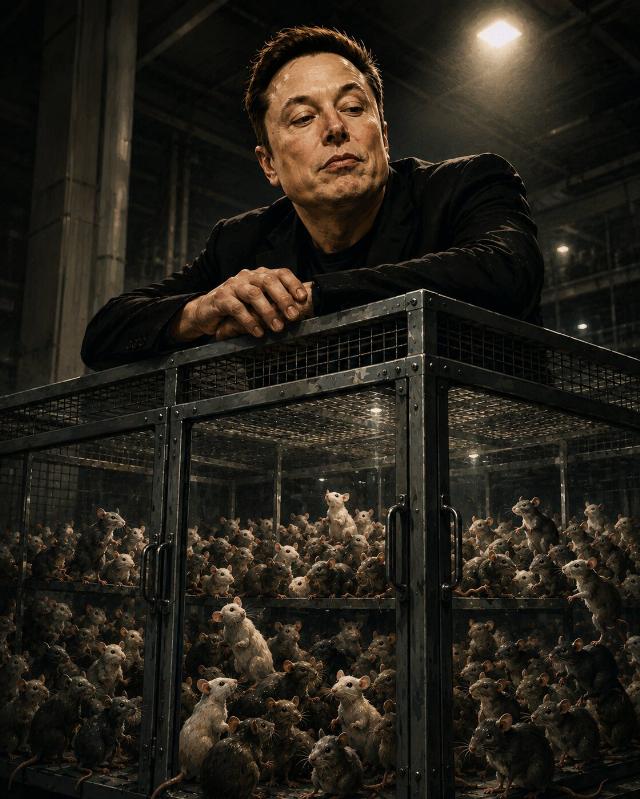
Image generated by ChatGPT.