
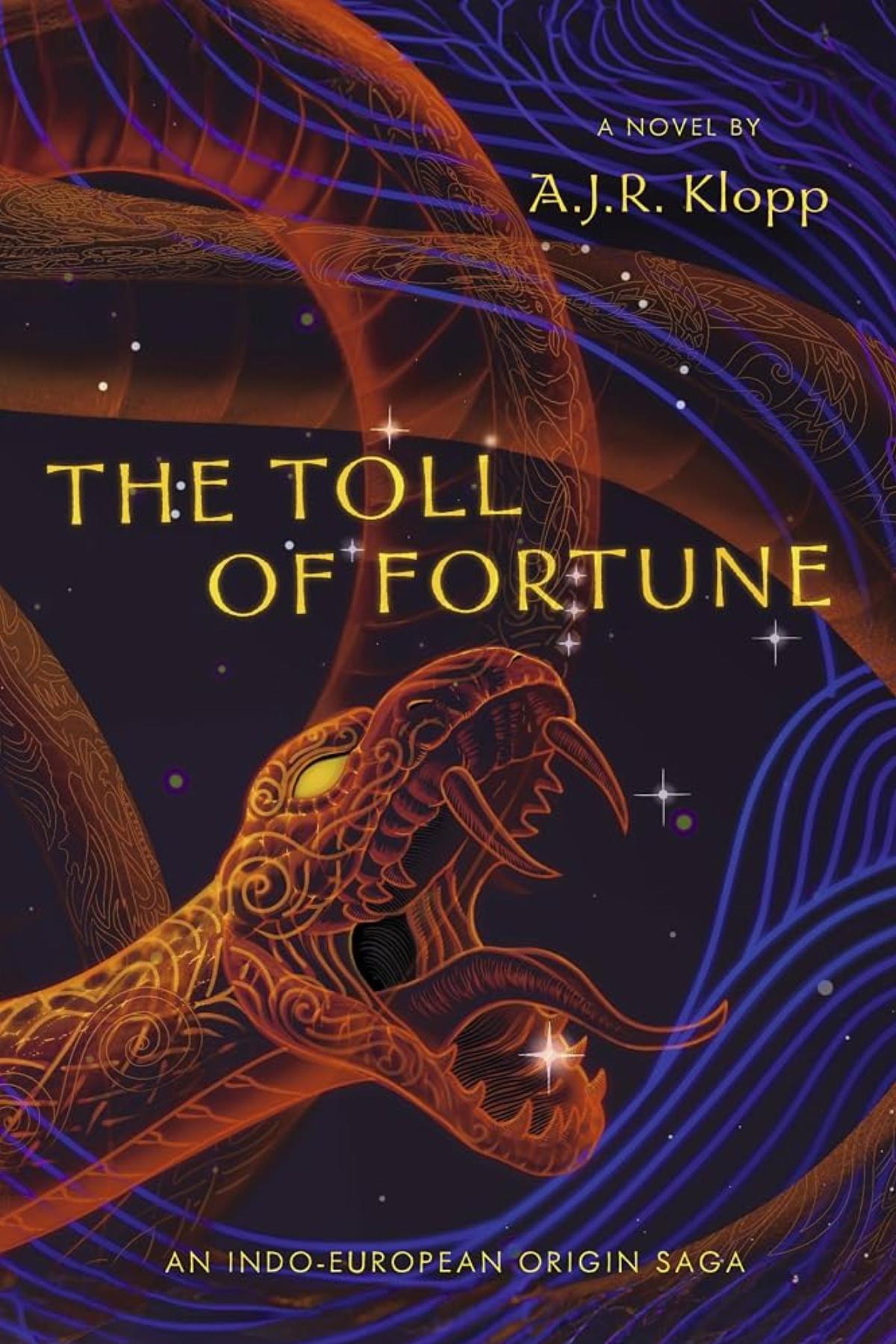
For a little more than a year, I have been in the habit of reviewing works of fiction by right-leaning authors who are sympathetic to the worldview of Twilight Patriot. It was my friend Alexander Macris, from Contemplations on the Tree of Woe, who helped me get this started: Alex has always admired right-wingers who push back on left-wing cultural dominance by creating art of their own.
Read more USGCRP’s Fresh Head Brings Fresh Air To US Climate Science
Today’s entry is The Toll of Fortune: An Indo-European Origin Saga, by A. J. R. Klopp, who was kind enough to send me a free copy last month.
The Toll of Fortune is a hard book to put into a category. Is it historical fiction? Not really. It’s set in 3309 BC, well before the invention of writing, and the cultures that appear in it are known only through archaeology and comparative linguistics. Is it fantasy? Sort of: Klopp’s characters believe in a lot of things that we would call supernatural, but they don’t live in an invented world with its own languages and races and geography — Klopp is writing about our actual ancestors.
The author of The Toll of Fortune is a man of diverse interests and experiences. He studied physics and astronomy in college, then spent a few years doing radio astronomy near the summit of Mauna Kea, where he studied star formation rates in distant galaxies. Then he decided to move on to something more human, and went to law school. After three years practicing corporate law (he specialized in acquisitions, mergers, and debt financing) he ended up working as a bond trader for BlackRock. But now, he’s finally found the time for his “real passion,” which “is history, especially retracing the steps of our ancestors to the remote past.”
The Toll of Fortune is an adventure story in the mould of the great epics, and the main action begins when a group of Proto-Indo-European youths (the Danger-Runner band, away from home on the rite-of-passage that will make them into men) are massacred by primeval monsters long thought to be extinct. (Neanderthals, perhaps? Here is Alexander Macris’s article about the possibility that Homo neanderthalensis used to eat H. sapiens.)
After a few survivors limp back to the Great Tent, bearing horrid wounds, the Clan-Father Ever-Wheel gathers a “special warband, whose purpose will be to avenge the Danger-Runner band and end the race of whichever miscreants committed this heinous act!” Thus begins our adventure – but it’s not just a battle between the heroes and the fallen elder race that they sometimes call “the Titans” or “the Gods’ First Born Children.” This warband will also encounter a strange society ruled from the Broad-Eave Hall, a literal longhouse whose Kin-Lord and Maven preside over a way of life very different from their own.
And it is through the foil of the Maven’s people that the reader is able to see Ever-Wheel’s people as the heroes, even though (like any group of copper-age warriors) they do a lot of things that seem barbaric to us. Barbarism is a good thing, Klopp seems to be saying, when you compare it to civilization gone wrong.
The heroes of The Toll of Fortune are Proto-Indo-Europeans, the speakers of a language that’s ancestral to the mother tongues of about half the people in the world today. All of the Germanic languages (including English), plus Spanish and French and the other Romance languages, along with Greek, Russian, Iranian, and most of the languages of India, are all descended from a single language that was spoken on the Pontic Steppe, in what is now Ukraine and southern Russia, about five thousand years ago.
The people who spoke it were cattle-herders, and they were probably also the first people to ever ride horses. Needless to say, this was a skill that served them well in their various wars of conquest, as they spread far and wide at the expense of less adaptive civilizations. In a way, it’s odd that most people know so little about the Proto-Indo-Europeans, since anyone with Caucasian ancestry is, in large part, their descendant.
And they also passed down bits and pieces of their worldview to us. Do you pray to a deity called Father-in-Heaven? So did they. Do you eat cattle, pigs, and chickens with gusto, while recoiling from dog meat? So did they. Most ancient cultures did not have those quirks.
Klopp’s thesis is that we should know and care more about our ancestors. And he tries to draw their society as accurately as he can, based on the latest discoveries in archeology and paleo genomics. The characters that he creates are strange, and yet in some ways familiar. They don’t live by Christian ethics (no one did, three millennia before Christ) but despite their raiding and reaving of the “Farm People” whom they look down upon, they are shown, over and over again, to be more honorable, and more like us, than the various enemies they have to fight.
It’s the mark of a non-woke mind that one can honor his ancestors for what they did right, regardless of the big differences in custom and morality between their times and ours. And that shouldn’t stop with the American Founders, or the Pilgrims on the Mayflower, or the Crusader kings. Before any of those people, at the very headwaters of what became Western Civilization, are the Proto-Indo-Europeans.
A hunter named Wolf and his son Bear are the central characters of The Toll of Fortune, and they both make it all the way to the final battle with the Titans. But Wolf isn’t quite a member of the tribe in which he lives — he married into it, and he’s always been somewhat of an outsider, someone who’s not expected to ever join the Shouting Council that advises the Clan Fathe
But the other men respect Wolf for what he is – a man who’s brave, quick-thinking, skilled in combat, and full of practical knowledge about the beasts and monsters that never stop menacing mankind. When we first meet him, he’s saving a vassal tribe from being annihilated by “wolves in dogs’ skins,” vile creatures who can give men what we would call rabies, but what Wolf and his 16-year-old son Bear call the morbus bite.
Again and again, we are introduced to the Indo-European worldview through conversations between fathers and sons, like this one:
Read more Democratic Socialists Are Courting the Youth
Bear: ‘Who is Chaos, Father?’
Wolf: ‘Chaos takes on many forms, boy. But Chaos is not a god like the Sky-Father or the Lord of Storms – Chaos was here long before the gods and will remain even after they are gone and the sky crashes down upon us, and mountains are blown to dust by the Krivach.’
Bear digested these words slowly. He’d never heard of sacrifices to any god who came before the Sky-Father, certainly not this ‘chaos’ fellow.
Wolf: ‘Chaos is the yawning chasm that existed when even time itself had a dawn. Chaos is the Ever-Serpent, coiling itself about the roots of the Axle-Tree at the base of the World, impelling its growth and causing its rot. Chaos knows all and yet knows nothing. It grants no intercession on account of offerings or sacrifice. So do not try! But that does not mean Chaos will never present you with gifts, either. These gifts will manifest in ways that can only be seen by the keenest eye.’
Later on:
Wolf: ‘Long before Rain and your mother’s people brought cattle to these plains, they too were hunters. The same as my own forefathers. And before them an Age of Ice held sway – some say since the beginning of time, for the Sun – that your mother’s people call the Sky-Father – had yet to appear. During that time, beasts with fangs the size of my arm preyed on our ancestors in the darkness. In those days only the Lord of Storms, called Perqueunos, ruled the sky. And only when he defeated the Great Serpent, could we flourish.’
And then there is this:
Bear: ‘Why do the Farm People make slaves?’
Wolf: ‘Because they can. Because they are weak and because those they take as slaves are weaker still.’
Bear: ‘Shouldn’t we take slaves too then?’
Wolf: ‘Strong men do not need slaves. Resourceful men do not want slaves. And cunning men have no use for an enslaved mind….’
Bear: ‘But we could if we desired it?…’
It makes one think of the discourse about slavery during the American Founding, when a lot of people agreed that slavery was bad for society, but they didn’t always agree about why, and they weren’t passionate enough to actually put a stop to it.
But if the Proto-Indo-Europeans were ambivalent about how to treat people weaker than themselves, there was no equivocating about the other side of the issue. They themselves must never be weak. Indeed, Klopp is really talking to us moderns when he has the old Clan-Father say:
‘These lands are not our lands. Not yet. They belonged to others who have left them to waste. But they will be your lands, my son, if you can stay here long enough… But beware. One day, someone might lurk over the horizon. Someone who waits until you are weakened, and leaving the land to waste, and then pushes you out.’
What actually happens in The Toll of Fortune? Well, a lot of the same things that you’ll see in any good adventure novel. There are battles, long journeys into strange lands, and scenes inspired by Homer, Shakespeare, and the Beowulf poet. There are great warriors and great smiths. There is a man who takes a meteorite (the only source of iron that existed back then) and forges it into the Hammer of Heaven.
The Toll of Fortune is the tale of a boy becoming a man, and then becoming more than a man. And it is a tale about men who must fight the monsters of primeval chaos, and then turn around and fight a new kind of monster, the society of the Broad-Eave Hall, whose drugged-out, faux-matriarchal rulers are there to show that a civilization that’s too confident in its own knowledge, and too controlling of its people, can be worse than barbarism.
In case you’re interested in reading more, I have a longer and more detailed review of The Toll of Fortune at the Twilight Patriot Substack. And if you don’t need any more convincing, then you can go straight ahead and purchase Klopp’s masterpiece here.
Twilight Patriot is the pen name for a young American who lives in South Carolina, where he is currently working toward a graduate degree.
Read more Billion-Dollar Data Centers And The Growing Opposition
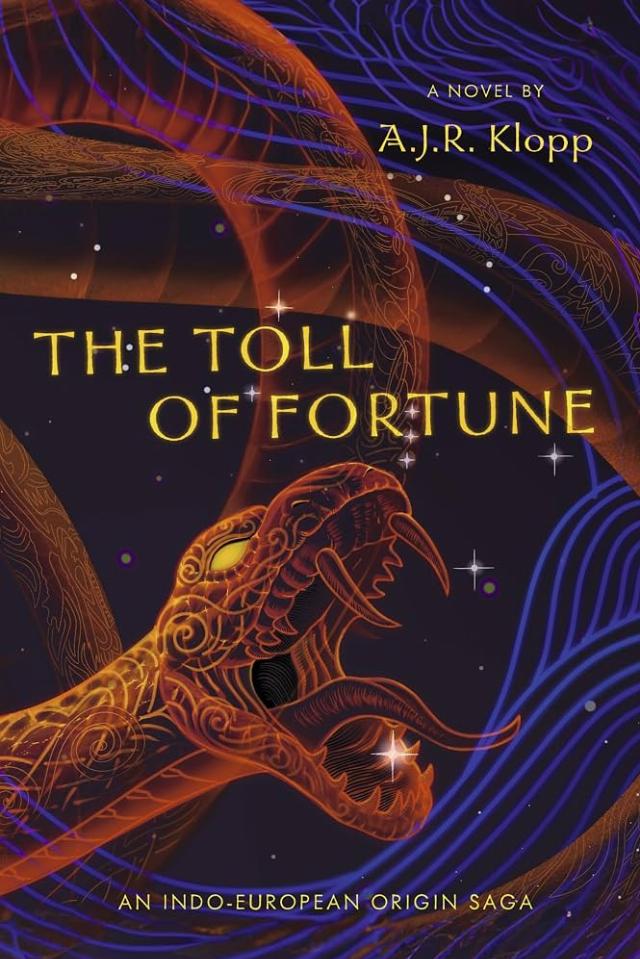
Image: Book cover.