
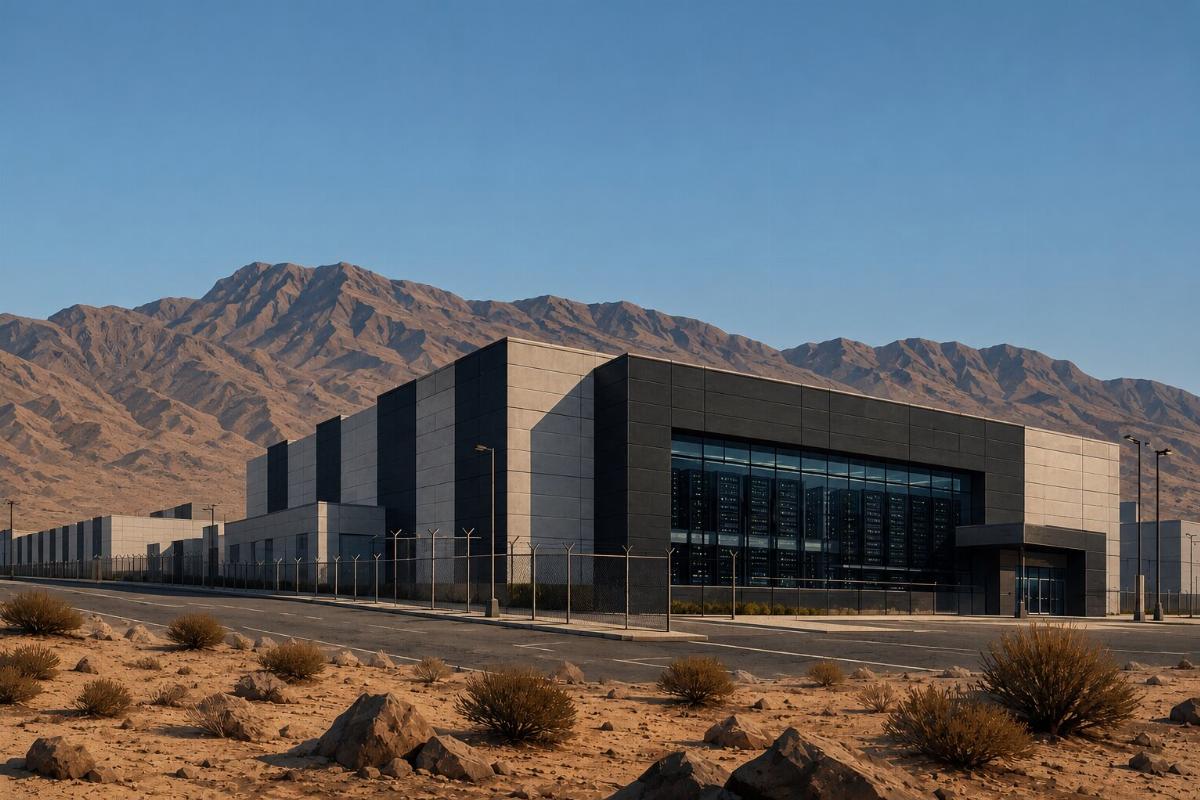
Nestled between the sere hills east of Sparks, Nevada, and a little off the U.S. Parkway (SR-439), Switch’s Citadel Campus is a Las Vegas company specializing in data centers. One building is already operational: Tahoe Reno 1, a high-security, futuristic industrial shed standing on endless rows of girders, with a roof designed to withstand 200-mile-per-hour winds.
Read more Gad Saad, Meet Alexis de Tocqueville
Inside, thousands of servers process data for businesses that pay for space, bandwidth, and security. To dissipate the enormous heat from the servers and the generators powering the unit, several million gallons of water are circulated through hundreds of miles of tubing—this in the driest state in the U.S., where groundwater is declining at an alarming rate. The low-frequency hum and noise from the center can be heard nearly a mile away.
Switch describes it as “the single largest colocation data center facility on the planet.” It has a footprint of 1.3 million square feet, roughly equivalent to 23 American football fields. Its power capacity—a metric of processing ability and the equivalent backup supply and cooling required—is 130 MW. For perspective, one megawatt can power 75 racks, each holding 21–42 servers, and power 500–1,000 homes.
When the eight planned buildings are ready, the 2,000-acre Citadel Campus, bounded by concrete walls, will offer a whopping 7 million square feet of server space and 650 MW of power capacity, making it the world’s most powerful data complex. Switch plans to develop it into an exascale ecosystem—with computers capable of quintillions of calculations per second, needed for AI and high-speed work, and power capacity running into several gigawatts.
As AI, cloud computing, and digital services touch all lives and demand for processing power grows exponentially, data centers are proliferating across the U.S. Over 3,000 centers are now operational, with 1,500 slated for development. While 87% of current centers are in urban areas, 67% of the newer ones are planned in rural areas, and 39% in counties with no centers.
In Nevada and elsewhere, communities, local and city governments, and legislatures are raising concerns about the significant environmental and quality-of-life impacts of data centers. In fact, Reno has a moratorium until August 2027 on approving data centers within the city. Surveys show that most Americans oppose data centers in their neighborhoods.
The biggest concerns are acreage and water use; strain on power grids; air pollution from backup generators, although many centers claim to rely on green backups; and noise pollution, with the low-frequency buzz affecting humans even when it is inaudible.
Give Us Your Acres
Data centers of the future require vast acreage, so construction is naturally shifting toward rural areas. Concerns are mounting over the rapid conversion of farmland into industrial sites because farmland loss is usually permanent and significantly affects food production. In addition, profligate water use will affect the water table, and the arrival of power grid infrastructure and industrial activity could lead to the destruction of wetlands, grasslands, and ecosystems.
Farmers are reporting—and refusing—tempting offers for their land, a generational asset to which they are deeply attached. Offers from Fortune 100 companies run into the double-digit millions. One offer for a Kentucky farm, where an undisclosed industrial development was planned, was $10 million, five times what the owner paid 30 years ago. Another farmer was told to name any price. Yet another was offered $33 million and told that details about the project would be provided if she signed a non-disclosure agreement.
The question is: How long will they be able to resist? With President Trump pushing for America to become an AI superpower, data centers are unlikely to be stalled. Staunch Trump supporters and Republicans in rural areas, already hurt by retaliatory tariffs from China and Canada, are unhappy. They are questioning and opposing this relentless encroachment.
Even in cities and suburbs, data centers compete directly with residential development, driving up land prices and reducing the number of viable housing sites. In northern Virginia, data centers accounted for a disproportionate 30% of land development between 2013 and 2021. These trends, which will likely be seen in all states soon, will jeopardize the housing supply.
Read more The Death of the Cash Cow
Give Us Your Power
Data centers are the most energy-intensive building types, consuming 10–50 times more energy per square foot than a typical commercial office. A single AI data center can use as much power as 100,000 homes, but the massive ones coming up can use up to 20 times that amount.
In fact, by 2030, power demand is projected to reach 130 gigawatts—a gigawatt equals a million megawatts—about 13 times New York City’s peak summer power demand and 25-30% of the United States’s average power usage. Data center power consumption is set to triple, from 4% of U.S. usage in 2023 to 12% in 2028.
Data centers aim for a PUE of 1.4–1.5 (power usage effectiveness), which is easier to understand as 67% of total consumption going to IT equipment. This is much better than general computing centers, where PUE is 2, meaning only 50% of the power consumed powers IT equipment. But general computing uses only 10–50 kW for smaller centers, up to 2 MW for campus-level hubs, and up to 5 MW for corporate centers.
Take Pollution in Return
The thousands of server racks in data centers must be cooled to prevent overheating and failure, requiring massive cooling systems of two types: immersion and water circulation. The first immerses equipment in special dielectric fluids, which can pose health risks from exposure. Water-based systems pollute the environment because their discharge contains coolants, biocides, corrosion inhibitors, concentrated minerals, and heavy metals.
Noise from data centers reaches 96 decibels (dB) inside facilities, while generator noise can reach 105 dB, comparable to a jet flying overhead. By comparison, noise levels in quiet neighborhoods are 45–55 dB, and in mixed-use neighborhoods, 55–65 dB. Chronic exposure to noise above 65 dB can cause hypertension, headaches, nausea, insomnia, dizziness, and cardiovascular issues.
Diesel-fueled backup generators at data centers emit nitrogen oxides (NOx), carbon monoxide, and particulate matter (PM2.5), all linked to asthma, respiratory disease, and heart disease. Communities near these facilities experience higher air pollution levels than the rest of the country. The power supply will be slow to meet demand, so data centers may rely more on backup generators, increasing pollution.
Proliferation and Opposition
The proliferation has begun. Virginia, which has 320 data centers, the most in the U.S., expects a total of 954. Texas will eventually surpass Virginia with 962. Northern Virginia houses 50 million square feet of data center space, has earned the moniker Data Center Alley, and serves as a backbone for Big Tech and AI development.
The opposition has also begun. People have protested the noise and the constant hum from data centers in northern Virginia. There is also a surge in efforts to block data center construction, especially projects planned near residential areas. In northern Virginia, Blackstone was forced to abandon its 22 million-square-foot facility at the Prince William Digital Gateway.
Time for a Rethink
A Reuters/Ipsos survey found that 57% of respondents opposed data centers, while a Gallup survey found that seven in 10 opposed them. Across almost all 50 states, there’s a move toward moratoriums on building data centers as concerns about their potential impact grow. New York, Georgia, Oklahoma, Vermont, and Virginia have introduced legislation to impose moratoriums or bans on new data centers.
President Trump has strongly advocated data center development as a means to make America the AI leader. Other politicians have promoted data centers to drive economic growth. But they must reconsider, as data centers are now a political liability with voters.
Read more Catholic politicians and the weeds in the wheat
Image generated by ChatGPT.