
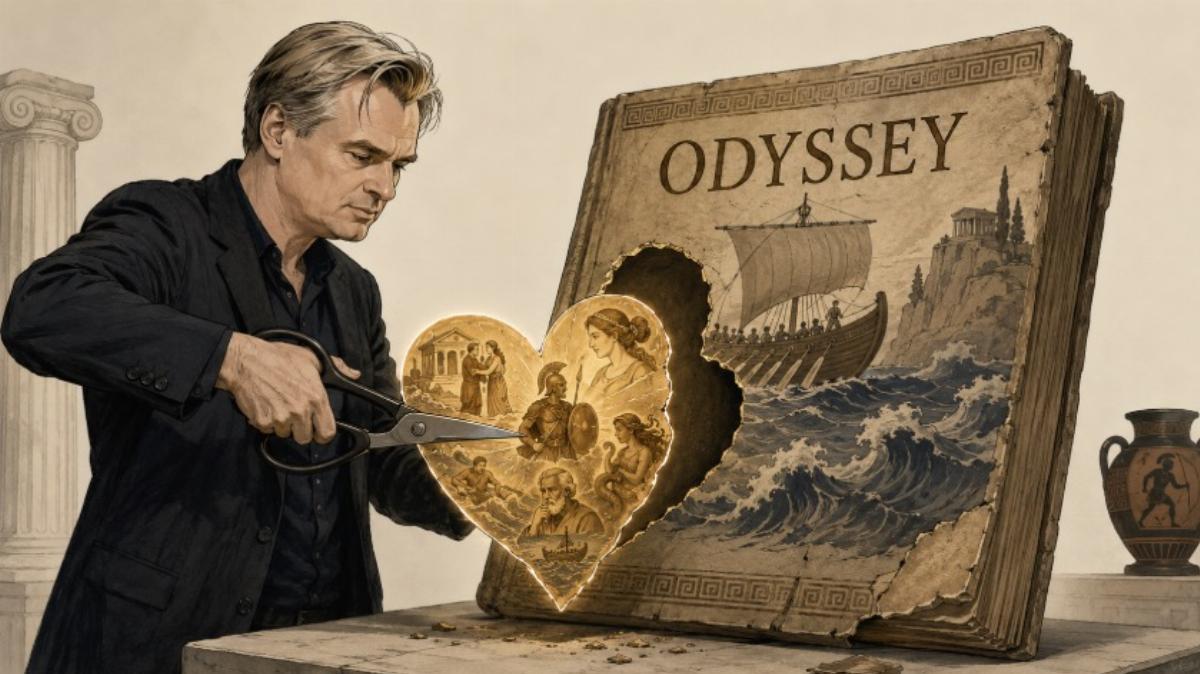
Christopher Nolan’s audacity to gut one of the greatest stories ever told of its themes, meaning, and essence is an unforgivable sin that can only have been perpetrated by Hades or Hollywood.
Read more A National Embarrassment in the U.S. Flag Code
The only reason Nolan’s Odyssey is winning praise at the box office is that we stopped teaching the Classics a hundred years ago, and with it, education itself.
Homer’s most important lessons do not even make the screen. What he replaces them with is an assault on the heroic and divine world of the poem, amplifying everything in modern society that is weak, therapeutic, and self-loathing.
The Cicones of Ismarus
Nolan presents a war-weary Odysseus landing at Ismarus in search of provisions for the journey home. They find burning buildings and a single inhabitant remaining. Odysseus asks, “We’ve come for provisions. Only food. Why did your people burn this place and flee?”
Homer’s account is nothing like this. Odysseus sets sail from Troy to Ismarus, an ally of Troy, for revenge. His forces sack the city, kill its fighting men, and take its women and wealth as plunder.
Odysseus orders an immediate departure. His men refuse. Drunk on wine and victory, they remain feasting on the spoils. Reinforcements arrive, a pitched battle ensues, and Odysseus barely escapes, losing 72 men.
Homer’s lesson: Greedy indulgence destroys discipline. A force that will not obey its commander turns victory into disaster.
Nolan’s lesson: Never fear the stranger on your shore.
The Lotus-Eaters
Several of Odysseus’s men consume the Lotus flower, a mythical plant that induces euphoric forgetfulness and erases their desire to return home. Odysseus does not reason with them; he drags them back on the ship, binds them beneath the rowing benches, and orders immediate departure.
Homer’s lesson: False contentment through narcotic oblivion is no substitute for reality, responsibility, and purpose.
Nolan’s lesson: The scene is left on the cutting-room floor—although Nolan later resurrects the lotus to undermine one of the most dramatic choices in literary history.
The Cyclops
Nolan handles the land of the Cyclops quite well, but removes two of its most important elements.
In Homer, Odysseus tells the Cyclops his name is “Nobody.” After Odysseus and his men drive a sharpened stake into the monster’s eye, the Cyclops cries out to his neighbors, “Nobody is killing me.” They conclude it must be an act of the gods and leave him. This is one of the most celebrated demonstrations of Odysseus’s cunning—metis.
But no sooner have Odysseus and his men escaped than he throws it all away. His men beg him to be silent. Instead, he taunts the Cyclops: “Tell him Odysseus, sacker of cities, blinded you—the son of Laertes, whose home is Ithaca.”
The Cyclops is Poseidon’s son and prays to his father for vengeance. He asks that Odysseus never reach home—or, if fate requires his return, that he arrive late, alone, and broken. It is the turning point in the epic. Nolan omits it.
Homer’s lesson: Cunning without self-control is incomplete. Hubris can destroy everything that discipline and intelligence have achieved.
Nolan’s lesson: None.
Achilles in Hades
In the underworld, Achilles tells Odysseus: “I would rather be a hired laborer for another, a man with no land, than rule over all the dead.” Achilles had chosen a short life crowned with everlasting glory rather than a long and peaceful life without immortal fame. Yet death has taught him that even the humblest human life is preferable to sovereignty among the dead.
The scene also prepares us for the choice Odysseus will soon face: whether mortal life itself is worth choosing over divine immortality.
Nolan does not have Odysseus meet Achilles. Instead, he meets Sinon, played by Elliot Page. Sinon rebukes Odysseus for the deception of the Trojan Horse. But Sinon is not in Homer’s Odyssey; he is in Virgil’s Aeneid. Virgil writes that Sinon knowingly deceived the Trojans and opened the trapdoor to let the warriors out.
Homer’s lesson: Life is a value greater than glory, power, and everlasting fame.
Nolan’s lesson: He indicts Odysseus’s strategic cunning, the very essence of his heroism.
Read more Phantom Nation Obliterates the ‘Free Palestine’ Hoax
Calypso
After Odysseus’s disobedient crew slaughters the sacred cattle of Helios, Zeus destroys their ship, and Odysseus washes ashore on Calypso’s island. Calypso rescues him and loves him but refuses to let him leave.
Odysseus pines for home—”he sat on the shore, weeping, looking out over the barren sea”—yet Calypso denies his release. Instead, she offers him marriage to a goddess, eternal youth, immortality, safety, and paradise. She reminds him that she surpasses Penelope in beauty. Odysseus concedes the point. Nevertheless, he chooses Penelope.
He chooses mortality over immortality, an aging wife over an ageless goddess, danger over safety, and the imperfect reality of home over paradise.
In Nolan’s version, Odysseus is recast as a shell-shocked veteran who consumes lotus flowers to forget the war. Calypso is transformed from his captor into a caregiver rehabilitating a psychologically wounded man until he is prepared to return home.
The offer of immortality is expunged. Odysseus’s conscious choice is eliminated. One of the supreme affirmations of mortal human life in Western literature vanishes.
Homer’s lesson: Mortal life at home among those you love is greater than immortality, eternal youth, divine beauty, safety, and paradise.
Nolan’s lesson: Womanly compassion can heal the psychological scars of committing egregious war crimes.
The Homecoming
The connection between Odysseus and Penelope is an intellectual union between two people of extraordinary cunning, patience, foresight, and self-command. Calypso could offer beauty, immortality, youth, safety, and paradise. What she could not offer was Penelope’s mind. Penelope is Odysseus’s equal.
After 20 years, both proceed cautiously. Odysseus conceals his identity. Penelope cannot simply accept that the stranger is her husband. So, she tests him.
Penelope orders a servant to move their marriage bed. Odysseus reacts immediately. The bed cannot be moved. He built the bedroom around the living trunk of an ancient olive tree. Only Odysseus and Penelope know this secret.
Penelope’s test establishes his identity not through appearance, strength, or sentiment, but through shared knowledge. The bed is also the poem’s great symbol of marriage, home, and permanence. Like the olive tree, their union is alive, deeply rooted, and inseparable from the house around it.
Nolan omits the scene. Instead, Odysseus laments the war, his deceit in deploying the Trojan Horse, and doubts his own ability to rule. Rather than reclaiming Ithaca, Odysseus and Penelope depart in guilt and penance, leaving Telemachus to rule. Homer’s restoration becomes Nolan’s renunciation.
Homer’s lesson: Odysseus’s choice of mortality, home, and family is made meaningful by his union with Penelope—a marriage rooted in shared memory, intelligence, loyalty, and identity.
Nolan’s lesson: The warrior must confess his guilt, surrender his authority, and depart in shame.
Homer Replaced
Nolan has not adapted Homer so much as replaced him. The names, voyage, monsters, and spectacles remain, but the epic’s moral compass is corrupted.
Homer’s Odysseus learns that intelligence must be governed by restraint; pleasure without purpose is oblivion; life is greater than glory; mortality with those one loves is greater than immortality without them; home is greater than wealth; and a marriage of two equal minds can survive time, war, and temptation.
Nolan replaces discipline with trauma, cunning with guilt, captivity with caregiving, restoration with renunciation, and heroic self-command with therapeutic self-reproach.
One would do far better to reread Homer than submit to Nolan’s toxic assault on Western civilization.
Read more Trump faces the ugly facts about American ‘democracy’
Image created using AI.
Huck Davenport is a pseudonym.